
Moving is stressful under the best of circumstances. When you or someone you care for relies on In-Home Supportive Services (IHSS), a move raises an urgent question: what happens to your hours, your provider, and your care? The reassuring news is that IHSS does not simply disappear when you cross a county line or change your living situation. But because IHSS is run at the county level, a move almost always triggers paperwork — and sometimes a fresh look at your case. Knowing the process ahead of time is the best way to keep your care uninterrupted and your hours intact.
This guide covers two common situations: moving to a new California county, and moving in with family — which can affect your case even if you stay in the same county.
Moving? Keep these five things in mind
- Your IHSS eligibility follows you anywhere in California — you don’t reapply from scratch.
- Tell your current county before you move so services don’t lapse.
- Your old county keeps paying until the transfer to the new county is complete.
- The new county runs its own assessment, so your hours could change.
- If hours are cut unfairly, you have 90 days to appeal — and free help is available.
Why “county-administered” matters
IHSS is a statewide program, but each of California’s 58 counties runs its own IHSS office, conducts its own assessments, and manages its own provider paperwork. Your underlying eligibility for IHSS follows you anywhere in California — you don’t reapply from scratch. What does not automatically follow you is your case file. That has to be transferred, and your new county has both the right and the responsibility to take a fresh look at your needs.
Moving to a new county: the Inter-County Transfer (ICT)
When you move from one county to another, your case goes through what’s called an Inter-County Transfer, or ICT.
Step one is the most important: tell your current county before you go, not after. Contact your existing IHSS social worker, report your new address, and give them your case number and your provider’s information. This starts the transfer. If you simply disappear from one county and resurface in another, you risk a gap in both services and pay.
Here’s the part that eases the worry. Under state regulations, there is to be no interruption or overlap in services because of a move. Your current (sending) county remains responsible for authorizing and paying for your IHSS until the transfer is complete. The transfer is meant to wrap up quickly — generally no later than the first day of the month following 30 calendar days after your old county notifies your new county.
Once your new (receiving) county takes over, it will typically schedule its own face-to-face assessment. This is where families sometimes get surprised. The new county is not bound to match your old county’s authorization exactly. In many cases hours stay the same; in others, the county’s assessment lands on a different number. A different result is not automatically wrong — but it isn’t automatically right either, and you have appeal rights, covered below.
One more piece: your provider. If your current provider is moving with you, they will generally need to complete enrollment in the new county — new provider paperwork, not a new hiring decision on your part. If your provider is staying behind, you’ll need to find someone new where you’re headed.
Your inter-county transfer checklist
- Notify your current county. Report your new address, case number, and provider info before you move.
- Keep your services. Your old county authorizes and pays until the transfer is done — no gap.
- Expect a new assessment. The receiving county schedules its own face-to-face visit.
- Sort out your provider. A provider moving with you re-enrolls; if not, line up someone new.
- Check the result. Compare new hours to old. If they dropped without cause, you can appeal.
Moving in with family (even in the same county)
You don’t have to cross a county line to change your IHSS picture. Moving in with family is a change in your living arrangement, and that on its own can prompt a reassessment.
This is where accurate expectations matter, because there’s a lot of fear and misinformation. Moving in with relatives does notautomatically slash your hours. Your personal care services — help with bathing, dressing, grooming, eating, toileting, mobility, and similar hands-on tasks — are based on your individual needs. The fact that a family member lives in the home does not, by itself, reduce those tasks.
What can change are your domestic and related services — house cleaning, meal preparation, meal cleanup, laundry, and shopping. When you share a household, the county may prorate the tasks that benefit everyone in the home. In plain terms: if a chore is done for the whole household, the county divides that time among the people who benefit, and you’re assessed for your share. Tasks and spaces that are for you alone are still assessed on your individual need. Notably, protective supervision is no longer prorated among household members.
A move can also touch the financial side. If your household or income situation changes, the county may reassess your Medi-Cal and any IHSS “share of cost.” And if the family member moving in wants to become your paid provider, keep in mind that certain providers — including parents of minor children and spouses — are generally required to live in the same home as the recipient.
Found a new home? Now find (or advertise for) a provider
Whether you’ve landed in a new county or reshuffled your living situation, one practical need tends to come up fast: care in your new location. If your old provider didn’t move with you, don’t wait until services lapse to start looking.
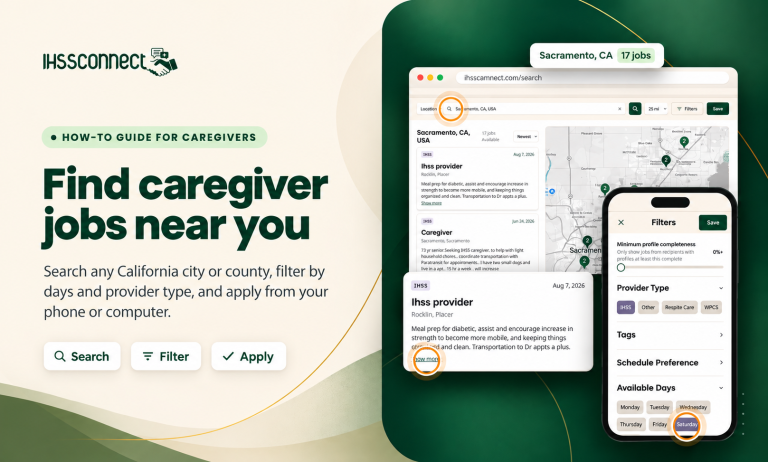
IHSS Connect makes this part easier. You can search for available providers in your new county, and if you’d rather have candidates come to you, you can place a job ad describing the hours and help you need. Posting early — even before your transfer is fully finalized — means you’re not scrambling to cover care on day one in your new home.
New county? Line up your care now.
Search for a provider near your new home, or post a job ad and let caregivers come to you.
If your hours are cut unfairly after a move
Sometimes a “simple” move leads to a not-so-simple result: fewer hours than you had before, with no clear justification. You are not stuck with that outcome.
Every time a county changes your services, it must send you a written Notice of Action explaining what is changing and why. Read it carefully and note the dates. You have the right to appeal by requesting a state hearing, and you generally have 90 days from the date of that notice to ask for one.
Timing matters for one powerful protection: “aid paid pending.” If you request your hearing before the effective date of the reduction, your services generally continue unchanged while you wait for the hearing decision — and if you lose, you typically do not have to pay those hours back. Miss that window and you can still appeal within 90 days, but your hours may drop in the meantime.
You can request a hearing by phone at 1-800-743-8525 (TDD 1-800-952-8349), or online or by mail. Help is available at no cost: Disability Rights California and local legal aid organizations handle IHSS appeals, and the State Hearings Division can point you to legal aid referrals in your area.
If you’d rather have an experienced advocate handle the case alongside you, California Advocacy Group works on IHSS appeals in every California county and offers a free consultation to review your situation. Learn more at www.caadvocacygroup.com.
Hours cut after your move? You can push back.
A county must send a written Notice of Action before changing your services. You generally have 90 days to request a state hearing — and if you ask before the change takes effect, your hours continue while you wait for the decision.
Free help
Disability Rights California and local legal aid handle IHSS appeals at no cost.
Prefer an advocate?
California Advocacy Group handles IHSS appeals in every California county and offers a free consultation. caadvocacygroup.com
A move doesn’t have to mean losing your care. Tell your county early, expect a fresh assessment, line up a provider in your new location, and read every notice you receive. If a move leaves you with fewer hours than your needs justify, you have real appeal rights — and both free and paid help to enforce them.