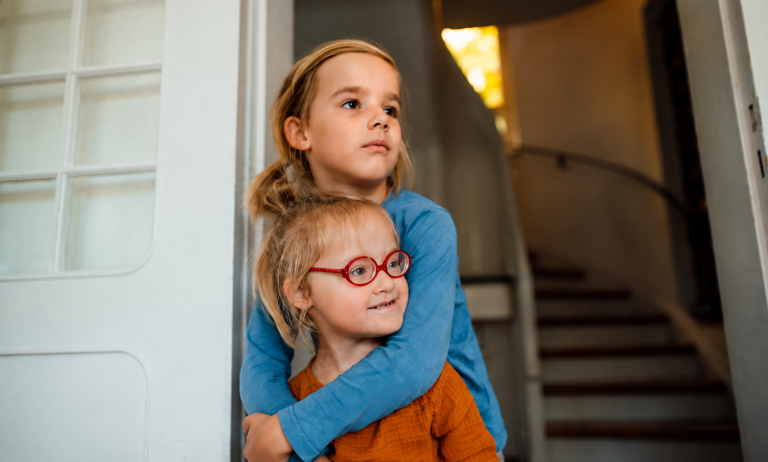
If you’re raising a child with a developmental disability, you’re also raising their brothers and sisters — and a lot of families come to IHSS Connect asking the same question: does the regional center do anything for the sibling? The honest answer is that there’s no single program with that name. What exists is a set of tools built into the regional center’s general family-support authority, plus a handful of community programs that regional centers connect families to with varying degrees of formality.
This article walks through the legal basis for sibling-inclusive family support, what it actually looks like county to county, the statutory conversation about future caregiving that often lands on a sibling’s shoulders, and where to find a real sibling support group right now — whether or not your regional center funds one directly.
Sibling support through the regional center — the short version
- There's no single program called "Sibling Support." It's built from general Family Support Services authority.
- Only the person with the developmental disability is the regional center's "consumer" — a sibling isn't automatically eligible.
- Sibshops (peer support groups) are the most common real-world option, but not every regional center funds or hosts them.
- State law requires a "caregiver succession" conversation about future caregivers — often a sibling — by age 22 and yearly after.
Siblings aren’t the regional center’s client — and that matters
Under the Lanterman Act, regional center eligibility belongs to the person with the developmental disability — an intellectual disability, cerebral palsy, epilepsy, autism, or a closely related condition. A brother or sister doesn’t become an eligible “consumer” just by being related to someone who is. They’d need to independently qualify, most commonly by also having a developmental disability of their own.
That distinction shapes everything else in this article. Regional centers don’t open a case file for a sibling. What they can do is fund or connect families to services that support the whole household around the eligible child — and state law is explicit that this is the intent.
A sibling is not the regional center's "consumer." Regional center eligibility under the Lanterman Act belongs to the person with the developmental disability. A brother or sister only becomes an eligible consumer in their own right if they independently qualify — for example, if they also have a developmental disability. Everything else described here is funded or offered as a family support built around the eligible child, not as a direct service to the sibling.
The legal hook: Welfare & Institutions Code §4685
Section 4685 of the Welfare and Institutions Code sets the legislature’s intent for regional center family support services. It says regional centers should “focus on the entire family” — not just the eligible child — and lists the kinds of services that qualify, including specialized medical and dental care, respite, homemaker services, camping, day care, counseling, and mental health services.
None of those line items say “sibling” by name. But “counseling,” “camping,” and “focus on the entire family” are broad enough to cover sibling-specific supports — sibling counseling, a sibling camp session, a peer support group — when a regional center chooses to fund them as part of the family plan.
What sibling support actually looks like in California
The Sibshop model
The most common form of organized sibling support is the “Sibshop” — a peer support group, usually for school-age kids roughly 7 to 13 (some programs extend the age range to 18), that mixes games and recreation with structured conversation about what it’s like to have a sibling with a disability. The model was created in 1982 by Don Meyer at the University of Washington and is now run by the national Sibling Support Project, which has trained facilitators for hundreds of Sibshops worldwide.
In California, Sibshops show up under a few different sponsors: some regional centers host or co-host them directly, some fund a community nonprofit to run them, and some simply hand families a referral. The Regional Center of Orange County, for example, maintains a siblings resource page that points families to a local nonprofit running beach-based sibling programs, rather than vendoring the service itself. Coverage and format are not consistent statewide.
Statewide option: Sibshops West
The California Sibling Leadership Network runs “Sibshops West,” a free virtual Sibshops program grouped by grade band (3–5, 6–8, and 9–12), open to siblings statewide regardless of which regional center serves their family. Because it’s virtual and statewide, it’s a reliable starting point if your local regional center doesn’t vendor anything.
For younger siblings: Family Resource Centers
California’s network of Family Resource Centers, part of the Early Start early intervention system for children birth to 3, frequently runs sibling support groups for younger children as one of several parent- and family-facing services. Availability and age range vary by center; the DDS-maintained directory lists the Family Resource Center serving each regional center’s catchment area.
Sibling support isn't a guaranteed line item at any of California's 21 regional centers. Some centers directly fund or co-host Sibshops-style groups; others only hand families a referral to a community nonprofit that runs its own, unaffiliated program. Purchase-of-service guidelines differ center to center, and we found no statewide requirement that a regional center offer or fund sibling peer support specifically.
Confirm what your own regional center actually vendors before you count on it — ask your service coordinator directly, in writing if you can.
Getting it into the plan: funded service vs. referral
If you want the regional center to actually pay for something — rather than just point you toward it — it has to go through the Individual Program Plan (IPP), the planning document at the center of every regional center relationship.
State law requires that when a child with a developmental disability lives with their family, the IPP include a “family plan component” describing the services and supports needed to keep the child successfully at home. That’s the mechanism to use: ask your service coordinator to discuss sibling-inclusive support — a Sibshop, family counseling that includes the sibling, a sibling camp session — as part of that family plan component, rather than as an informal aside.
- Ask specifically, and ask for it to be documented in the IPP — verbal assurances don’t create a paper trail.
- If your service coordinator says it’s not something the regional center funds, ask what it does fund under family support services, and what the center’s purchase-of-service guidelines say.
- If you believe the regional center isn’t offering adequate support to keep your child at home — and you consider sibling support part of that — you have the right to request a fair hearing. A family cannot be required to begin a placement process to receive requested services.
That fair hearing right is written into the same section of the code that establishes family support services generally. We haven’t found a case testing it specifically for sibling support, so treat it as a reasoned extension of the broader right rather than a guaranteed outcome.
The other side of "sibling support": the caregiver succession conversation
There’s a second, very different reason siblings come up in regional center planning — and this one has firmer legal footing. California law requires regional centers to raise a “caregiver succession” discussion with families whose adult child still lives at home, and, practically, the person families most often turn to is a sibling.
Under Welfare and Institutions Code §4646.5(a)(9), when a regional center consumer is cared for in the family home, the regional center must raise this discussion at the IPP no later than the consumer’s 22nd birthday, and then annually after that, for as long as the consumer lives at home. “Caregiver succession” is defined in the statute as the point when the primary caregiver — usually a parent — is no longer able to fully care for the consumer.
The caregiver succession timeline
Welfare & Institutions Code §4646.5(a)(9)
- By the 22nd birthdayIf your child is cared for in the family home, the regional center must raise a "caregiver succession" discussion at the IPP no later than this date.
- Every year afterThe conversation repeats annually for as long as the consumer lives in the family home.
- What it can includeIdentifying who might provide care later — often a sibling — and possible future housing options, if the family wants to develop a plan.
If the family wants to, the conversation can lead to a caregiver succession plan that identifies who might step in — often a sibling — and what future housing options might look like. The law doesn’t require a plan to be written, only that the conversation happen.
The caregiver succession conversation at the regional center is a care-planning discussion, not a legal or financial plan. It does not create a will, a special needs trust, a power of attorney, or a conservatorship, and it doesn't protect your child's public benefits. If a sibling may become a future caregiver, that conversation is the moment to also get a referral to a special needs planning attorney — the regional center discussion is a starting point, not a substitute.
What’s been proposed but doesn’t exist — yet
In 2024, Assembly Bill 2360 (Rendon) would have created a statewide “Family Wellness Pilot Program,” requiring regional centers to provide counseling and peer support group services — language broad enough to cover sibling support — to families of regional center consumers, phased in starting with families of consumers age 6 and under. It passed the Assembly unanimously and moved through Senate committees with bipartisan support before being held in the Senate Appropriations Committee on August 15, 2024, over cost. It was never enacted.
In 2024, Assembly Bill 2360 would have created a statewide "Family Wellness Pilot Program" requiring regional centers to provide counseling and peer support — including for siblings — to consumer families. It passed the Assembly unanimously but was held in the Senate Appropriations Committee on August 15, 2024, over cost, and was never enacted. No dedicated statewide sibling-support program exists in state law as of this writing. Advocacy groups may reintroduce similar legislation; check for updates before assuming otherwise.
Where to find sibling support right now
Whether or not your regional center vendors anything directly, these are real, currently operating starting points:
Start here whether or not your regional center vendors anything directly.
Free virtual Sibshops for ages 8–18, grouped by grade band, statewide.
californiasibs.org/sibshopsThe national organization behind the Sibshop model; has a directory to find one near you.
siblingsupport.org/sibshopsCalifornia's Early Start network often runs sibling groups for younger children; ask about school-age options too.
DDS Family Resource Center listingsAsk directly what's vendored locally, and ask for sibling support to be discussed as part of the family plan component of the IPP.
Find your regional centerSources
- Cal. Welfare & Institutions Code §4685Family support services intent, purchasable services list (camping, counseling, respite), fair hearing right
- Cal. Welfare & Institutions Code §4646.5IPP planning requirements; caregiver succession discussion at §4646.5(a)(9)
- AB 2360 (Rendon, 2023–24) bill historyFamily Wellness Pilot Program — held in Senate Appropriations, Aug. 15, 2024; not enacted
- The Arc & UCP California Collaboration — AB 2360 status updateConfirms AB 2360 did not move forward in 2024
- California Sibling Leadership Network — Sibshops WestStatewide virtual Sibshops program details and age bands
- Sibling Support Project — SibshopsNational origin and structure of the Sibshop model
- Regional Center of Orange County — Siblings resource pageExample of an individual regional center's sibling referral practice
- DDS — Family Resource Center listingsStatewide directory of Family Resource Centers, several of which run sibling groups
About this article
IHSS Connect publishes this article for general information and education. It is not legal advice, and reading it does not create an attorney–client relationship. IHSS Connect is not a law firm and is not affiliated with the California Department of Developmental Services, any regional center, or any county agency.
Regional center practices vary by center and can change. Only your regional center and your child’s IPP planning team can decide what services apply to your case. If a regional center decision looks wrong, or you want advice about your own situation: free and low-cost legal help is available at LawHelpCA.org; Disability Rights California can be reached at 1-800-390-7032 for regional center clients at no cost; and the DDS information line is 833-421-0061.
Verified September 2026.