Many recipients have no idea what social workers write after a home visit — here’s what’s actually documented, who can see it, and how to request your own.
Editor's note: This piece is written from a composite social-work perspective, drawing on the state's official documentation standards for IHSS case files, current confidentiality law, and fair hearing regulations. It does not describe any single caseworker's private files.
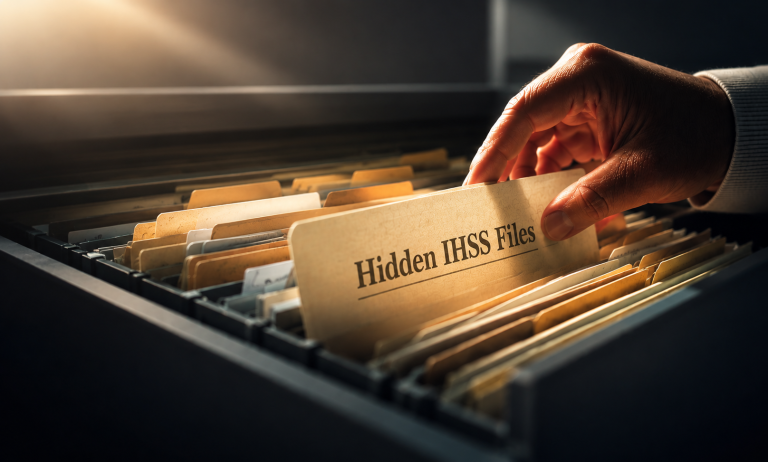
Every time an IHSS social worker sits down at your kitchen table, something happens that most recipients never think about: they start writing. Not just a checklist of the tasks you need help with, but a narrative — a written account of what they observed, what you said, and how they reached their decision. That document becomes part of your permanent case file. Years later, it can be the single most important piece of evidence in a dispute over your hours.
What's Actually In the File
The California Department of Social Services publishes a formal case narrative guide that tells county social workers exactly what to document at every visit. Recipients rarely see this document, but it describes precisely what ends up in a case record. The main categories are:
- Visit details: the date and time of the home visit, who was present, and the type of assessment (initial, annual reassessment, inter-county transfer, or a change in hours).
- Social worker observations: your appearance and physical well-being, the condition and safety of your home, and any functional abilities or limitations the worker saw for themselves rather than heard about secondhand.
- Health information: your diagnoses, current medications, recent ER visits or hospitalizations, and — notably — any discrepancies between what you or your doctor reported and what the worker observed.
- Functional Index rankings and hours: the numeric rankings for tasks like bathing, dressing, and meal preparation (recorded on form SOC 293), along with the math behind your authorized hours.
- Critical incidents and referrals: anything reported as a safety concern, along with any referrals made to other agencies.
- Forms on file: which official IHSS forms were used, signed, missing, or refused, and why.
This isn’t a rumor about what social workers write — it’s the state’s own published documentation standard for the program.
The Part That Surprises People Most
It’s the discrepancy notes. If what you tell your social worker about your abilities doesn’t line up with what your doctor’s paperwork says, or with what the worker observes during the visit, that gap gets written down — not to catch you in something, but because the county’s assessment process is built to compare self-report against clinical documentation and direct observation. This is exactly why keeping your medical records and your own account of your daily needs consistent, current, and specific matters so much.
Who Is Allowed to See It
Public social services case records, including IHSS files, are confidential by default under California Welfare and Institutions Code Section 10850. That statute restricts examination of the file to purposes directly connected with administering the program.
But there is a specific carve-out for you: under Section 10850.2, factual eligibility information you provided yourself must be open to your own inspection, and county practice — reflected in the state’s Manual of Policies and Procedures and in county guidance such as Los Angeles County’s DPSS policy — confirms that recipients and their authorized representatives can inspect the non-privileged, non-confidential parts of their own case record without filing a formal California Public Records Act request.
The limit: The county can redact or withhold anything genuinely privileged or confidential before you see it. Information tied to elder or dependent adult abuse investigations, for example, carries its own separate protections.
So "your file" and "everything the county has ever written about you" aren't always identical.
How to request your file
- Contact your county IHSS office or Public Authority directly — you generally don't need a formal Public Records Act request as an individual recipient.
- Ask for specific documents by name: your needs assessment forms, the SOC 293 functional ranking form, and the narrative or contact notes from your visits.
- Request an appointment to review the file in person, or ask for copies to be mailed or emailed if your county offers that option.
- Give the county reasonable lead time — redacting privileged material takes staff time, so the week before a hearing is cutting it close.
Why This Matters Most Before a Fair Hearing
If your hours are being reduced or terminated and you request a state hearing, federal Medicaid hearing regulations give you a specific right: under 42 CFR Section 431.242(a), you’re entitled to examine your case file and every document the county plans to use against you, at a reasonable time before the hearing and again during it.
Advocacy groups like Disability Rights California consistently advise recipients to request assessment forms, functional ranking sheets, and visit notes well ahead of a hearing date. The reason is practical: a hearing goes better when you can point to something specific, such as a functional ranking that doesn’t match a recent doctor’s letter or a care log, rather than making a general statement that you need more help.
A Few Honest Caveats
- Reviewing your file doesn’t automatically win an appeal. It tells you what the county is working from, which is a different — and still valuable — thing.
- A case narrative reflects a single visit on a single day. If something in it seems incomplete, the practical move is usually to add current documentation (a doctor’s letter, a care log) rather than trying to get the county to rewrite its notes.
- Not everything gets handed over. The county can lawfully withhold or redact genuinely privileged or confidential material.
Make It a Habit
ou don’t need to be heading into a dispute to request your case file. Doing it once a year is a reasonable habit — it’s the fastest way to catch an outdated diagnosis, a stale phone number, or a functional ranking that no longer reflects your reality, long before any of that becomes the reason your hours get cut.
Sources
- CDSS — IHSS Quality Assurance Case Narrative GuideCalifornia Department of Social Services, PDF, March 30, 2015
- Welfare & Institutions Code § 10850California Legislative Information
- Welfare & Institutions Code § 10850.2California Legislative Information
- Release of Case RecordsLos Angeles County DPSS policy
- 42 CFR § 431.242 — Procedural Rights of the Applicant or BeneficiaryElectronic Code of Federal Regulations
- IHSS Self-Assessment and Fair Hearing GuideDisability Rights California
- IHSS Fair Hearings GuideDisability Rights California