If you spend any time in California IHSS caregiver or recipient groups online, you already know the rhythm. The 1st and the 15th roll around, and within a day or two, the same question floods every thread: “Where is my check? It’s already been three days.”
It’s a fair question to ask. It’s frustrating to budget around a paycheck that doesn’t arrive on a fixed date the way a typical hourly job’s might. But the frustration usually comes from a mismatch between expectation and how the IHSS payroll system is actually built — not from anything going wrong. The truth is that a payment landing five, seven, or even nine business days after the pay period closes isn’t a delay. It’s the system working exactly as designed.
Here’s what’s actually happening behind the scenes, and how to plan your finances around it instead of around when you wish it worked.
The Two Pay Periods, and Why the Clock Doesn’t Start When You Think
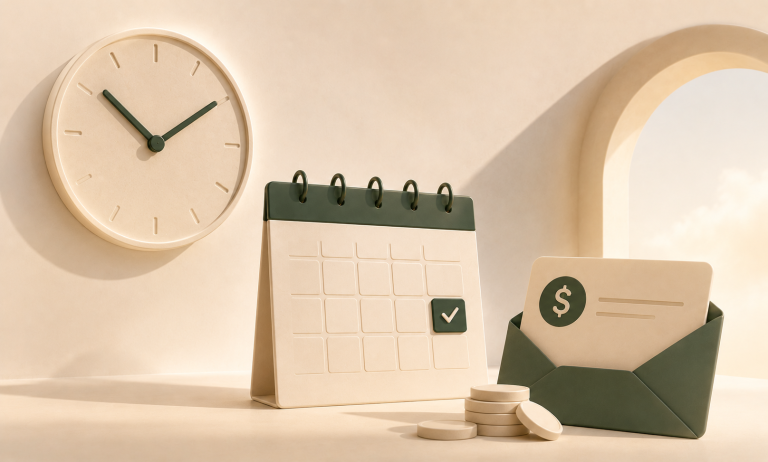
IHSS runs on a semi-monthly payroll calendar with two fixed pay periods every month: the 1st through the 15th, and the 16th through the last day of the month. There’s no flexibility in these dates — every provider and every recipient in California operates on this same schedule, regardless of county.
This is the part that trips people up: a timesheet can’t be signed, dated, or submitted until the pay period it covers has actually ended. According to the California Department of Social Services (CDSS) Timesheet Training Academy materials, signatures and dates on a timesheet must come after the close of the pay period, and the timesheet itself cannot be submitted before the last day of that period.
So if you’re a provider hoping to get ahead of the rush by signing and mailing your timesheet on the 13th for a period that ends on the 15th, that timesheet will be rejected. The earliest a provider and recipient can legally sign it is the 15th itself — or the last calendar day of the month for the second pay period. There is no way to front-load the process. The 10-business-day clock that everyone is waiting on doesn’t start until the pay period closes and a valid, signed timesheet actually reaches the processing facility.
Where Your Timesheet Actually Goes
Timesheets aren’t reviewed by your county IHSS office or your local social worker. Every timesheet — paper or electronic — is routed to a single centralized location: the Timesheet Processing Facility (TPF) operated by CDSS in Chico, California. There, it’s checked against the recipient’s authorized hours, the provider’s enrollment status, and any other providers billing time for the same recipient.
Paper timesheets are scanned by machine, not reviewed by a person, which is why CDSS is strict about black ink only, no stray marks, no correction fluid, and no folding. A smudge or an altered box can be enough to kick a timesheet into manual review and add days to the wait.
Once the TPF has a clean, valid timesheet in hand, the State of California has up to 10 business days to issue payment. That 10-day window is a real, state-recognized standard — not an estimate caregivers invented to manage expectations. It’s referenced directly by CDSS materials and by IHSS Public Authority offices across multiple counties as the official benchmark for how long the state has to act once a timesheet is received.
Why “Ten Business Days” Isn’t the Same as “Ten Calendar Days”

Business days exclude weekends and state holidays, so a timesheet that arrives at the TPF on a Friday effectively starts its clock the following Monday. A pay period that ends on a Saturday or Sunday can push the realistic turnaround even further out, simply because of how the calendar lands that month.
This is also where direct deposit versus paper check makes a real difference. Once the state issues a direct deposit payment, the funds move through the ACH (Automated Clearing House) network, and most banks make that money available within one to three additional business days. Paper checks, by comparison, still have to travel through the mail in both directions — first the blank timesheet to you, then your completed timesheet back to Chico, then the check back to your mailing address — which is why paper-based providers tend to feel the full 10-day window more acutely, and sometimes longer.
If you’re not yet enrolled in direct deposit, it’s worth setting up through the Electronic Services Portal (ESP) at etimesheets.ihss.ca.gov. Keep in mind it takes about 30 days after enrolling before direct deposit payments actually begin, so this is a change worth making well before you’re depending on it.
This Is Normal — Not a Sign Something Went Wrong
It’s worth saying plainly: a payment arriving anywhere within that 10-business-day window is the system functioning as intended. It is not evidence of a backlog, a glitch, or your county “holding” your money. The comparison many people reach for — “a regular job pays the same day or the next day” — doesn’t hold up against how most hourly and salaried payroll actually works, either. Many private employers run payroll on a similar one-to-two week lag between when hours are worked and when a paycheck clears, precisely because payroll systems need time to verify hours before money moves. IHSS isn’t unusual in having a processing gap; it’s unusual in publishing exactly how long that gap is allowed to be.
That predictability is actually useful information, even when it doesn’t feel like good news in the moment. A fixed, known maximum is something you can build a budget around. An unknown, anxiety-driven guess is not.
How to Manage Around a 10-Day Window Instead of Fighting It
Since the timeline is fixed by policy rather than by your actions, the most effective move isn’t trying to speed up an individual payment — it’s adjusting how you plan around the known maximum. A few practical habits help:
- Submit the moment you’re able to. You can’t submit early, but you can submit immediately once the pay period closes. Sign and mail (or electronically submit) on the 15th or the last day of the month rather than waiting a few extra days — every day you wait is a day added to your wait for payment.
- Use the Electronic Services Portal or Telephonic Timesheet System. Electronic submission skips mail transit time entirely and avoids the handwriting and scanning issues that commonly delay paper timesheets.
- Set up and confirm direct deposit. It removes the mail time on the back end of the process and gets funds into your account within a few business days of the state issuing payment, rather than days later by check.
- Build your budget around the 10th business day, not the 1st. If you treat the full 10-business-day window as your real payday — rather than the date the pay period ends — an on-time payment will never catch you off guard, and an early one will feel like a bonus instead of a baseline expectation.
- Double-check your timesheet before it leaves your hands. Black ink only, no corrections with fluid or tape, both signatures present, and dates that fall after the pay period ends. A single processing error is the most common reason a payment takes longer than 10 business days.
None of this erases the real strain that comes with waiting on a paycheck you depend on, especially if you’re managing rent, utilities, or other fixed costs around it. But understanding exactly how the system is built — and exactly where the 10 days come from — turns a source of recurring anxiety into something you can plan for with confidence.
One More Time For Those In the Back
Your IHSS payment isn’t late if it arrives within 10 business days of your timesheet reaching the processing facility in Chico. That window is the official standard, not a worst-case scenario, and it starts only after the pay period closes — timesheets can’t be submitted early. The most reliable way to manage your finances around IHSS pay is to plan for the full window every single pay period, use direct deposit and electronic submission where you can, and treat a faster payment as a pleasant surprise rather than the rule.
Know a caregiver who keeps asking “where’s my check?” Share this with them.
Link copied! Paste it anywhere — group chat, Facebook group, text message.