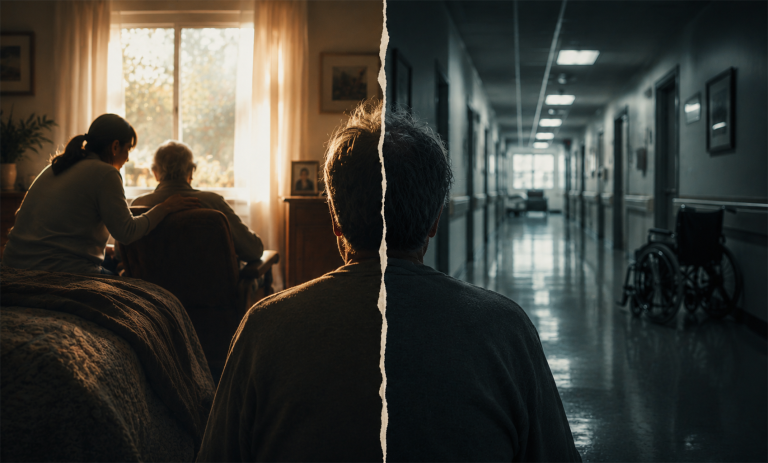
Imagine waking up tomorrow to the news that California’s In-Home Supportive Services (IHSS) program no longer exists. No phaseout. No replacement program. No transition plan. Just gone.
For most Californians, that headline would barely register. Most people have heard of IHSS, but few understand what it actually does or what would happen if it disappeared. Yet for hundreds of thousands of older adults and people with disabilities, IHSS is the thin line separating independence from institutionalization. It is the difference between staying home and entering a nursing facility, and it’s a big part of why so many family caregivers can keep working instead of leaving the workforce entirely.
The thought experiment is uncomfortable, but it’s worth sitting with. When policymakers debate funding levels, eligibility rules, overtime policy, or administrative changes, they are not debating an abstract government program. They are debating the infrastructure that keeps California’s long-term care system from collapsing.
What IHSS Actually Does
At its core, IHSS pays for help with activities of daily living and protective supervision so that eligible aged, blind, and disabled Californians can remain safely in their own homes instead of being forced into institutional care.
Today, the program serves more than three-quarters of a million Californians. The Legislative Analyst’s Office projects that in 2025-26, an estimated 771,650 recipients will receive an average of 123.7 service hours per month. [1]
That number represents far more than housekeeping or meal preparation. It includes people living with dementia who wander from home, adults with severe developmental disabilities, children with profound medical needs, stroke survivors, people with traumatic brain injuries, and Californians who need help bathing, dressing, eating, toileting, transferring, or otherwise safely managing daily life. For many recipients, IHSS is not a convenience. It is the mechanism that keeps them living outside of an institution.
IHSS by the Numbers
What's actually at stake
Californians projected to receive IHSS in 2025–26
Average hours of monthly support per recipient
Of IHSS consumers need a nursing-facility level of care — and receive it at home instead
Median annual cost of a semi-private California nursing home room, the fallback if home care isn't available
Sources: California Legislative Analyst's Office, 2025-26 Budget Analysis; Justice in Aging; Genworth/CareScout 2024 Cost of Care Survey.
The First Crisis: Nursing Homes Would Fill Almost Immediately
The most immediate consequence would be a surge in demand for institutional care. California’s nursing facilities already operate within a strained long-term care system. If even a fraction of current IHSS recipients lost their ability to remain at home, demand for skilled nursing beds would spike overnight.
And that creates a simple problem: there are not enough beds. Many IHSS recipients qualify medically for nursing facility placement but remain at home because home-based care is both preferred and less expensive — the state itself describes IHSS as an alternative to out-of-home care. In fact, more than half of IHSS consumers need a nursing-facility level of care, and choose, with IHSS support, to receive it at home instead. [2]
Without that alternative, institutional placement becomes the default outcome. It’s worth asking where, exactly, these individuals would go. Some would wait in hospitals because no nursing facility bed is available. Others would cycle between emergency rooms, temporary placements, rehabilitation facilities, and short-term arrangements that were never designed to absorb this kind of pressure.
The Hospital System Would Feel It Next
Most discussions about IHSS focus on caregiving. They should also focus on hospitals.
Emerging research on home and community-based services suggests that adequate support in the community is associated with fewer avoidable hospitalizations and lower emergency department use, though the evidence base is still developing and researchers caution that more work is needed to fully isolate cause and effect. [3]
The pattern makes intuitive sense. A person with dementia forgets medication. A child with dangerous behaviors needs constant supervision. An adult with mobility limitations falls attempting to transfer alone. When home supports disappear, medical crises tend to follow, and those crises become emergency room visits, ambulance transports, hospital admissions, rehospitalizations, and long-term institutional placements. The healthcare system becomes the backup plan for a caregiving system that failed, and hospitals are among the most expensive settings in healthcare to fill that role.
California's Hidden Workforce Would Be Devastated
Perhaps the least understood part of IHSS is that it supports two populations at once: the recipient, and the caregiver.
Many IHSS providers are family members: spouses, parents, adult children, siblings, other relatives who stepped in because someone had to. [1]
Without IHSS, many of these caregivers would face impossible choices — quit working entirely, cut their hours, drain savings, leave the workforce for good, or attempt unsustainable unpaid caregiving on top of everything else they’re already carrying.
California already talks constantly about workforce shortages. Removing IHSS would manufacture one overnight, pushing thousands of caregivers out of employment or dramatically reducing their participation in the labor market. The ripple effects would extend well past the disability community: businesses would lose workers, tax revenue would decline, consumer spending would shrink, and the retirement and Social Security contributions tied to those paychecks would disappear along with them.
What IHSS Care Actually Looks Like
Share of IHSS consumers who need help with each task
Bathing, oral hygiene, and grooming
Dressing
Domestic services, meal prep, and food shopping
Toileting assistance
Source: Justice in Aging, "In-Home Supportive Services: California's Personal Caregiving Program for Older Adults and People with Disabilities."
Family Financial Collapse Would Become Common
Many families are already operating on the edge: a parent caring for a child with severe autism, a husband caring for a wife with dementia, an adult daughter caring for a parent after a stroke. These households are often juggling mortgage or rent payments, medical costs, transportation expenses, specialized equipment, and the earnings they’ve already given up to provide care.
IHSS doesn’t make these families wealthy. It prevents financial disaster. Without it, many would lose thousands of dollars a month in caregiver income while facing higher care costs at the same time, and the math simply stops working. Some families would try to purchase private care. Others would stop working altogether. Savings would run out faster than anyone planned for, homes would be at risk, and debt would pile up in ways that are difficult to ever fully repay. None of this would unfold gradually over years. It would begin within weeks.
The State Budget Would Not Save Money
This is where the conversation tends to get counterintuitive. Some critics view IHSS purely as an expense, but the more useful question policymakers ask is what the replacement cost would actually be.
If IHSS disappeared, the need for care wouldn’t disappear with it. The bill would simply move elsewhere. Instead of funding home-based care, California would be funding skilled nursing facilities, hospitalizations, emergency services, institutional long-term care, and additional Medi-Cal expenditures.
And that shift isn’t cheap. A semi-private room in a California nursing home now carries a median annual cost of $140,343, and a private room runs $182,135 — both well above the national median. [4] Medi-Cal, meanwhile, remains one of the largest line items in California’s budget.
The real policy question was never whether care costs money. It does. The question is whether that care gets delivered at home, in a hospital, or in an institution. Home-based services are generally the least restrictive and often the most cost-effective setting for people who can safely remain in the community, which is exactly why states across the country have spent decades trying to expand home and community-based care rather than shrink it.
The Human Cost Would Be Even Greater Than the Financial Cost
Policy discussions tend to focus on dollars. Families focus on something else: dignity.
Most people want to remain at home. They want to wake up in their own bedroom, eat at their own kitchen table, see familiar faces, and stay connected to their community. For people with disabilities, aging adults, and medically fragile children, home is often more than a preference. It’s part of their identity. Removing IHSS would force many Californians into settings they never wanted and often fear. The loss wouldn’t only be financial. It would be personal, and for many, permanent.
What This Means for Policymakers
The easiest way to misunderstand IHSS is to treat it like a social services line item. It isn’t one. IHSS is infrastructure.
Just as roads move vehicles, IHSS moves long-term care out of institutions and into communities. Just as water systems prevent public health disasters, IHSS prevents long-term care disasters. Just as emergency services protect public safety, IHSS protects vulnerable Californians from preventable institutionalization.
“
IHSS is infrastructure. Just as roads move vehicles and water systems prevent public health disasters, IHSS prevents long-term care disasters.
It protects vulnerable Californians from preventable institutionalization — quietly, every single day.
Seen that way, the question changes. Instead of asking “how much does IHSS cost?” the better question is: “what would California actually look like without it?” The answer isn’t complicated. Hospitals would become overcrowded. Nursing facilities would face demand they can’t meet. Family caregivers would leave the workforce in large numbers. Household finances would collapse for families already living close to the edge. State costs would shift rather than disappear. And hundreds of thousands of Californians would lose the ability to remain safely in their own homes.
The Real Lesson
The most important public programs are often the ones people never notice, not because they’re small, but because they work.
IHSS quietly prevents crises every day: the child with severe autism who stays safe at home, the grandmother with dementia who avoids a nursing facility, the adult with a brain injury who remains part of their community, the caregiver who can keep working because support exists. If IHSS disappeared tomorrow, Californians would quickly discover something policymakers should never forget. The true value of a program is often measured not by what it costs, but by the catastrophe it prevents. Few programs prevent more catastrophe, more efficiently, than IHSS.
Sources
-
1
The 2025-26 Budget: In-Home Supportive Services
California Legislative Analyst's Office · March 6, 2025
- 2
-
3
Home and Community-Based Services Improve Outcomes While Reducing Costs
Community Living Policy Center, Brandeis University
-
4
Long-Term Care Costs Increase in California, Exceeding National Costs
Genworth / CareScout, 2024 Cost of Care Survey · March 4, 2025
Editorial Notes & Accuracy Caveats
- The 771,650 recipients / 123.7 hours figure is the LAO’s 2025-26 estimate, the most current available as of publication. This is an annually republished figure — flag for review each time the LAO releases its next budget analysis (typically each March).
- The nursing home cost figures ($140,343 semi-private / $182,135 private, annual median) come from the 2024 Cost of Care Survey, released March 2025 — the most recent edition available. CareScout typically republishes updated data each spring; recheck before this piece’s next refresh cycle.
- The HCBS-and-hospitalization link is presented as “emerging research” and an association, not a proven causal claim — the source itself describes the evidence base as still developing.
- No current, reliable percentage of IHSS providers who are family members could be sourced. Available figures (CDSS, year 2000 data; LAO, 2010 analysis) are too dated to responsibly cite in 2026. The claim is written qualitatively instead, echoing the LAO’s own “oftentimes a family member or relative” language.