If you or someone you care for has a disability, a service animal can make a significant difference in daily life — helping with mobility, alerting to medical events, supporting mental health, and more. But the process of getting one can feel confusing, especially with so much misleading information online about registrations, certifications, and official IDs that don’t actually exist under the law.
This guide explains what a service animal actually is under California and federal law, what steps you need to take, and how to find reputable organizations that can help — without paying for anything you don’t need.
First: What Counts as a Service Animal?
Under the Americans with Disabilities Act (ADA), a service animal is a dog that has been individually trained to do work or perform tasks for a person with a disability. The work or task must be directly related to the person’s disability.
Examples of qualifying tasks include:
- Guiding a person who is blind or has low vision
- Alerting a person who is deaf or hard of hearing to sounds
- Pulling a wheelchair
- Detecting and alerting to a seizure
- Reminding a person with a psychiatric condition to take medication
- Calming a person with PTSD during an anxiety attack
Since March 15, 2011, only dogs are recognized as service animals under Titles II and III of the ADA, with one narrow exception: miniature horses may be permitted in limited circumstances.
Emotional support animals (ESAs) are not service animals under the ADA. If an animal’s only function is to provide comfort or emotional support through its presence, it does not qualify. ESAs have different and more limited legal protections, which are covered in a separate guide.
California law is largely aligned with the ADA on service animals, governed primarily by the Unruh Civil Rights Act (Civil Code §§51–51.2) and the Disabled Persons Act (Civil Code §§54–55.32).
When state and federal law differ, whichever offers greater protection to the person with a disability generally applies.
Step 1: Confirm You Have a Qualifying Disability
There is no government form to submit or application to approve before you get a service animal. The legal framework is self-operative: if you have a disability as defined under the ADA — a physical or mental impairment that substantially limits one or more major life activities — and your dog is trained to perform a task related to that disability, you have a service animal.
That said, consulting with your doctor or licensed mental health professional is a practical starting point if you’re unsure whether your condition qualifies or which tasks a dog could perform to help you.
Step 2: Get or Train a Dog
You have two legitimate options.
Option A — Go through a training organization.
Reputable programs breed, raise, and place fully trained service dogs with handlers. The process typically involves an application, interviews, and a waiting period. Wait times vary widely depending on the organization and your needs — some programs have wait times of a year or more.
Many established nonprofits provide dogs at no cost to recipients, funded through donations. Others may have cost-sharing arrangements.
Option B — Owner-train your dog.
In California, it is perfectly legal for a person with a disability to train their own service dog. Dogs can be trained by the person with the disability, a professional trainer, or with the help of a training organization.
While there is no legally required minimum training standard, San Diego Humane Society guidance suggests a service dog receive a minimum of 120 hours of training over at least 6 months, with at least 30 of those hours devoted to real-world outings in public settings. This reflects industry best practice, not a legal requirement.
Step 3: Understand What Is — and Is Not — Required
No registration or certification is required. This is one of the most important things to know. Neither California nor federal law requires service dogs to be registered, certified, or carry identification.
There is no official government service dog registry in California. Any website claiming to offer “official” registration or government-recognized certification is not providing something legally meaningful. Business operators and government officials cannot require proof of registration, training, or licensing as a condition for you to enter their establishment.
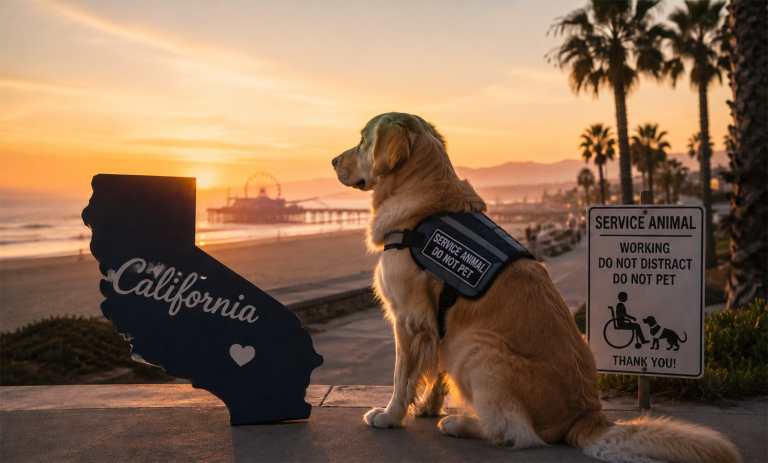
Many handlers use vests, ID cards, or patches for personal convenience — to reduce repeated questions in public. These have no legal standing either way, but some people find them useful.
What is required: Your dog must stay current on local licensing and vaccinations as required by your city or county. These are standard requirements for all dogs in California, not special service animal requirements.
One area where California law goes further than federal law: under the California Disabled Persons Act, you can bring a service dog in training to public places. The ADA does not extend that protection.
Step 4: Know Your Public Access Rights
Once your dog is trained to perform a task related to your disability, you have the right to bring them into most public spaces — restaurants, stores, hotels, public transportation, and more — even where pets are otherwise prohibited.
If your disability is not obvious, staff may ask you two questions only:
- Is the animal required because of a disability?
- What work or task has the dog been trained to perform?
They cannot ask about the nature or details of your disability, require you to demonstrate the task, or demand documentation. They also cannot charge you extra fees because of your service animal.
Service animals can be asked to leave only if the animal is out of control and the handler does not take effective action, or if the animal poses a direct threat to the health or safety of others.
A Word on Fraud — and Why It Matters to Our Community
Falsely representing a pet as a service animal is a crime in California. Under California Penal Code §365.7, it is a misdemeanor to knowingly and fraudulently represent a dog as a guide, signal, or service animal. Penalties include up to six months in county jail and/or a fine of up to $1,000.
This matters not just legally, but practically. When people misrepresent untrained pets as service animals, it creates access problems and public distrust that disproportionately affects people in our community who depend on legitimate service animals every day.
Reputable Organizations That Can Help
These organizations are established, accredited, and California-connected. Verify current eligibility and wait times directly with each program, as these change.
Canine Companions
Founded in Santa Rosa, CA in 1975 — the first organization to receive full Assistance Dogs International accreditation. Serves adults, children, and veterans with physical and developmental disabilities. Dogs and all follow-up services provided free of charge.
Guide Dogs for the Blind
Based in San Rafael, CA (founded 1942). The largest guide dog school in North America, with more than 16,000 guide dog teams graduated. All services free, funded entirely without government support.
Guide Dogs of America / Tender Loving Canines
ADI-accredited organization providing guide dogs for people who are blind or visually impaired, service dogs for veterans, and autism service dogs for children.
Pawsitive Teams
San Diego-based nonprofit (founded 1997), focused specifically on individuals with mobility-limiting disabilities and veterans with PTSD. ADI-accredited. Note: serves San Diego County residents only and places a small number of dogs per year.
California Service Dog Academy
A California nonprofit and ADI candidate program dedicated to raising, training, and providing service dogs to people who legitimately need them.
Assistance Dogs International — Member Search
ADI is the global accrediting body for assistance dog organizations. Their searchable directory lets you find accredited programs by location and disability type — one of the most reliable ways to vet an organization before applying.
What About Cost?
Fully trained service dogs from professional programs can cost between $15,000 and $60,000 to breed and train. Many accredited nonprofits cover that cost through donations and provide the dog to recipients at no charge, though some have cost-sharing components. Owner-training can reduce direct financial costs but requires a significant investment of time.
Be cautious of for-profit companies selling “certified” or “registered” service dogs at high prices. No certification is legally required, and organizations claiming to offer official credentials that improve your legal standing are not being honest about what California or federal law requires.
Quick Summary
- A service animal is a dog trained to perform a specific task related to your disability.
- No government registration, certification, or ID is required or legally recognized.
- You can use a program-trained dog or train one yourself — both are legal in California.
- Your dog must be current on local licensing and vaccinations.
- In public, staff may ask only two questions — not about your diagnosis, not for documentation.
- Falsely representing a pet as a service animal is a misdemeanor in California.
- ADI-accredited nonprofits, many of them free, are the safest path to a well-trained service dog.