Every month, the California Department of Social Services quietly publishes a workbook of IHSS program data. Most people never open it. But inside those spreadsheets is information that can help you protect your hours, your pay, and your loved one’s care.
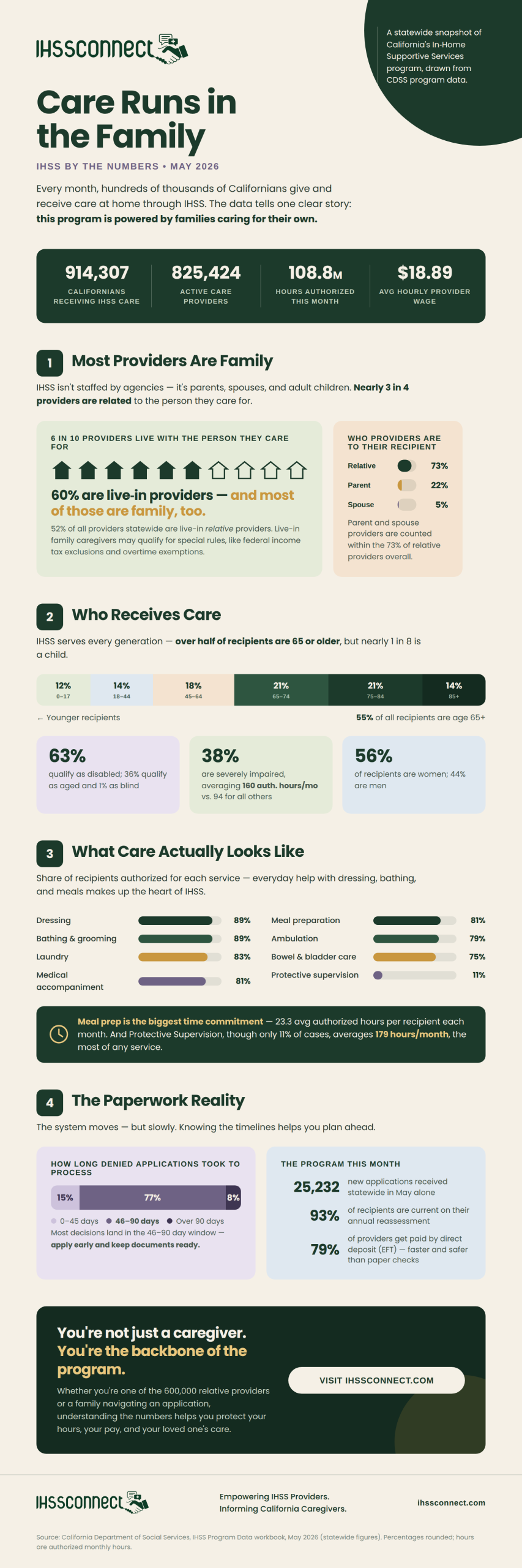
The May 2026 numbers tell one clear story: 914,307 Californians received IHSS care, supported by 825,424 active providers who were authorized for 108.8 million hours of care in a single month — and most of those providers are family. We pulled the full picture into the infographic below. Underneath it, five things worth actually doing with this information.
The 5 Practical Takeaways
1. If you live with the person you care for, two rules can change your bottom line
Nearly 3 in 4 IHSS providers are related to the person they care for, and 60% live in the same home. If that’s you, the tax code treats you differently — in a good way.
Under IRS Notice 2014-7, live-in IHSS providers may exclude their IHSS wages from federal gross income. This is not automatic. You have to file form SOC 2298 (the Live-In Provider Self-Certification) so the state stops reporting those wages as taxable income. The exclusion only applies while you actually live with your recipient, and it can interact with other parts of your tax picture — including credits like the EITC — so it’s worth a conversation with a tax professional before you decide how to file.
Separately, some live-in family providers caring for two or more IHSS recipients in their home may qualify for a workweek exemption that raises the usual 66-hour weekly cap to as much as 90 hours. If you’re a parent caring for multiple children on IHSS, or caring for a spouse plus another family member, ask your county about it.
2. Build a 90-day runway when you apply
Counties received 25,232 new IHSS applications in May alone. Among applications that were ultimately denied, 77% took 46 to 90 days to process, and 8% took longer than 90 days. (The published processing data covers denied applications, so approved cases may move on a different timeline — but the window is a reasonable planning assumption either way.)
The practical move: don’t wait for a crisis to apply. Confirm Medi-Cal eligibility first, since IHSS requires it. Have your doctor’s information ready for the health care certification (SOC 873). Respond to county requests quickly — stalled paperwork is the most common self-inflicted delay. If care is needed now, ask the county about expedited processing.
3. Treat the annual reassessment as hour protection, not paperwork
93% of recipients are current on their annual reassessment. That’s good news, because the reassessment is where your hours are won or lost.
The data shows where the time actually goes: meal preparation is the single biggest time commitment in the program, averaging 23.3 authorized hours per recipient each month, and everyday services — dressing, bathing, meals — sit at the heart of most care plans. Before your assessment visit, keep a one-week care log and describe your hardest days, not your best ones. Assessors authorize hours based on need as documented, not need as endured.
One service deserves special attention: protective supervision. Only 11% of recipients are authorized for it, but it averages 179 hours per month — the most of any service. It exists for people who cannot safely be left alone because of a cognitive or mental impairment. If that describes your loved one and it’s not in your care plan, raise it at your next assessment.
4. If you’re still getting paper checks, switch
79% of providers now get paid by direct deposit. That leaves roughly 1 in 5 waiting on paper checks — slower, and easier to lose or steal. Enrolling takes a few minutes through the Electronic Services Portal (ESP), and payment lands faster with no trips to the bank. If you’ve been putting it off, this is the lowest-effort improvement on this list.
5. Know where you fit in the bigger picture
Over half of IHSS recipients are 65 or older, and nearly 1 in 8 is a child. 63% qualify as disabled. And the program keeps growing — the state projects caseload rising roughly 8% into 2026–27.
Why does that matter to you? Because when budget season arrives and IHSS is on the table — as it was this year — these numbers are the evidence. This is not an agency workforce; it’s hundreds of thousands of families providing care the state would otherwise pay far more to deliver in institutions. Whether you’re writing to a legislator, sitting in a county hearing, or just explaining to a relative what you do all day, the data backs you up.
A note on the data
Figures come from the California Department of Social Services IHSS Program Data workbook, May 2026 (statewide). One nuance worth knowing: the monthly workbook counts individuals served in that month, while state budget documents cite fiscal-year average paid caseload (810,336 for 2025–26) — which is why headline counts differ between sources. Percentages are rounded; hours are authorized monthly hours.