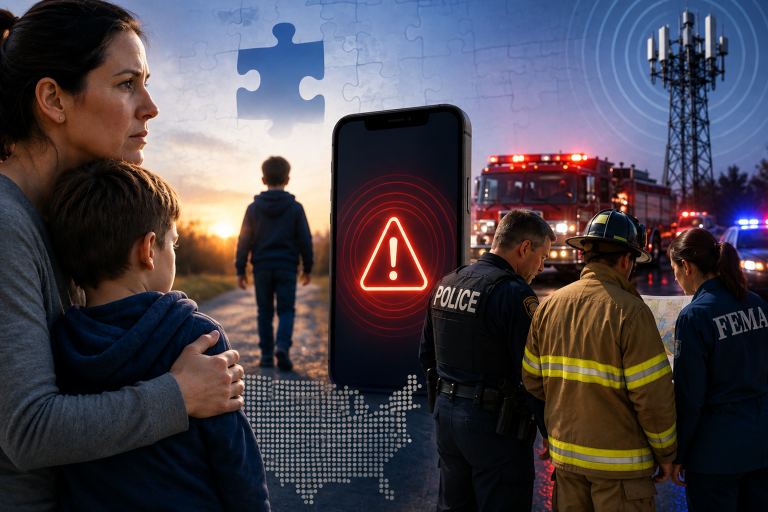
On August 21, 2026, the U.S. Department of Health and Human Services announced the National Autism Missing and Endangered Person Alert Initiative at an event in Rochester, Minnesota, alongside the Department of Justice, FEMA, and the Department of Homeland Security. The stated goal is a national framework for how law enforcement, emergency managers, and first responders act when an autistic child or adult is reported missing.
The details matter more than the headline. This is not a new alert arriving on your phone, and it is not running yet. It is federal guidance pushing states and counties toward an alert category that has existed since 2024. Below is what was actually announced, how well the evidence behind it holds up, what California already has on the books, and what a family can do tonight.
At a glance
- Announced August 21, 2026 by HHS with DOJ, FEMA, and DHS.
- It is not a new alert. It promotes consistent use of the Missing and Endangered Person (MEP) alert code the FCC created in August 2024.
- It is not active yet. HHS Secretary Kennedy said the system is still being developed. No rollout date, funding figure, or statutory authority has been published.
- Local agencies keep the final say. Federal guidance does not compel any sheriff or police department to issue an alert.
- California already has a route. The Endangered Missing Advisory covers people who are developmentally disabled or cognitively impaired, today.
What was announced
HHS framed the initiative as a partnership rather than a program with its own budget line. Three agencies signed on publicly:
- HHS, which is coordinating the effort and housing it under its autism work.
- The Department of Justice, which oversees missing-person alert programs and grant funding.
- FEMA, which operates the Integrated Public Alert and Warning System (IPAWS), the pipe that emergency alerts travel through.
HHS Secretary Robert F. Kennedy, Jr. said, “When an autistic child or adult goes missing, every minute matters.” Attorney General Todd Blanche said the effort “will help law enforcement and emergency responders act quickly and effectively when an autistic individual goes missing.” DHS Secretary Markwayne Mullin described FEMA’s role as supporting coordination across emergency management, law enforcement, first responders, and community partners.
The alert initiative was one of several autism announcements made the same day. HHS also pointed to an Applied Behavior Analysis toolkit released by the Centers for Medicare & Medicaid Services, health care training work through the Health Resources and Services Administration, and new federal working groups on communication, medical research, and lifespan supports.
It is not a new alert. It is a push to use one that already exists.
The initiative builds on the Missing and Endangered Person alert, or MEP. The Federal Communications Commission created the MEP event code in a Report and Order adopted August 7, 2024 and released the following day. MEP was designed as a catch-all for missing-person cases that do not meet AMBER Alert criteria, and it is the umbrella code that carries state programs such as Silver Alerts, Feather Alerts, and Ashanti Alerts.
Two features of MEP are worth knowing. First, it travels over both the Emergency Alert System, which interrupts radio and television, and Wireless Emergency Alerts, the messages that arrive on a mobile phone. Second, the FCC order that created it already contemplated autism directly, using as an example a “missing autistic 10 year old child” who “has walked away during severe weather” and noting that such a case does not qualify as a child abduction emergency.
So the federal initiative is not building separate infrastructure. According to the HHS fact sheet, it promotes consistent use of the existing MEP category through IPAWS for qualifying autism-related incidents, and adds:
- Updated IPAWS message templates and autism-specific messaging guidance.
- National guidance and model MEP activation protocols.
- Standardized public alert language and evidence-informed search practices.
- Training for first responders on recognizing autism-related wandering.
What the initiative does
- Promotes use of the existing MEP alert code for autism cases
- Promises IPAWS message templates and autism-specific wording
- Promises model MEP activation protocols for agencies to adopt
- Promises first responder training on autism-related wandering
- Promises evidence-informed search practices
What it does not do
- Create a new alert category or a new phone notification
- Require any state, county, or city to issue an alert
- Attach funding to the training it calls for
- Set a published rollout date
- Change California’s alert criteria on its own
The detail that decides whether this works: local discretion
The fact sheet says state, tribal, territorial, and local jurisdictions are to adopt and implement the federal guidance within their existing alert and emergency-response systems, and that those authorities “retain discretion over alert activation decisions.”
That single sentence is the whole ballgame. A model protocol does not compel any sheriff’s department to issue an alert. Whether an autistic adult who walks away from a group home in Fresno triggers a phone alert will still be a judgment call made by the agency taking the report, exactly as it is today. What changes is that the agency will have a template and a training module telling it what a good decision looks like.
HHS Secretary Robert F. Kennedy, Jr. said the nationwide autism-specific alert “is not yet active, but federal, state and local partners are working to develop it.”
The HHS fact sheet publishes no rollout date, no funding amount, and no statutory authority. If you need help today, use the California route described further down this article.
The two statistics HHS is citing, and how solid they are
Both numbers in the federal materials are doing real persuasive work, so both deserve a hard look. One holds up reasonably well with caveats. The other does not hold up as stated.
| Claim in the HHS fact sheet | What the cited source actually says | How solid |
|---|---|---|
| About half of autistic children engage in wandering behavior. | Anderson et al., Pediatrics (2012): 49% of 1,218 children with autism attempted to elope at least once after age 4; 26% went missing long enough to cause concern. | Moderate. An online survey of a volunteer research registry, not a population sample. The authors say it may not generalize. The study is 14 years old. |
| An average of eight autistic children die each month following wandering. | The National Autism Safety Council says “eight to ten individuals” per month, all ages, based on its own unpublished 1974-to-present surveillance data. | Weak as stated. HHS narrowed an all-ages figure to children. The underlying dataset is not public. A separate count found roughly two per month for 2011–2016. |
“Approximately half of autistic children engage in wandering behavior”
HHS attributes this to Anderson and colleagues, published in Pediatrics in 2012, and to a CDC summary of the same evidence. The study found that 49 percent of 1,218 children with autism had attempted to elope at least once after age four, compared with 13 percent of their unaffected siblings. Twenty-six percent of the full sample went missing long enough to cause concern. Among those who went missing, 65 percent had a close call with traffic injury and 24 percent with drowning. Elopement attempts peaked at a mean age of 5.4 years.
This was an online survey distributed through the Interactive Autism Network, a volunteer research registry, not a population sample. The authors state their findings “may not be generalizable to all children with ASD” because participants were more likely to be white and highly educated, and because families of children who died while eloping could not be included.
The study is now 14 years old. The direction it points is well supported. The precise figure is not a population rate, and should not be reported as one.
“An average of eight autistic children die each month”
The fact sheet attributes this to the National Autism Safety Council. Three things are wrong or unverifiable about it as written.
- The source says something different. The Council’s own page states that “an average of eight to ten individuals die each month in the U.S. following elopement.” Individuals, not children. HHS narrowed an all-ages figure to children, and the source does not support that.
- The underlying data is not publicly checkable. The Council attributes the figure to its own longitudinal surveillance data on elopement fatalities spanning 1974 to the present, presented through an analytics dashboard rather than a peer-reviewed publication or a downloadable dataset.
- An independent count is far lower. The National Autism Association tracked media and agency reports of wandering-related deaths from 2011 through 2016 and documented 139 deaths over six years, roughly two per month, rising to what it described as “two to three times a month on average in 2015 and 2016.” Drowning accounted for 71 percent. That is the same method family, media and agency reporting, and it produces a very different number.
Both mortality counts, the National Autism Safety Council’s and the National Autism Association’s, are surveillance estimates compiled by advocacy organizations from media and agency reports. Neither is peer-reviewed. Both almost certainly undercount, because no federal system records wandering as a cause of death.
Wandering deaths are real, preventable, and concentrated in drowning. The specific claim that eight autistic children die every month should not be repeated as established fact until the underlying data is published.
What California already has: the Endangered Missing Advisory
California does not have an autism-specific alert, and the federal initiative does not create one. What California does have is the Endangered Missing Advisory, or EMA, authorized by Government Code section 8594.11 and added by Assembly Bill 946. It is California’s implementation of the federal Ashanti Alert Act of 2018, and it is administered by the California Highway Patrol.
The CHP lists five criteria, all of which must be met:
Worth knowing: Authority is California Government Code section 8594.11, added by AB 946. Only the investigating law enforcement agency can determine the criteria are met and request the advisory — a family cannot request one directly. What you can do is call 911, describe the risk in specific terms, and ask the responding agency to consider one by name.
Developmental disability and cognitive impairment qualify explicitly under the first criterion, which is why an autistic person who wanders can already fall within EMA today, without waiting for the federal framework.
California also runs AMBER, Silver, Blue, Yellow, Feather, and Ebony alerts through the CHP. Silver Alerts cover older adults and, in practice, adults with cognitive impairment. None of these is autism-specific.
The registry California passed and never built
There is a second California story here, and it is the one that shows what the federal initiative is up against.
The Manny Alerting Act, Assembly Bill 911, was enacted as Chapter 686 of the Statutes of 2019 and added Government Code sections 8592.20 through 8592.22. It directed the California Office of Emergency Services to study whether the state could build a voluntary self-registration system, one that lets an older adult, a disabled person, or an at-risk person put health and safety information on file in advance so that Public Safety Answering Points, the 911 centers, could give it to responders in real time.
Cal OES completed the study in 2020. It concluded that a self-registration database is technically feasible and that integrating the data into 911 workflows is operationally feasible, provided the data stays accurate, concise, consistent, and timely. The estimated cost was roughly $116 million a year statewide. The registry was never funded and never built.
On April 14, 2026, the California Department of Justice’s SB 882 Advisory Council, created by Senate Bill 882 in the 2021 to 2022 session to improve interactions between people with intellectual and developmental disabilities and law enforcement, recommended legislation to fully implement the Manny Alert Act, “including a funded voluntary statewide registry made available for real-time access to all Public Safety Answering Points, Computer Aided Dispatch Systems, and field first responders.”
Guidance, templates, and training are inexpensive. Dispatch-integrated data about a specific person, kept accurate and current, is not.
California priced its own registry at roughly $116 million a year in 2020 and has not funded it in the six years since. The federal initiative runs into that same wall from the opposite side: it can supply the protocol, but not the local capacity to act on it.
Why some autistic advocates are cautious
Support for faster searches is close to universal. The disagreements are narrower and specific, and they are worth stating accurately rather than as generalized objection.
Registries and data collection
On May 13, 2025, the American Civil Liberties Union, the Autistic Self Advocacy Network, and roughly 80 other disability rights, civil rights, and public health organizations wrote to Secretary Kennedy about the National Institutes of Health’s proposed autism “real-world data platform,” widely described as a registry. Their objection was not to autism research. It was that basic questions were unanswered: what data would be collected, what sources it would draw on, and how it would be anonymized and secured. The letter cited the “increased risk of surveillance, stigmatization, and marginalization from data collection, particularly for disabled people,” and asked for three things: meaningful engagement with autistic people, real privacy protections, and assurance the platform would benefit rather than harm the people in it.
Those questions apply directly to any voluntary registry, including the one California’s own advisory council is now recommending. The answer is not necessarily no. It is consent, scope limits, retention rules, and a clear account of which agencies can read the record and for what.
The alert works by sending police
An alert is a mechanism for producing contact between a disabled person and law enforcement, often at speed, often at night, often with searchers who have never met them. That contact carries its own risk, which is precisely why California’s SB 882 Advisory Council exists. Announcing its report, Attorney General Rob Bonta said that “existing research shows that people with mental health conditions or intellectual and developmental disabilities are more likely to have potentially heightened or escalated interactions with law enforcement.”
The council’s recommendations run in the same direction as the federal initiative’s training component: funded 24-hour mental health crisis teams to handle non-crime 911 and 988 calls, an assessment by the Department of Developmental Services of safety training that covers interactions with peace officers, and stronger content on intellectual and developmental disabilities in Commission on Peace Officer Standards and Training curriculum. Training is the piece both HHS and the council name. It is also the piece with no appropriation attached to it in either case.
Where autism organizations landed
David Sitcovsky of Autism Speaks told Disability Scoop that a more consistent national framework for autism-informed emergency response “has the potential to build on that work and address gaps that vary significantly from state to state,” while stressing that it will require first responder training, community engagement, and adequate state resources. That is roughly where most of the response has settled: the framework is welcome, the follow-through is the open question.
One thing the federal materials get right and deserve credit for: HHS uses identity-first language throughout, referring to “autistic individuals” and “an autistic child or adult.”
That is the usage most autistic self-advocates ask for, and federal autism messaging has not always followed it.
What to do if someone you support goes missing
None of this waits on the federal rollout. These steps work under current California law today.
- Call 911 immediately. California Penal Code section 14211 requires all local police and sheriff’s departments to accept any missing-person report from any party, including by telephone, “without delay,” and to give those reports priority over property-crime reports. There is no waiting period. If the person is under 21 or there is evidence they are at risk, the agency must broadcast a “Be On the Lookout” bulletin without delay and transmit the report to the Department of Justice within two hours.
- Use the words “autistic” and “high risk.” HHS’s own guidance to families is to report that the person is a high-risk, autistic individual and to ask authorities to use their Missing and Endangered Person protocols. Say it in those terms.
- Tell them where the water is. Drowning is the leading cause of death in these cases in every dataset available. Name every pond, canal, creek, pool, drainage channel, retention basin, and fountain within walking distance. Searchers will not know your neighborhood the way you do.
- Describe how the person communicates. Tell responders whether the person speaks, whether they will answer to their name or move away from a stranger calling it, what they are drawn toward, whether they respond to a specific song or phrase, and whether they can give their name and address. The National Autism Association reports that more than a third of autistic children who elope cannot communicate their name, address, or phone number.
- Ask for an Endangered Missing Advisory by name. You cannot request one yourself, but you can ask the investigating agency whether the case meets the Government Code section 8594.11 criteria and ask them to contact the CHP. Naming the mechanism changes the conversation.
- Ask your county what it already runs. Ask your sheriff’s department or police department whether they operate a voluntary registry for residents with disabilities or a locative-device lending program. The Department of Justice’s Kevin and Avonte Program, authorized by Kevin and Avonte’s Law in 2018, funds exactly this: locative technology and wandering-prevention programs run by law enforcement, health care agencies, and partnering nonprofits. Funding is open for fiscal year 2026. Whether your county has applied for it is a local question with a local answer.
- 1Call 911 immediatelyCalifornia Penal Code section 14211 requires departments to accept any missing person report, from any party, by phone, “without delay.” There is no waiting period. For someone under 21 or at risk, the agency must broadcast a Be On the Lookout bulletin without delay and send the report to the state DOJ within two hours.
- 2Say “autistic” and “high risk”HHS tells families to report that the person is a high-risk, autistic individual and to ask authorities to use their Missing and Endangered Person protocols. Use those words.
- 3Tell them where the water isDrowning is the leading cause of death in these cases in every dataset available. Name every pond, canal, creek, pool, drainage channel, retention basin, and fountain within walking distance.
- 4Describe how the person communicatesWill they answer to their name, or move away from a stranger calling it? What are they drawn to? Can they give their name and address? The National Autism Association reports more than a third of autistic children who elope cannot.
- 5Ask for an Endangered Missing Advisory by nameYou cannot request one yourself. You can ask the investigating agency whether the case meets the Government Code section 8594.11 criteria and ask them to contact the CHP.
- 6Ask your county what it already runsAsk whether your sheriff or police department operates a voluntary registry for residents with disabilities or a locative-device lending program. DOJ’s Kevin and Avonte Program funds exactly this, and fiscal year 2026 funding is open.
One connection for IHSS families
The risk profile behind this alert, a person who cannot safely be left alone because they may leave and walk into danger, is the same risk profile IHSS Protective Supervision is meant to cover. The elopement record you build for a Protective Supervision assessment, the SOC 821, is also the record that helps searchers move fast: dates, times, how far the person got, what drew them, how they were found, and what did or did not work to prevent the next one.
Keep it in one place, keep it dated, and keep it specific. It serves two purposes at once, and you will not want to be reconstructing it from memory on either occasion.
Where to go
Save these before you need them.
- Someone is missing right nowCall 911. No waiting period applies in California.
- California DOJ Missing Persons tip line1-800-222-FIND (1-800-222-3463) · oag.ca.gov/missing
- Active California alertsCHP State of California Missing Person Alert Plan
- Endangered Missing Advisory criteriachp.ca.gov — Endangered Missing Advisory
- Locative device and registry grantsDOJ Kevin and Avonte Program — ask your county whether it participates
- The federal initiativeHHS fact sheet
What to watch next
- Whether HHS actually publishes the IPAWS message templates and model activation protocols, and on what date.
- Whether the CHP or Cal OES adopts the federal guidance and whether California adds explicit autism language to its EMA materials.
- Whether the Legislature funds the Manny Alert registry in a coming budget, after the SB 882 Advisory Council’s April 2026 recommendation.
- Whether any appropriation attaches to the first responder training both HHS and the SB 882 council say is essential.
- Whether the National Autism Safety Council publishes the surveillance dataset behind the mortality figure HHS is now repeating.
Sources
HHS, “HHS Launches First National Autism Missing and Endangered Person Alert Initiative” (Aug. 21, 2026) — announcement date and location, the participating agencies, the quotes from Secretary Kennedy, Attorney General Blanche, and Secretary Mullin, and the same-day CMS, HRSA, and working-group announcements.
https://www.hhs.gov/press-room/hhs-launches-national-autism-missing-person-alert-initiative.html
HHS, “Fact Sheet: National Autism Missing and Endangered Person Alert Initiative” — the reliance on existing MEP processes through IPAWS, the four categories of promised federal support, the local-discretion language, the guidance to families, and both cited statistics.
https://www.hhs.gov/press-room/fact-sheet-hhs-launches-national-autism-missing-person-alert-initiative.html
FCC, Report and Order FCC 24-83, The Emergency Alert System and Wireless Emergency Alerts — the August 7, 2024 adoption of the MEP event code, its scope as the non-AMBER umbrella covering Silver, Feather, and Ashanti alerts, delivery over both EAS and WEA, and the missing autistic child example in the order text.
https://docs.fcc.gov/public/attachments/FCC-24-83A1.pdf
Anderson C., et al., “Occurrence and Family Impact of Elopement in Children With Autism Spectrum Disorders,” Pediatrics 130(5):870-877 (2012) — the 49 percent elopement figure, the 26 percent who went missing long enough to cause concern, the 65 percent traffic and 24 percent drowning close calls, the peak age of 5.4 years, and the authors’ own generalizability limitations.
https://stacks.cdc.gov/view/cdc/33848/cdc_33848_DS1.pdf
National Autism Safety Council, “Autism & Safety” — the “eight to ten individuals” per month figure that HHS restated as eight children, and the attribution to the Council’s own 1974-to-present surveillance data.
https://autismsafetycouncil.org/autism-safety
National Autism Association, “Mortality & Risk in ASD Wandering/Elopement 2011-2016” (March 2017) — the 139 documented deaths over six years, the 71 percent drowning share, the “two to three times a month” characterization for 2015 and 2016, and the stated limits of media-based case collection.
https://nationalautismassociation.org/wp-content/uploads/2017/04/NAAMortalityRiskASDElopement.pdf
California Highway Patrol, “Endangered Missing Advisory” — the five EMA activation criteria, the inclusion of developmental disability and cognitive impairment, the Government Code section 8594.11 and AB 946 authority, the Ashanti Alert Act connection, and the rule that the investigating agency determines activation.
https://www.chp.ca.gov/news-alerts/alerts/Endangered-Missing-Advisory-ema/
California Highway Patrol, “State of California Missing Person Alert Plan” — the list of California alert types, confirming that none is autism-specific.
https://www.chp.ca.gov/news-alerts/State-of-California-Missing-Alert-Plan/
California Penal Code section 14211 — the requirement that departments accept any missing-person report without delay and prioritize it, the “Be On the Lookout” broadcast requirement for at-risk persons and those under 21, and the two-hour DOJ transmission requirement.
https://law.justia.com/codes/california/code-pen/part-4/title-12/section-14211/
California Attorney General, “SB 882 Advisory Council Releases Report and Recommendations” (Apr. 14, 2026) — the recommendation to fully implement and fund the Manny Alert registry, the crisis-team and POST training recommendations, and the quote from Attorney General Bonta.
https://oag.ca.gov/news/press-releases/sb-882-advisory-council-releases-report-and-recommendations-improving
California OES / SB 882 Advisory Council, “The Manny Alerting Act AB 911: An Overview of the Feasibility Study” — the 2019 enactment, the Cal OES feasibility mandate and January 2021 reporting deadline, the technical and operational feasibility findings, and the roughly $116 million annual statewide cost estimate.
https://oag.ca.gov/system/files/media/Agenda-Item-6-12102025.pdf
Autistic Self Advocacy Network, “Disability Rights and Privacy Advocates Raise Concerns with Proposed Autism ‘Registry’” (May 13, 2025) — the coalition of ACLU, ASAN, and roughly 80 organizations, the letter to Secretary Kennedy, the unanswered data questions, and the surveillance and stigmatization concerns.
Disability Rights and Privacy Advocates Raise Concerns with Proposed Autism “Registry”
Disability Scoop, “National Alert System For Missing Persons With Autism In The Works” (Aug. 24, 2026) — Secretary Kennedy’s statement that the system is not yet active, and the Autism Speaks response.
National Alert System For Missing Persons With Autism In The Works
Bureau of Justice Assistance, “Kevin and Avonte Program: Overview” — the 2018 authorization under Kevin and Avonte’s Law, what the grants fund, who is eligible to apply, and the open fiscal year 2026 funding.
https://bja.ojp.gov/program/kevin-avonte/overview
HHS and FEMA are the primary authorities on the federal initiative; the California Government Code and the CHP govern how an alert actually issues in California. Where a federal fact sheet and the statute differ, the statute governs. Statistics attributed to advocacy organizations are labeled as such in the text.