The ADA at 36: A Law Worth Defending
Since 1990, the Americans with Disabilities Act has been the legal floor under disability rights in America — the reason ramps, captions, accessible websites, and in-home care programs exist as a matter of right, not charity. In 2026, that floor is being tested.
This past July marked 36 years since the Americans with Disabilities Act became law. For most of that history, the ADA has functioned like plumbing: essential, mostly invisible, and easy to take for granted until it stops working. In 2026, parts of it are starting to stop working, and that should concern every IHSS recipient, caregiver, and disabled Californian reading this.
What Is the ADA?
Five Titles, One Law
Employers with 15+ workers can't discriminate and must provide reasonable accommodations.
State and local government services, transit, courts, and websites must be accessible.
Private businesses open to the public — stores, restaurants, clinics — must remove barriers.
Relay services guarantee phone access for people who are deaf or hard of hearing.
Protects anyone who asserts their ADA rights from retaliation.
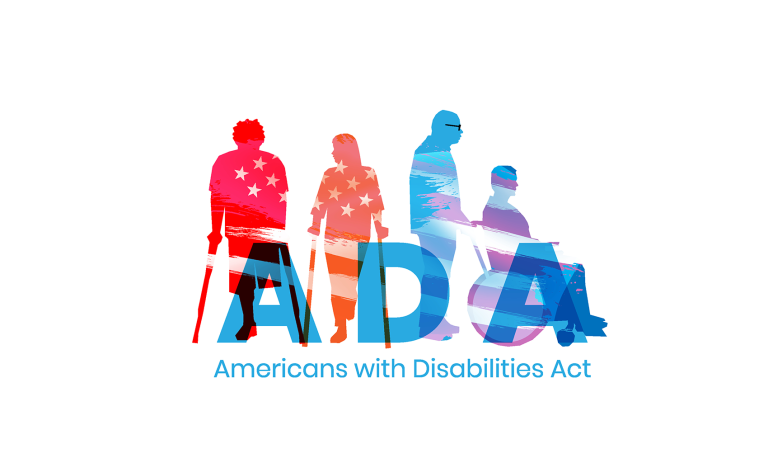
The Americans with Disabilities Act (ADA) is a federal civil rights law that prohibits discrimination against people with disabilities in employment, public services, public accommodations, transportation, and telecommunications. It doesn’t grant special treatment. It establishes that disability discrimination is illegal, the same way the Civil Rights Act of 1964 made race and sex discrimination illegal.
The law is organized into five titles:
- Title I bars employment discrimination by employers with 15 or more workers and requires reasonable accommodations for qualified employees.
- Title II covers state and local government services, programs, and activities, including public transit, courts, and government websites.
- Title III covers “public accommodations”: private businesses open to the public, such as restaurants, stores, hotels, and medical offices.
- Title IV requires telecommunications relay services for people who are deaf or hard of hearing.
- Title V contains miscellaneous provisions, including protection from retaliation against people who assert their ADA rights.
When It Started
President George H.W. Bush signed the ADA into law on July 26, 1990, after it passed the Senate 76–6 and the House by voice vote, a genuine bipartisan consensus worth remembering now. At the signing ceremony, Bush said, “Let the shameful wall of exclusion finally come tumbling down.” The law was later strengthened by the ADA Amendments Act of 2008, signed by President George W. Bush, which broadened the legal definition of disability after courts had narrowed it through restrictive rulings.
How We Got Here
President George H.W. Bush signs the ADA after it passes the Senate 76–6.
Olmstead v. L.C. rules that unjustified institutionalization is disability discrimination under the ADA — the legal root of home-based programs like IHSS.
The ADA Amendments Act restores a broader legal definition of disability after restrictive court rulings.
DOJ finalizes a rule requiring state and local government websites to meet accessibility standards.
DOJ delays the web rule a year and issues a memo stepping back from enforcing Olmstead's community-integration mandate.
Who It Helps
According to the CDC, more than 70 million U.S. adults, roughly 1 in 4, report having a disability. That includes people with mobility, cognitive, vision, hearing, independent living, and self-care disabilities. It includes IHSS recipients who need personal care to remain in their own homes. It includes family caregivers who rely on accessible buildings, transit, and communication systems to support the people they care for. And it includes people whose disabilities are invisible: chronic illness, mental health conditions, and cognitive disabilities that don’t come with a wheelchair symbol.
The ADA doesn’t just help people who are disabled today. Disability is the one minority group anyone can join at any time, through age, illness, or injury. The curb cut, the accessible bathroom stall, the captioned video: these were fought for by disabled advocates but now serve parents with strollers, delivery workers, and anyone recovering from surgery.
1 in 4
U.S. adults — over 70 million people — report having a disability.
Source: CDC, Disability and Health Data System, 2022 data (released 2024)
Why It's Still Integral
The ADA isn’t just an employment or storefront law. It is the legal foundation underneath home and community-based services like California’s IHSS program. In 1999, the Supreme Court’s Olmstead v. L.C. decision interpreted the ADA’s Title II to mean that unjustified institutionalization of people with disabilities is itself a form of discrimination, and that states must provide services in the “most integrated setting appropriate” whenever possible. That ruling is a major reason programs like IHSS exist and continue to be funded: it gave people with disabilities a legal right to stay in their own homes and communities instead of being placed in nursing facilities or institutions.
Without the ADA and the case law built on top of it, there is no strong legal argument that keeping people in their homes is a right rather than a budget line item states can cut whenever convenient.
Why This Matters for IHSS
IHSS exists because the ADA and the Olmstead ruling established that people with disabilities have the right to live in their own communities rather than institutions whenever possible. That legal foundation is what states rely on when they justify — and fund — home care programs.
Weaken the enforcement of that right, and the argument for funding home-based care gets weaker too.
What's Happening Now
Over the past year, several federal actions have chipped away at how the ADA is enforced, even though the statute itself remains on the books.
In June 2026, the Department of Justice’s Office of Legal Counsel issued a memo concluding that neither the ADA nor Section 504 of the Rehabilitation Act requires states to provide services in the most integrated setting, and that Olmstead does not create a broad legal obligation to offer home- and community-based services. The DOJ stated it will no longer rely on its prior Olmstead guidance when enforcing Title II. Olmstead remains the law, but the federal government’s willingness to enforce it has been pulled back, and disability rights organizations, including The Arc and the National Down Syndrome Society, have warned this could push people back toward institutional care.
Separately, in April 2026, the DOJ delayed enforcement of its 2024 Title II rule requiring state and local government websites to meet accessibility standards (WCAG 2.1 AA), pushing compliance deadlines back a full year, to 2027 and 2028. The administration has also signaled it may revisit the rule itself rather than simply delay it, and over the past year it withdrew a number of existing ADA guidance documents and paused new rulemaking.
None of this repeals the ADA. But civil rights laws only protect people to the extent they are enforced, and enforcement is exactly what’s being scaled back.
What Changed in 2026
- June 2026: DOJ's Office of Legal Counsel says it will no longer rely on Olmstead guidance when enforcing Title II — Olmstead is still law, but federal enforcement has stepped back.
- April 2026: DOJ delays state and local government website accessibility deadlines by a year and signals it may revisit the rule itself.
- 2025–2026: Several existing ADA guidance documents have been withdrawn as agencies reconsider enforcement priorities.
Why Weakening the ADA Is the Wrong Direction
Framed as cost-cutting or regulatory relief, these changes are presented as narrow and technical. In practice, they remove the leverage disabled people and their advocates have used for 36 years to keep public entities, employers, and states accountable. A website that isn’t required to be accessible on any fixed timeline is a website many disabled users simply cannot use, for job applications, benefits enrollment, or public meetings. A weakened Olmstead standard is a weaker argument for funding IHSS and similar programs the next time a state budget gets tight.
The ADA was never a finished project. It didn’t anticipate the internet, and its protections for community-based living took another decade of litigation to establish through Olmstead. If anything, the honest case is that the ADA needs strengthening: clearer statutory language guaranteeing home- and community-based services rather than relying on court interpretation, updated digital accessibility standards that keep pace with technology, and stronger enforcement funding at the DOJ so violations are addressed instead of just filed.
Rolling back protections doesn’t return the country to some neutral, pre-regulation baseline. It returns disabled people to a legal landscape where their right to work, to move through public space, to access government services, and to live in their own homes depends on the discretion of whichever administration or state budget happens to be in charge that year. That is precisely the instability the ADA was written to end.
Thirty-six years ago, a Republican president and a bipartisan Congress agreed that excluding disabled people from public life was a civil rights violation, not a matter of preference. The version of the ADA worth defending in 2026 is not a weaker one.
Reinforcement, Not Retreat
The ADA didn't finish the job in 1990 — it took another decade of litigation just to establish the right to live at home instead of in an institution. The honest response to 2026's rollbacks isn't to accept a narrower ADA. It's to demand a stronger one.
- Follow enforcement changes through disability-led organizations like The Arc, DREDF, and NDSS.
- Tell state and federal representatives that home- and community-based services are a right, not a discretionary line item.
- Document and report accessibility barriers — enforcement depends on complaints being filed.
Sources & Further Reading
- ADA.gov — “Americans with Disabilities Act of 1990, As Amended”
- EEOC — “Titles I and V of the Americans with Disabilities Act of 1990 (ADA)”
- HISTORY.com — “Americans with Disabilities Act signed into law,” July 26, 1990
- Miller Center — “Remarks on the Signing of the Americans with Disabilities Act,” July 26, 1990
- CDC — “CDC Data Shows Over 70 Million U.S. Adults Reported Having a Disability,” July 2024 (2022 BRFSS data)
- Olmstead v. L.C. — 527 U.S. 581 (1999), full opinion via Justia
- NPR — “Disability advocates say DOJ memo threatens community-based care,” June 20, 2026
- Disability Scoop — “Trump Administration Claims People With Disabilities Don't Have Right To Community-Based Services,” June 22, 2026
- American Bar Association — “Narrowing Olmstead: A Response to the OLC's June 2026 Memorandum”
- Disability Scoop — “Trump Administration Casts Doubt On New ADA Rules,” April 20, 2026
- Jackson Lewis — “DOJ Extends Public Entities' Compliance Deadline for ADA-Related Website Accessibility,” 2026