A plain-language guide for IHSS recipients, caregivers, and families raising a child who is both a Regional Center client and an IHSS recipient.
The 30-second version
- The law didn't change. Regional Centers can now see your IHSS data because state departments share it directly.
- Your child can receive both IHSS and Regional Center respite — they are different services.
- The statewide respite tool is not in use yet; DDS plans to finalize it later in 2026.
- You keep your right to ask questions, document unmet needs, and appeal a reduction or denial.
If you care for a child who has both In-Home Supportive Services (IHSS) hours and a Regional Center Individual Program Plan (IPP), you may have heard that California “changed the rules” in 2026. The short version is calmer than the rumors: the laws governing how these programs fit together did not change. What changed is that Regional Center service coordinators can now see your IHSS information directly, because state departments have started sharing that data with each other.
That single change — better visibility — is what’s driving everything families are noticing: more questions at IPP meetings, more attention to how many IHSS hours a child has, and more discussion of which program should pay for what. This article explains what is actually new, what is not, and how it affects families whose child sits in both systems at once.
What actually changed in 2026 — and what didn’t
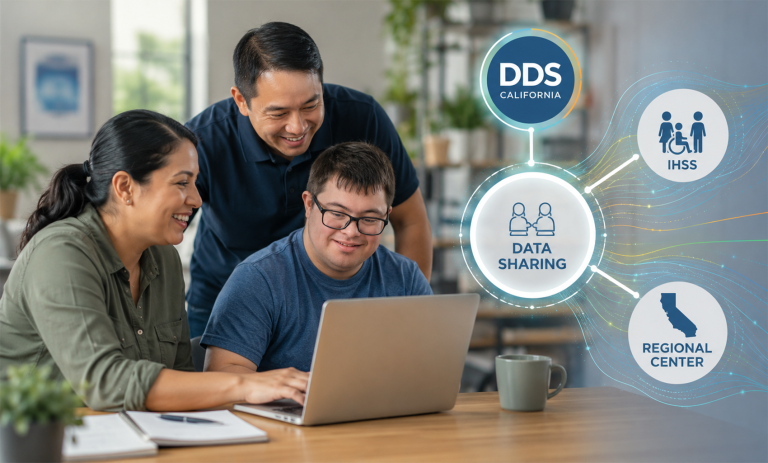
The real, verifiable change is data sharing. As of spring 2026, the Department of Developmental Services (DDS), the Department of Social Services (DSS, which runs IHSS), and the Department of Health Care Services (DHCS, which runs Medi-Cal) share certain information with one another. As a result, your Regional Center service coordinator can now view your IHSS data — such as the services and hours you already receive — without you having to gather and hand over that paperwork yourself.
What did not change is the underlying law. DDS did not pass a new rule making Regional Centers stricter, and the “payer of last resort” principle you may hear about has been in California law for decades. Framing 2026 as a wave of tough new restrictions overstates it. The accurate way to think about it: the rules are the same, but the Regional Center can now see more, so those long-standing rules may come up more often in your planning meetings.
What changed in 2026
State departments (DDS, DSS, DHCS) now share data, so your Regional Center service coordinator can see your IHSS hours and services directly — less paperwork for you.
What did not change
The "payer of last resort" law has been in place for decades. There is no new legal standard — the same rules simply come up more often now that coordinators can see more.
“Payer of last resort”: the rule behind the questions
Under the Lanterman Act, a Regional Center is generally the payer of last resort. State law requires Regional Centers to “identify and pursue all possible sources of funding” before spending their own funds, and it prohibits them from paying for a service that another public program is already responsible for providing (Welfare and Institutions Code §§4659 and 4648(a)(8)). IHSS is one of those other programs — what the system calls a “generic resource.”
Generic resources a Regional Center may expect a family to use first can include:
- In-Home Supportive Services (IHSS)
- Medi-Cal and Medicare
- School district and special education services
- Private health insurance
- Other publicly funded support programs
In practice, this means that when the Regional Center can now see your IHSS hours, it may ask whether those hours have been fully explored before it authorizes overlapping in-home support. That is not a new legal standard — but with data sharing, it is a conversation more families will have.
Do you have to sign anything? What DDS actually says about consent and privacy
A common point of confusion is whether families must sign a release for this data sharing, or can opt out of it. Based on what DDS has published, the information is shared directly between state departments — DDS, DSS, and DHCS — rather than through a form you sign at each Regional Center. DDS describes this as part of California’s broader effort to coordinate government programs and reduce the paperwork families repeatedly submit. DDS has not published a family opt-out for the department-to-department sharing itself.
DDS says the information is protected under state and federal privacy law, including HIPAA, the Lanterman Act’s confidentiality provision (Welfare and Institutions Code §4514), and related privacy statutes, and that it is to be used only to coordinate your services. If you want to know exactly what is being shared about your family and how it is used, the most reliable step is to ask your service coordinator directly and request DDS’s privacy fact sheet. You always retain the right to ask questions and to correct inaccurate information in your record.
Editor's note for accuracy
You may see other articles claiming families must “sign a release” or can “decline to sign” for IHSS data sharing. DDS’s own published materials do not describe it that way — they describe automatic sharing between state departments. If a specific Regional Center asks you to sign a consent form for something, read it and ask what it covers.
A second, quieter change: work requirements and why most families are exempt
The same data-sharing effort touches a newer federal requirement that people work or perform community service to keep Medi-Cal, IHSS, or CalFresh, unless an exemption applies. This is where families of children with disabilities should exhale: people with disabilities — and some of their caregivers — are exempt. DDS says that by sharing data across departments, exempt families should no longer have to re-prove every six months that they qualify. In other words, for most families in both systems, this piece is designed to reduce paperwork, not add a hurdle. If you are told your child’s exemption is in question, that is worth raising immediately with your service coordinator or an advocate.
The heart of it: when your child has both IHSS and a Regional Center IPP
This is where families most need clarity, because IHSS and Regional Center respite are different services — and the difference protects you.
IHSS and Regional Center respite are different services
IHSS (county)
Pays a provider — often a parent — to do specific tasks on the IHSS worksheet: bathing, feeding, and protective supervision when the child qualifies. Workers do only what is listed.
Respite (Regional Center)
Pays for a break from caregiving. The respite worker covers all of your child's needs during those hours — not just the tasks on a worksheet.
Why it matters: A Regional Center cannot fund a service that duplicates IHSS — but it can fund needs beyond what IHSS covers. Accepting respite does not reduce your child's IHSS.
Because they are different, families can generally receive both. The key rules, drawn from Disability Rights California’s guide to the Lanterman Act and the governing authorities, are:
- A Regional Center cannot pay for services that duplicate IHSS — but if your child’s need for a service is greater than the hours IHSS provides, the Regional Center can fund the additional amount.
- Regional Center services cannot be counted against your child’s IHSS eligibility as an “alternative resource” (DSS All County Letter 98-53). Accepting Regional Center respite does not reduce IHSS.
- For minors, IHSS assessments subtract “parental responsibility” — the ordinary care any parent provides a same-age child. IHSS covers the extra care your child needs because of disability, which is why “just get more IHSS” has real limits for children.
If a Regional Center tells you it will not authorize respite until your child gets IHSS, know that Disability Rights California specifically flags this as a situation to challenge, not simply accept. You can ask for the decision in writing and seek help.
The Standardized In-Home Respite Tool: coming, but not in use yet
You may also hear that DDS rolled out a statewide respite tool. To be accurate as of mid-2026: it is not in use yet. A 2023 state law (Senate Bill 138) directed DDS to make respite decisions more consistent across California, because families with similar needs have long received very different respite hours depending on which of the 21 Regional Centers serves them. DDS tested a second version of the tool from January 26 to April 30, 2026, using it alongside — not instead of — existing processes, so no family’s services were changed by the test.
DDS has said it plans to release the finalized tool and train Regional Centers on it later in 2026. When it arrives, the tool is meant to help decide how many respite hours are authorized by looking at factors such as caregiver stress, medical and behavioral support needs, daily supervision, family circumstances, and natural supports in the home. Importantly, DDS says the tool itself will not decide whether your family needs respite — your IPP planning team still makes that decision.
What this means for your IPP meeting
As IHSS, Medi-Cal, and Regional Center information become more connected, expect your IPP meetings to spend more time on what you already receive and whether generic resources have been fully used before the Regional Center adds funding. The most effective response is preparation. It helps to bring documentation of:
Bring this to your IPP meeting
- Your child's current IHSS hours and the tasks on the IHSS worksheet
- Care needs that go beyond what IHSS covers — and why
- Protective supervision or safety and supervision concerns
- Caregiver stress, fatigue, and the limits of natural supports at home
- Any needs still unmet despite the IHSS hours already in place
Clear documentation of unmet need is what distinguishes a duplicate service (which the Regional Center cannot fund) from an additional need (which it can).
Your rights if services are reduced or denied
Coordination between agencies does not remove your appeal rights. If a Regional Center reduces or denies a service, you are entitled to the decision in writing and to appeal it. If an IHSS decision is at issue, you can request a state fair hearing. You do not have to accept a verbal “no,” and you do not have to navigate it alone — an advocate or Disability Rights California can help you prepare for reassessments, IPP meetings, and appeals.
Where to learn more
For official guidance, families can review the California Department of Developmental Services, DDS’s IHSS Data Sharing Toolkit, and the DDS Bridges newsletter update “New Data Sharing Helps Families Access the Services They Need.”
For the respite tool’s status, see DDS’s In-Home Respite Tool: Data Collection Phase Ends. For how respite and IHSS work together for children, Disability Rights California’s Rights Under the Lanterman Act (Section 6.31) is a clear, authoritative resource.
DDS guidance is still evolving through 2026, so it is worth checking official DDS updates and raising questions with your service coordinator or an advocate.
Navigating IHSS and Regional Center together?
California Advocacy Group helps California families understand their rights and find support across every county — including preparing for IHSS home visits and reassessments.
Get connected todayThis is a paid advertisment.