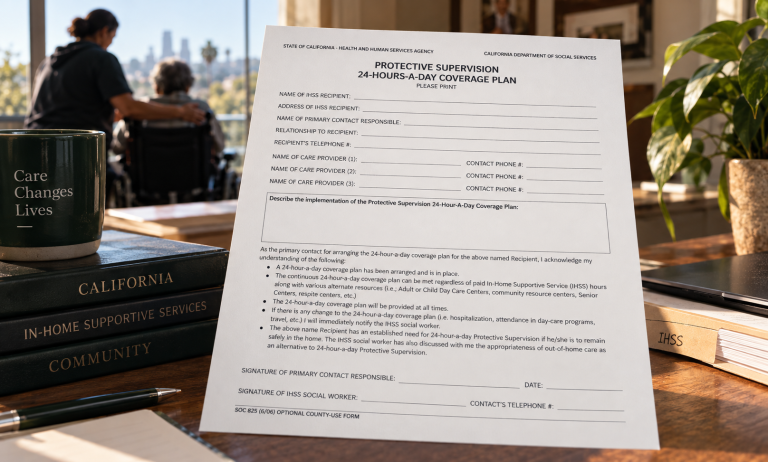
If your family has been approved for — or is applying for — IHSS Protective Supervision, at some point your social worker may hand you a form called the SOC 825. It doesn’t decide whether you qualify for Protective Supervision. It documents how you’ll cover the hours IHSS itself doesn’t pay for.
This guide walks through what the form is for, who’s supposed to fill it out, and what to actually write in the one open box most people freeze on — plus two real filled-out examples, so you’re not starting from a blank page.
SOC 825, at a glance
What the SOC 825 Actually Is
The SOC 825 is the “Protective Supervision 24-Hours-A-Day Coverage Plan,” a California Department of Social Services form (revised 6/06). Right on the form’s own footer, it’s labeled an “OPTIONAL COUNTY-USE FORM.” CDSS developed it in 2006 with the County Welfare Directors Association as a tool counties could use — not a form every county is required to collect in this exact format.
Because it’s optional, some counties may ask for the same information a different way. But the underlying task — showing the county how 24-hour supervision will actually happen — is something Disability Rights California describes as part of what the county is expected to collect once Protective Supervision is on the table, regardless of which specific paperwork does it.
Flag: SOC 825 and SOC 821 are not the same form, and mixing them up is the single most common source of confusion.
SOC 821 (“Assessment of Need for Protective Supervision”) is completed by a physician or medical professional. It helps establish whether the recipient qualifies for Protective Supervision in the first place.
SOC 825 only comes into play once Protective Supervision is being considered or already authorized. It documents how 24-hour coverage will actually happen — it has nothing to do with proving eligibility.
Why This Form Exists
Here’s the math that explains the whole form. IHSS Protective Supervision hours are capped — up to 283 hours a month for a recipient classified as “severely impaired,” and 195 hours a month for a recipient who is “non-severely impaired” (the exact ceiling varies slightly by funding subprogram; Disability Rights California’s publication breaks down the four subprograms in detail). A month has roughly 730 hours in it. Even at the maximum, paid IHSS hours cover well under half of a full month of round-the-clock supervision.
The SOC 825 is the county’s way of confirming that the rest of those hours are actually covered by someone or something else — a parent, another paid provider, school, a day or respite program, or a family member or friend helping without pay. It doesn’t create more IHSS hours. It shows that a real plan, not just a hope, fills the gap the paid hours leave behind.
The form itself ties this directly to whether the recipient can safely stay at home. By signing it, the primary contact acknowledges that the recipient “has an established need for 24-hour-a-day Protective Supervision if he/she is to remain safely in the home,” and that the social worker has “also discussed the appropriateness of out-of-home care as an alternative.” A solid coverage plan is part of what keeps that conversation about staying home instead of facility placement.
Who Fills It Out, and When
The “primary contact responsible” — usually a parent or family member coordinating the recipient’s care — completes and signs the plan. The IHSS social worker co-signs once the plan has been discussed and accepted. It typically comes up at the initial assessment, once a potential need for Protective Supervision has been identified, and a worker can ask for it to be revisited at reassessment.
Filling Out Each Section
- Recipient information — full name, address where the coverage will happen, and a phone number for the recipient.
- Primary contact responsible — name, relationship to the recipient, and a phone number.
- Read the acknowledgment statements — these aren’t boilerplate. Signing confirms a plan is in place, that it will hold at all times, and that you’ll notify the social worker immediately if anything changes (hospitalization, a new day program, travel).
- List the care providers — name and phone number for up to three providers, paid or unpaid. Attach an extra sheet if more than three people share coverage.
- Describe the 24-hour implementation — the open box where most people freeze. See below for exactly what belongs here.
- Signatures — the primary contact signs and dates first; the social worker co-signs once the plan is accepted, not before.
What to Actually Write in the Schedule Box
The instructions on the form itself say only: “Enter the planned schedule, or explanation of the plan in which the above provider(s) will ensure the recipient is cared for the entire 24-hour period.” That’s it — which is exactly why people freeze. In practice, what works is:
- Break the day into contiguous blocks of time — midnight to midnight, with no gaps.
- Name who is providing Protective Supervision in every block, not just the busy ones.
- Say whether that block is covered by a paid IHSS provider, a school or day program, or someone helping voluntarily.
- If a family member or friend is helping without pay, know that’s a separate certification — form SOC 450 — not something the SOC 825 covers on its own. Ask your social worker whether it’s expected for your voluntary hours.
- Break the day into contiguous blocks of time — midnight to midnight, with no gaps.
- Name who is providing Protective Supervision in every block, not just the busy ones.
- Say whether that block is covered by a paid IHSS provider, a school or day program, or someone helping voluntarily.
- Unpaid help from a family member or friend is a separate certification — form SOC 450 — not something the SOC 825 covers on its own. Ask your social worker whether it's expected for your voluntary hours.
Example 1: The County’s Own Sample
This is a fictional example reproduced from the county’s own Protective Supervision Reference Guide — the same one many counties hand out to explain the form.
Example 1: the county’s own sample
Reproduced verbatim from the county’s Protective Supervision Reference Guide (a fictional example the county itself uses to teach the form).
| Time | Description, exactly as written on the form |
|---|---|
| M–F, 6:30–7:30 a.m. | Mother provides protective supervision |
| M–F, 7:30 a.m.–2:30 p.m. | Staff at Jimmy’s school provide protective supervision |
| M–F, 2:30–8:00 p.m. | Paid IHSS provider provides protective supervision |
| M–F, 8:00 p.m.–1:00 a.m. | Mother comes home from FT job and provides protective supervision |
| M–F, 1:00–6:30 a.m. | Family friend voluntarily provides protective supervision (SOC 450) |
| Sat, 1:00 a.m.–12:00 p.m. | Mother provides protective supervision |
| Sat, 12:00–5:00 p.m. | Jimmy goes to a respite care program |
| Sat, 5:00 p.m.–12:00 a.m. | Mother provides protective supervision |
| Sun, all day | Mother provides protective supervision |
Example 2: A Real Coverage Plan
This one was built with an actual IHSS family. All names, the address, phone numbers, and the signature have been removed — only the schedule and roles remain.
Example 2: a real coverage plan
Reproduced verbatim (obvious typos silently corrected) from an actual submitted SOC 825. All names, the address, phone numbers, and the signature have been removed — the recipient is referred to below only as “the recipient.”
| Time | Description, exactly as written on the form |
|---|---|
| 12:00–7:00 a.m. | Dad provides PS throughout the night |
| 7:00–7:30 a.m. | Breakfast immediately after wake up — Mom provides PS |
| 7:30–9:00 a.m. | Screentime with Mom providing PS in home |
| 9:00 a.m.–12:00 p.m. | Mom provides PS while keeping the recipient busy with various art projects |
| 12:00–1:00 p.m. | Lunch — Mom provides PS |
| 1:00–2:00 p.m. | Shower / Washing — Mom provides PS (this can vary, sometimes after dinner) |
| 2:00–5:00 p.m. | The recipient is at home with mom |
| 5:00–6:00 p.m. | Dinner — Dad voluntarily provides PS |
| 6:00–7:00 p.m. | After-dinner walk when weather / behavior appropriate |
| 7:00–8:30 p.m. | Nighttime activities — Mom provides PS |
| 8:30–10:00 p.m. | Prepare for sleep (takes a while) — Mom provides PS |
| 10:00 p.m.–12:00 a.m. | Dad provides PS throughout the night |
Common Mistakes on the SOC 825
- Leaving a gap in the 24-hour timeline
- Confusing this with SOC 821
- Signing the acknowledgment statements without reading them
- Naming an unpaid provider without checking whether a SOC 450 should also be on file.
- Assuming the SOC 825 will get more IHSS hours approved
- Leaving a gap in the 24-hour timeline — the schedule has to run midnight to midnight with no unaccounted stretch.
- Confusing this with SOC 821 — SOC 825 doesn’t establish eligibility for Protective Supervision, it documents coverage after the fact.
- Signing the acknowledgment statements without reading them — they’re a commitment to notify the worker of any change, not boilerplate.
- Naming an unpaid provider without checking whether a SOC 450 Voluntary Services Certification should also be on file.
- Assuming filling out the SOC 825 will get more IHSS hours approved — it can’t. It only documents how the hours you already have (plus other resources) add up to 24 hours.
Where to Download the Form
Free, direct from CDSS: SOC 825 (English, PDF). A Spanish version and additional languages are posted on CDSS’s IHSS recipient forms page. Some counties hand out their own version with the same fields — ask your social worker which one they want back.
Download the SOC 825
Free, direct from the California Department of Social Services. English and Spanish versions are posted; additional languages are on CDSS’s IHSS recipient forms page.
Get the SOC 825 (PDF)What Happens After You Submit It
The social worker keeps a copy in the case file, and the primary contact keeps a copy too. It may come up again at reassessment. Because the acknowledgment you sign commits you to notifying the worker of any change — hospitalization, a new day program starting or ending, travel — it’s worth treating the plan as something you update in real time, not a one-time form you file and forget.
About This Article
IHSS Connect publishes this article for general information and education. It is not legal advice, and reading it does not create an attorney–client relationship. IHSS Connect is not a law firm and is not affiliated with the California Department of Social Services or any county agency.
Program rules and county practice can vary and change over time. Only your county IHSS office can tell you what’s expected on your case, and only your assigned social worker can confirm whether a specific coverage plan will be accepted.
If a decision on your case looks wrong, or you want advice about your own situation, talk to someone who can look at your file:
- Free and low-cost legal help: LawHelpCA.org
- Disability Rights California: 1-800-776-5746
- CDSS Public Inquiry and Response: 1-800-952-5253
Verified October 2026.
Sources
- CDSS — SOC 825 form (PDF) — the form itself, its instructions, and the “optional county-use form” label.
- CDSS All-County Information Notice I-97-06 (Dec. 27, 2006) — announced the SOC 825 as an optional tool developed by CDSS with the County Welfare Directors Association.
- CDSS All-County Letter 15-25, Protective Supervision Clarifications (Mar. 19, 2015) — Protective Supervision regulations, MPP §§30-757.17–.172.
- Disability Rights California — In-Home Supportive Services Protective Supervision (updated Mar. 26, 2025) — hour caps by subprogram, the SOC 825/SOC 821 distinction, and why the coverage plan exists.
- Welfare and Institutions Code §12301.21 — statutory basis for the SOC 821 physician certification form.
- CDSS All-County Letter 00-28 (Apr. 25, 2000) — SOC 450 Voluntary Services Certification requirement for unpaid providers.