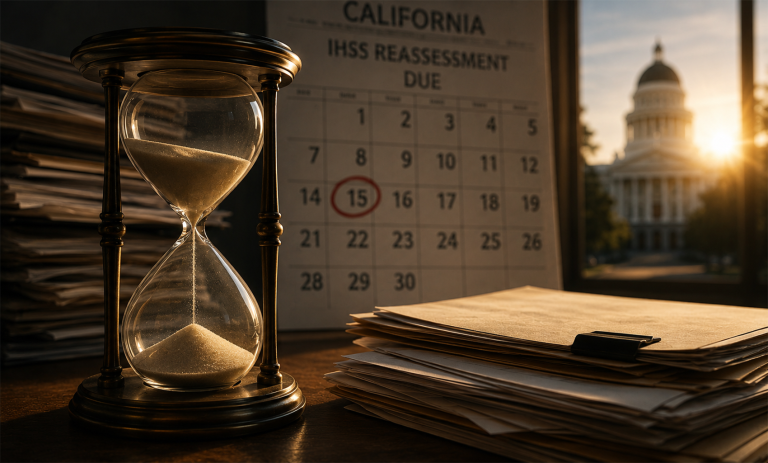
Counties now pay when IHSS reassessments run late
California has a new penalty for late CFCO reassessments. It's real — but it's money counties owe the state, not a fee you can collect. Here's what it is and what actually protects you.
You may have heard that California now penalizes counties that fall behind on IHSS reassessments. It is real, it is newly on the books, and it is worth understanding — but not for the reason some people hope. It is not a fee you can collect. Here is what the penalty actually is, where it is written, and what genuinely protects you when your reassessment runs late.
What the penalty is
Every IHSS recipient in the Community First Choice Option (CFCO) — the program most recipients are in — must be reassessed by the county at least once every 12 months. CFCO brings California extra federal money: the regular 50 percent federal match plus an enhanced 6 percent, for 56 percent total, authorized under Section 1915(k) of the Social Security Act. When a county misses a required CFCO reassessment deadline, those cases lose that extra 6 percent for the months they are out of compliance, and the state has to pay the federal government back. That repayment is the “CFCO late penalty.”
Every 12 mo.
How often counties must reassess CFCO recipients.
50% + 6%
Base federal match plus the enhanced CFCO match (56% total) that's at stake.
Lost 6%
What the state must repay the federal government when a reassessment is late.
Where it is written
The penalty lives in Welfare and Institutions Code Section 12306.16(d)(7), added by Assembly Bill 118, a 2025 budget trailer bill. The California Department of Social Services spelled out how it works in All County Letter 25-84 (November 20, 2025). For years, the cost of the lost federal money was absorbed by the state General Fund — about $63.2 million in 2023-24, according to the Legislative Analyst’s Office. The new law shifts it to counties: in fiscal year 2025-26 the state and county split it 50/50, and beginning July 1, 2026, the county pays 100 percent of the lost enhanced funding. ACL 25-84 also sets rules for who pays when a recipient moves between counties, giving the receiving county 30 days to complete the transfer.
Who pays the CFCO late penalty
- Through 2023-24State General Fund absorbs the lost federal money — about $63.2 million in 2023-24 (LAO).
- FY 2025-26State and county split the cost 50/50 (transition year).
- July 1, 2026 → ongoingCounty pays 100% of the lost enhanced funding, separate from its IHSS MOE.
The part people get wrong
This penalty is money a county owes the state — not a payment to you. There is no application, claim, or “penalty fee” a recipient can collect for a late reassessment. The purpose of the law is to give counties a strong financial reason to reassess on time, which should mean fewer delays for everyone. But if you are waiting on an overdue reassessment, the penalty itself does not put money in your pocket.
The myth
“If my county was late, I can claim the penalty fee.”
The fact
The penalty is money a county owes the state. There is no claim or fee a recipient can collect — but your services and appeal rights still protect you.
What actually protects you
The good news is that a late reassessment does not put your services at risk, and you have real tools:
What protects you when a reassessment is late
- Your services continue. A late county reassessment is not a reason to cut or stop your hours.
- Appeal fast if hours change. Request a state fair hearing — generally within 90 days of the notice date.
- Ask for Aid Paid Pending. Appeal before the change takes effect (usually within 10 days) to keep hours unchanged until the decision.
- You can request an earlier reassessment. If your needs change, you don't have to wait 12 months.
- Push on delays. Contact your social worker or county IHSS office; file a complaint if needed.
- Your services continue. A county’s failure to reassess on time is not a reason to cut or stop your hours. Your authorized services stay in place until the county completes a proper reassessment and sends you a valid Notice of Action.
- Appeal quickly if hours change. If you receive a Notice of Action reducing or ending your hours — especially a late one — request a state fair hearing. You generally have 90 days from the date on the notice.
- Ask for Aid Paid Pending. If you request a hearing before the change takes effect (usually within 10 days of the notice), your hours continue unchanged until the hearing decision. IHSS services are not treated as an overpayment, even if you lose.
- You don’t have to wait 12 months. If your needs change, you can ask your county for an earlier reassessment at any time.
- Push on delays. If your reassessment is overdue, contact your social worker or the county IHSS office, and file a complaint if needed. Disability Rights California offers free help at 1-800-776-5746.
The takeaway
The late-reassessment penalty is a real, recently enacted accountability measure — but it works behind the scenes, between counties and the state. For you as a recipient, the leverage is not the penalty; it is your right to keep your services during delays and to appeal any reduction. If a reassessment is dragging, use those rights.
Where this is written
- The statute
- Welfare & Institutions Code § 12306.16(d)(7), added by Assembly Bill 118 (2025 budget trailer bill).
- The guidance
- CDSS All County Letter 25-84 (Nov. 20, 2025) — penalty mechanics and inter-county transfer rules.
- The federal basis
- Social Security Act § 1915(k); 42 CFR § 441.590 (CFCO enhanced 6% federal match).
Reassessment overdue or hours cut?
Disability Rights California offers free help with IHSS delays, appeals, and Aid Paid Pending.
Call 1-800-776-5746