California’s In-Home Supportive Services (IHSS) program pays for caregivers to help eligible residents stay safely in their own homes. But when you’re new to the program — or helping a loved one navigate it — the question everyone asks first is: what exactly does IHSS cover?
Here’s the short answer: IHSS covers four main categories of care:
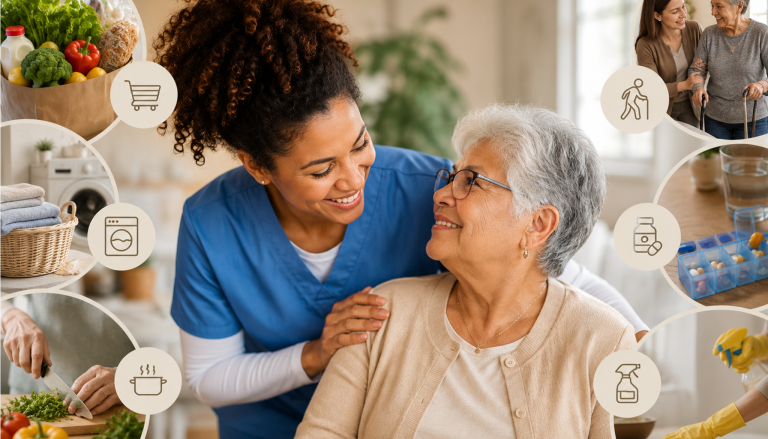
- Personal care services (bathing, dressing, grooming, eating)
- Domestic and related services (cleaning, laundry, meal preparation, shopping)
- Paramedical and specialized services (medications, catheter care, range-of-motion exercises)
- Protective Supervision (protecting an individual from unintentional self-harm)
The specific services you or your loved one receive — and how many hours are approved — depend on an individual needs assessment conducted by a county social worker. All recipients are assessed based on their own specific in-home care needs.
How IHSS Decides What Services You Receive
Before diving into the full list, it helps to understand how the program works. IHSS is administered county by county, but funded jointly by California state and federal Medi-Cal dollars. To qualify, you must:
- Be a California resident
- Be 65 or older, blind, or have a disability
- Be eligible for Medi-Cal (or be able to demonstrate financial need)
- Require assistance with at least one of the covered services to remain safely at home
Once you apply, a county social worker visits your home and conducts a needs assessment. The goal of the home visit is to evaluate your functional limitations in each service category and assign a number of monthly hours for each approved service. This total becomes your monthly “authorized hours” — the cap your caregiver can bill against.
The key point: your approved services are determined by your individual needs, not a fixed menu. Two people with the same diagnosis can receive very different hour authorizations based on their living situation, support network, and functional abilities.
Personal Care Services
Personal care services help recipients with the daily tasks of living that a disability or health condition makes difficult or impossible to do alone. These are typically the highest-hour category for recipients with significant physical needs.
| Service | What it includes |
|---|---|
| Bathing | Assistance with tub baths, showers, or bed baths |
| Oral hygiene | Brushing teeth, denture care, mouth rinsing |
| Grooming | Hair brushing and combing, shaving, nail care |
| Dressing | Putting on and removing clothing, including adaptive clothing |
| Feeding | Assisting with eating when the recipient cannot feed themselves |
| Bladder and bowel care | Assistance with toileting, incontinence care, catheter management |
| Ambulation | Helping with walking, transferring between bed and wheelchair, repositioning |
| Standby assistance | Being present to prevent falls during bathing, transfers, or other activities |
| Accompaniment | Accompanying the recipient to medical or other approved appointments |
| Rubbing and massaging | To prevent skin breakdown (e.g., for bedridden recipients) |
Important: Personal care hours are tied to the recipient’s documented functional limitations. If a condition worsens over time, you can request a reassessment to increase approved hours.
Domestic and Related Services
Domestic services are the category that surprises many people. IHSS doesn’t just cover hands-on personal care — it also covers help with the household tasks that keep a home safe and livable. These services are approved when the recipient is unable to perform them safely due to their disability or condition.
| Service | What it includes |
|---|---|
| House cleaning | Sweeping, mopping, vacuuming, cleaning bathrooms and kitchen |
| Laundry | Washing, drying, and folding clothing and bedding |
| Shopping | Grocery shopping and errands for essential household items |
| Meal preparation | Planning and cooking meals appropriate to dietary needs |
| Meal cleanup | Washing dishes, wiping counters, putting food away |
| Protective supervision | For recipients with cognitive impairments who cannot be left safely alone |
| Transportation | Travel to medical appointments or other approved activities (in some cases) |
A note on domestic hours: These services are approved only when the recipient is unable to perform them — not simply when they prefer assistance. If other capable adults live in the home, domestic hours may be reduced or denied, since IHSS is designed to cover needs that cannot be met otherwise.
Paramedical and Specialized Services
Paramedical services cover medically necessary tasks that a caregiver can perform under a physician’s direction. These are separate from medical treatment (which IHSS does not cover) — they are ongoing support tasks tied to a specific health condition.
| Service | What it includes |
|---|---|
| Medication management | Reminding recipients to take medications, assisting with self-administration and organization |
| Bowel and bladder programs | Catheter care, colostomy care, enemas as prescribed |
| Range-of-motion exercises | Prescribed physical exercises to maintain mobility |
| Wound care | Dressing changes for minor wounds under physician direction |
| Ventilator-dependent care | Assistance for recipients who use ventilators or other respiratory equipment |
| Feeding tube assistance | Supporting tube feeding as prescribed |
| Turning and repositioning | For recipients who cannot reposition themselves to prevent pressure sores |
These services require documentation from a licensed physician and are subject to separate authorization. A caregiver providing paramedical services is not required to be a licensed medical professional — but they must be trained and working within physician-approved protocols.
What IHSS Does NOT Cover
Understanding what IHSS doesn’t cover is just as important as knowing what it does — especially for family members coordinating care and setting realistic expectations.
- Skilled nursing or medical treatment. IHSS is a support program, not a medical one. A caregiver cannot administer injections, make medical decisions, or provide treatment that requires a nursing license.
- 24/7 supervision in most cases. IHSS hours are capped based on assessed need, not continuous care. Round-the-clock caregiving through IHSS is rare and typically only approved for recipients with the most complex needs.
- Yard work and home maintenance. Mowing lawns, fixing appliances, painting, or other home repair tasks are not covered, even if the recipient cannot do them.
- Pet care. Walking dogs, cleaning pet areas, or feeding animals is not an approved IHSS service.
- Childcare. IHSS is for the recipient’s needs, not for caring for their children or other household members.
- Shopping for non-essential items. IHSS-funded shopping time is for basic necessities only.
- Transportation for non-approved purposes. Rides to social events, errands unrelated to the recipient’s needs, or recreational outings are generally not covered.
- Services for other household members. Meal prep, cleaning, and care tasks performed for people other than the IHSS recipient are not reimbursable.
If your loved one needs services that fall outside this list, a social worker can help identify other programs — such as Medi-Cal Home and Community-Based Services (HCBS) waivers — that may fill the gap.
Can You Request Additional Services?
Yes — and many recipients don’t know this.
If you believe the needs assessment underestimated your hours or missed a service you need, you have the right to:
- Request a reassessment. Contact your county IHSS office and ask for a new in-home visit. This is appropriate when your condition has changed or your functional needs have increased.
- File an appeal (State Hearing). If your application was denied, or if a previously approved service was reduced or removed, you can request a State Fair Hearing through the California Department of Social Services. You must request the hearing within 90 days of the notice.
- Work with a patient advocate or social worker. Many counties have advocacy organizations that can help you prepare documentation and represent your needs during reassessments.
Don’t assume the first assessment is final. Reassessments and successful appeals are common — especially when new medical documentation is provided.
Frequently Asked Questions
Does IHSS cover transportation?
Transportation is covered in limited circumstances — primarily for accompanying the recipient to medical appointments or other approved activities. It is not a general transportation benefit and is not available for recreational or social trips.
Does IHSS cover medication management?
Yes. Medication management is a covered paramedical service. This typically includes reminding recipients to take their medications and assisting with self-administration (such as opening bottles). Caregivers cannot administer medications that require a nursing license, such as injections.
Can IHSS pay for overnight care?
IHSS can fund nighttime hours when a recipient’s assessed needs include assistance during the night — for example, for repositioning, toileting, or monitoring. However, IHSS does not automatically approve 24-hour or live-in care. This must be documented and approved through the needs assessment process.
What is the difference between IHSS and IHSS Plus?
IHSS Plus (also called IHSS Plus Option or IHSS-PLUS) is a variant available to certain recipients who live with their provider in a shared living arrangement. It may affect how hours are calculated and how the caregiver-recipient relationship works. Not all counties offer IHSS Plus, and eligibility requirements differ from standard IHSS.
Can a family member be my IHSS caregiver?
Yes. IHSS allows most family members — including parents, siblings, adult children, and spouses in some cases — to be paid as the recipient’s caregiver. There are specific rules around spousal provider relationships and parent/minor child situations. See our full guide on getting paid as a family caregiver through IHSS for details.
How many hours does IHSS provide?
There is no fixed number. Hours are determined by the needs assessment and can range from a few hours per week for recipients with minimal needs to well over 200 hours per month for those with complex, round-the-clock support requirements. The max amount of hours a recipient can receive is currently 283 hours per month.
What happens if I need more hours than I’ve been approved for?
You can request a reassessment at any time. If your condition has changed or new medical documentation supports additional need, the county can revise your authorized hours. You also have the right to appeal any reduction or denial through the State Fair Hearing process.
Finding a Caregiver Who Understands Your IHSS Services
Once you know what IHSS covers, the next step is finding a caregiver who has experience providing those specific services in your county.
IHSSConnect, available in 12 languages, is California’s only statewide platform built specifically for connecting IHSS recipients with qualified caregivers. Unlike county-by-county registries (or the absence of one in many counties), IHSS Connect lets you search across all 58 California counties, filter by the specific services you need, and connect directly with caregivers who understand the IHSS program.
Search for an IHSS caregiver near you →
This article is intended for general informational purposes. IHSS policies are subject to change and may vary by county. Always verify current guidelines with your county IHSS office or the California Department of Social Services (CDSS).
IHSS Services Cheat Sheet
| Category | Service | What it covers |
|---|---|---|
| Personal care | Bathing | Assistance with tub baths, showers, or bed baths |
| Personal care | Oral hygiene | Brushing teeth, denture care, mouth rinsing |
| Personal care | Grooming | Hair brushing and combing, shaving, nail care |
| Personal care | Dressing | Putting on and removing clothing, including adaptive clothing |
| Personal care | Feeding | Assisting with eating when the recipient cannot feed themselves |
| Personal care | Bladder & bowel care | Assistance with toileting, incontinence care, catheter management |
| Personal care | Ambulation | Helping with walking, transferring between bed and wheelchair, repositioning |
| Personal care | Standby assistance | Being present to prevent falls during bathing, transfers, or other activities |
| Personal care | Accompaniment | Accompanying the recipient to medical or other approved appointments |
| Personal care | Rubbing & massaging | Preventing skin breakdown for bedridden recipients |
| Domestic | House cleaning | Sweeping, mopping, vacuuming, cleaning bathrooms and kitchen |
| Domestic | Laundry | Washing, drying, and folding clothing and bedding |
| Domestic | Shopping & errands | Grocery shopping and errands for essential household items |
| Domestic | Meal preparation | Planning and cooking meals appropriate to the recipient’s dietary needs |
| Domestic | Meal cleanup | Washing dishes, wiping counters, putting food away after meals |
| Domestic | Protective supervision | Ongoing supervision for recipients with cognitive impairments who cannot be left safely alone |
| Domestic | Transportation | Travel to medical appointments or other approved activities (case-by-case approval) |
| Paramedical | Medication management | Reminding recipients to take medications; assisting with self-administration such as opening bottles |
| Paramedical | Bowel & bladder programs | Catheter care, colostomy care, enemas as prescribed by a physician |
| Paramedical | Range-of-motion exercises | Prescribed physical exercises to maintain or improve mobility |
| Paramedical | Wound care | Dressing changes for minor wounds under physician direction |
| Paramedical | Ventilator-dependent care | Assistance for recipients who use ventilators or other respiratory equipment |
| Paramedical | Feeding tube assistance | Supporting tube feeding as prescribed by a licensed physician |
| Paramedical | Turning & repositioning | Repositioning recipients who cannot move independently, to prevent pressure sores |
24 approved services across 3 categories. Paramedical services require physician documentation and separate authorization. Services and hours are assigned individually based on a county needs assessment.