If you’ve started the process of applying for IHSS Protective Supervision (PS) for your child, there’s a good chance you’ve already heard about the “SOC 821.” And if you’re like most parents, your first reaction was probably: What is that—and why does everyone keep mentioning it?
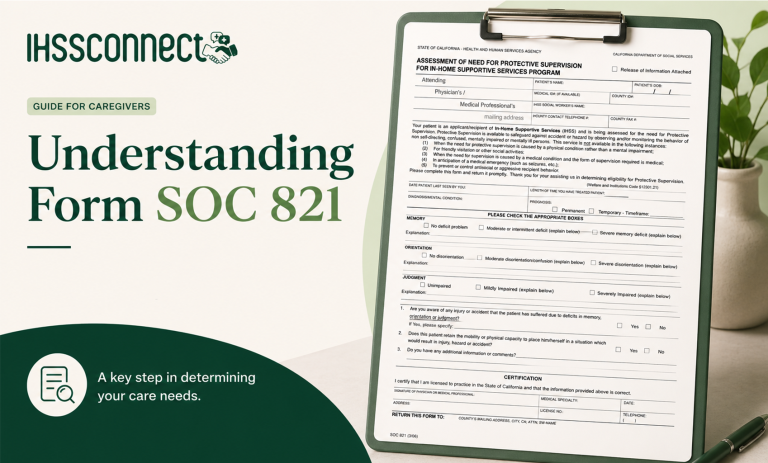
The SOC 821 is one of the most important forms in the entire Protective Supervision process. It’s officially called the “Assessment of Need for Protective Supervision”, and it’s completed by a licensed medical professional who can speak to your child’s cognitive functioning and safety awareness. But here’s the part many families don’t realize right away: while the SOC 821 is critical, it is not the only thing that determines whether your child qualifies.
Think of it as a cornerstone—not the entire foundation.
What the SOC 821 Actually Does
The SOC 821 is designed to help the county understand whether your child has impairments in areas like memory, orientation, and judgment, and whether those impairments create a real risk of harm if they are not supervised.
Protective Supervision is not about general caregiving. It’s specifically about whether a child requires 24-hour supervision to prevent injury due to cognitive limitations. That’s a high standard, and the SOC 821 is one of the main tools used to evaluate it.
When completed correctly, the form gives a medical perspective on something parents often live with every day: unpredictable and potentially dangerous behaviors that stem from a child’s inability to understand risk.
Who Completes the SOC 821?

This form must be completed by a licensed medical professional—typically a physician, psychologist, or another qualified clinician familiar with your child’s condition.
But here’s where many families run into problems: doctors are often busy, and unless you clearly communicate what’s going on at home, they may not fully understand the level of supervision your child actually needs.
That means your role is incredibly important.
You need to provide real, concrete examples of your child’s behavior—especially behaviors that show a lack of awareness of danger. This could include self-injury, wandering, impulsive actions, or anything that puts your child at risk without constant supervision. The more clearly you paint that picture, the better the doctor can accurately reflect it on the form.
What Makes a Strong SOC 821?
A properly completed SOC 821 should do more than just check boxes. Yes, the sections for memory, orientation, and judgment matter—but what really strengthens the form is how those boxes are supported.
If a doctor indicates impairment, they should include brief but meaningful explanations that connect directly to your child’s real-life behaviors. These explanations don’t need to be long, but they do need to make sense and align with what Protective Supervision is actually looking for.
For example, simply stating that a child has “poor judgment” isn’t enough. But explaining that the child engages in self-injurious behavior when dysregulated, or lacks awareness of environmental dangers, begins to meet the standard.
It’s also important that everything on the form is relevant to Protective Supervision eligibility. Not all challenges qualify. The focus needs to stay on behaviors that are unpredictable and dangerous, not just difficult or inconvenient.
And of course, the form must be signed, dated, and include the provider’s medical license number. Without that, it’s not considered valid.
How the SOC 821 Fits Into the Bigger Picture
Here’s where a lot of cases either come together—or fall apart.
Even a perfectly completed SOC 821 is not enough on its own to secure Protective Supervision. The county is required, understandably, to look at the totality of evidence, which includes:
- Parent testimony
- Social worker observations
- Medical records
- IEPs, IPPs, or other reports
- Behavioral documentation
And here’s the thing—everything needs to tell the same story.
If the SOC 821 says your child has severe impairments in judgment, but school reports describe them as largely independent and safe, that inconsistency can create problems. On the other hand, when all documentation aligns—when the doctor, the parents, and the records are all describing the same level of need—it becomes much harder for the county to deny services.
And if you need to appeal it, this is where consistency will pay off as judges appreciate not having to dig too deep for the truth.
Getting the Form Where It Needs to Go
Once the SOC 821 is completed, it should be submitted directly to your IHSS social worker. This ensures it becomes part of the official case file and is considered during the assessment.
Delays or miscommunication at this stage can slow down your case, so it’s always a good idea to confirm that the form was received and added to your file. Keep in mind counties vary on how they accept files—some accept emails while others must be sent the old fashioned way—via fax or mail. Of course, you can always drop off documents in person, too.
Approval Starts Here
The SOC 821 is not just another piece of paperwork—it’s a key voice in your child’s case. When done right, it helps translate your daily reality into a format the system understands.
But it works best when it’s part of a consistent, well-documented story about your child’s needs.
Take the time to prepare your doctor. Be clear about behaviors. Make sure what’s written reflects real risks, not just general challenges. And always remember: this form supports your case—but it doesn’t replace the importance of your voice and your child’s full story.