
IHSS for children California is the same program for minors as it is for adults — but there are important additional standards and exceptions that apply specifically when the recipient is a child. Most published guides ignore this entirely.
IHSS for Children: What Parents Need to Know
Can My Child Qualify for IHSS?
Yes. IHSS has no age minimum. Children with disabilities can qualify, but the assessment standards differ from adult cases in meaningful ways.
To be eligible, a child must:
- Be a California resident receiving Medi-Cal
- Have a physical, mental, or developmental disability that limits their ability to carry out certain daily activities without assistance
- Be assessed by their county IHSS social worker as needing in-home supportive services
Many families with disabled children are also connected to a Regional Center through the Department of Developmental Services. These programs serve different functions and can be used simultaneously — they do not cancel each other out. However, they can interact in ways that affect your authorized hours, so understanding both is important.
What Tasks Does IHSS Cover for a Minor?
Authorized tasks for minor recipients include the same core categories as adults: personal care (bathing, grooming, dressing, feeding), domestic services (meal preparation, laundry, cleaning), paramedical services, and accompaniment to medical appointments. Protective Supervision is also available for minors who are mentally impaired and whose behavior creates a risk of injury to themselves.
The critical distinction for minors is the parental responsibility standard. The county assesses how much care your child requires beyond what a parent would typically provide to a non-disabled child of the same age. Only that excess is eligible for authorization. This is not a denial of services — it is the legal framework used to determine the starting point for the assessment.
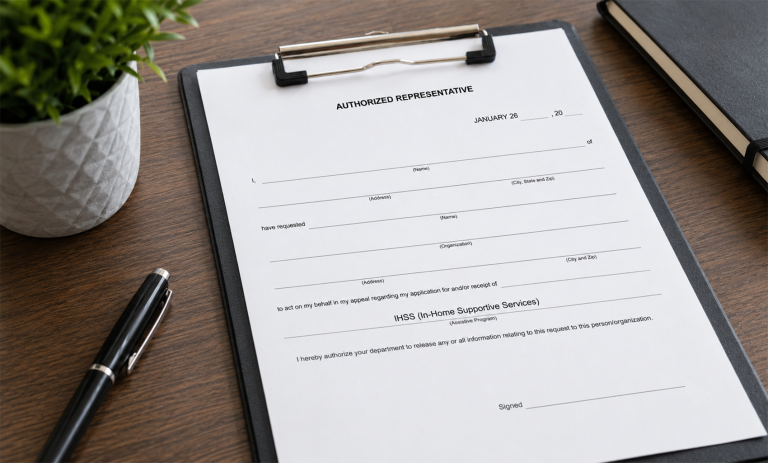
The county social worker will apply the parental responsibility standard during the assessment, which means the final authorized hours reflect the additional burden of your child's disability — not the total care you provide. Parents often receive a Notice of Action with fewer hours than anticipated for this reason. If you believe the assessment does not accurately reflect your child's functional limitations, you have the right to appeal.
The School-Hours Exclusion
IHSS hours cannot be authorized for time when your child is at school. During school hours, the school district — through your child’s IEP and any assigned school aide — is considered the responsible party for support and supervision.
In practice, this means:
- The assessment is conducted assuming typical school attendance during the day
- IHSS-eligible time generally covers morning preparation before school, after-school hours, evenings, nights, and weekends
- During summer, school breaks, or extended absences from school, you may be eligible for additional hours — contact your social worker to discuss how those periods are handled
How IHSS Hours Interact With a Child's Daily Schedule
A typical weekday — where IHSS can and cannot apply
6–8 am
8am–3pm
3–6 pm
6pm–6am
Regional Center Services and IHSS: What to Know
If your child receives Regional Center services, the two programs can run concurrently — they serve different functions and one does not replace the other. Regional Center typically funds therapies, day programs, and community supports. IHSS covers in-home personal care and daily living assistance.
The practical concern is duplication. If the same need is being addressed by both programs simultaneously, the county may factor that into the IHSS assessment. The best protection against this is documentation.
Your child's Individual Program Plan (IPP) from the Regional Center should clearly document their disabilities, functional limitations, and what services are being provided and why. A well-documented IPP is one of the strongest tools you have when the county assesses IHSS eligibility and hours.
Always be present when any professionals are discussing your child's needs or care — whether between the county, the Regional Center, or anyone else. Never allow two providers to reach conclusions about your child without you present. You control the narrative.
Can a Parent Be the Paid IHSS Provider?
As of February 19, 2024, yes — without restriction. California law was changed to remove the previous limitations on parents serving as paid IHSS providers for their minor children.
Under the old rules, a parent could only be paid if no other suitable provider was available and the parent was prevented from full-time employment due to the child’s care needs. Those restrictions no longer exist.
- A parent can now be paid as the IHSS provider for their minor child regardless of employment status
- A second parent in the home is no longer required to work full-time as a condition of the first parent becoming a provider
- Two parents may now divide authorized hours between them
- Families affected by the previous immigration status restrictions should contact their county IHSS office — changes to program enrollment may be needed, and families should confirm in advance that switching programs will not affect the child's authorized hours
- Standard provider enrollment requirements still apply: eligibility to work in the United States, background check, fingerprinting (LiveScan), and provider orientation
Quick Reference: IHSS Rules for Minors
| Topic | How it applies to minor recipients |
|---|---|
| Eligibility | Must have Medi-Cal, a qualifying disability, and a need for in-home support beyond typical parental care for a child of the same age |
| Parental responsibility standard | Hours are assessed based on the additional burden of the child's disability — not the total care provided |
| School-hours exclusion | IHSS cannot be authorized during school hours; the school district and IEP are responsible during that window |
| Parent as paid provider | Permitted without restriction as of February 19, 2024; standard enrollment requirements still apply |
| Regional Center coordination | Programs can run concurrently; ensure the IPP clearly documents the child's needs and funded services to prevent assessment conflicts |
| Protective Supervision | Available for minors with mental impairments whose behavior poses a risk of injury; governed by its own eligibility rules |
| Summer and school breaks | Additional hours may be available when school is not in session; discuss with your social worker |
Your Right to Appeal — and the Deadlines That Matter
When you receive a Notice of Action (NOA) reducing, denying, or discontinuing IHSS services, you have the right to request a State Fair Hearing. There are two deadlines you need to know, and they operate independently:
You have 90 days from the date on the NOA to request a State Fair Hearing. If you miss this window, you generally lose the right to challenge that decision — do not wait.
If you appeal within 10 days of the NOA date — and before the reduction takes effect — you can request "aid paid pending," which means your current hours continue unchanged while the hearing is pending. If you miss this window, your hours may drop while you wait for a decision.
Aid paid pending is one of the most important protections available to IHSS recipients. If granted, your services continue at their current authorized level until the hearing officer issues a final decision — regardless of how long the process takes. Even if you ultimately lose the hearing, you are not required to repay the hours received during the appeal period. File early. The 10-day window moves fast.
Protective Supervision cases involving minor recipients can be among the most complex to appeal, as eligibility turns on specific clinical and behavioral criteria that counties frequently apply inconsistently. If your child's Protective Supervision has been denied or reduced and you are preparing to appeal, California Advocacy Group has experience in this specific area and may be a useful resource as you build your case.
Looking for a Caregiver for Your Child?
IHSS Connect is California's statewide caregiver matching platform — search by county, specialty, language, and availability. No fragmented county registry. One place for the whole state.
Find a Caregiver →