
One of the most powerful — and often misunderstood — pathways to coverage in California is something called Institutional Deeming. For families who are over the income limits for Medi-Cal, this program can be the difference between going without services and unlocking comprehensive, life-changing care.
At its core, Institutional Deeming allows a child with significant disabilities to qualify for full-scope Medi-Cal based on the child’s needs alone — not the parents’ income.
Why Institutional Deeming Matters
The biggest advantage of Institutional Deeming is access to full-scope Medi-Cal, which includes:
- Medical and specialist care
- Dental and vision services
- Durable medical equipment (DME)
- Therapies (speech, occupational, physical, behavioral)
- In-home nursing and supports
- And critically, services under Early and Periodic Screening, Diagnostic and Treatment (EPSDT), which can fund medically necessary services even beyond standard limits
In many cases, children who qualify may also become eligible for In-Home Supportive Services (IHSS), which can provide paid in-home care and supervision. IHSS can work alongside — not replace — services provided by your Regional Center.
What Is Institutional Deeming?
Institutional Deeming is part of California’s Medicaid waiver system (often tied to Regional Center services). It allows the state to “deem” a child as if they were living in an institution for eligibility purposes — even though they live at home.
That technical distinction is what allows Medi-Cal to ignore parental income.
Basic Eligibility Requirements
To be considered for Institutional Deeming, your child generally must:
- Be under the age of 18
- Have a qualifying developmental disability diagnosed by a licensed professional
- Have a valid Social Security number (or be in the process of obtaining one)
- Live at home with a parent or guardian
- Be ineligible for Medi-Cal due to parental income
- Be a client of a California Regional Center
- Demonstrate significant functional limitations or medical needs
- Receive at least one Regional Center service and use it at least once per year
About “Functional Limitations”
Regional Centers look at substantial limitations in areas such as:
- Self-care and daily living skills
- Mobility and motor functioning
- Communication
- Behavior and safety awareness
- Medical fragility or complex health needs
If your child requires a level of care that would otherwise qualify them for institutional placement (even hypothetically), that strengthens eligibility.
How the Application Process Works
The process is coordinated through your Regional Center and your county’s Medi-Cal office (often called DPSS in Los Angeles County).
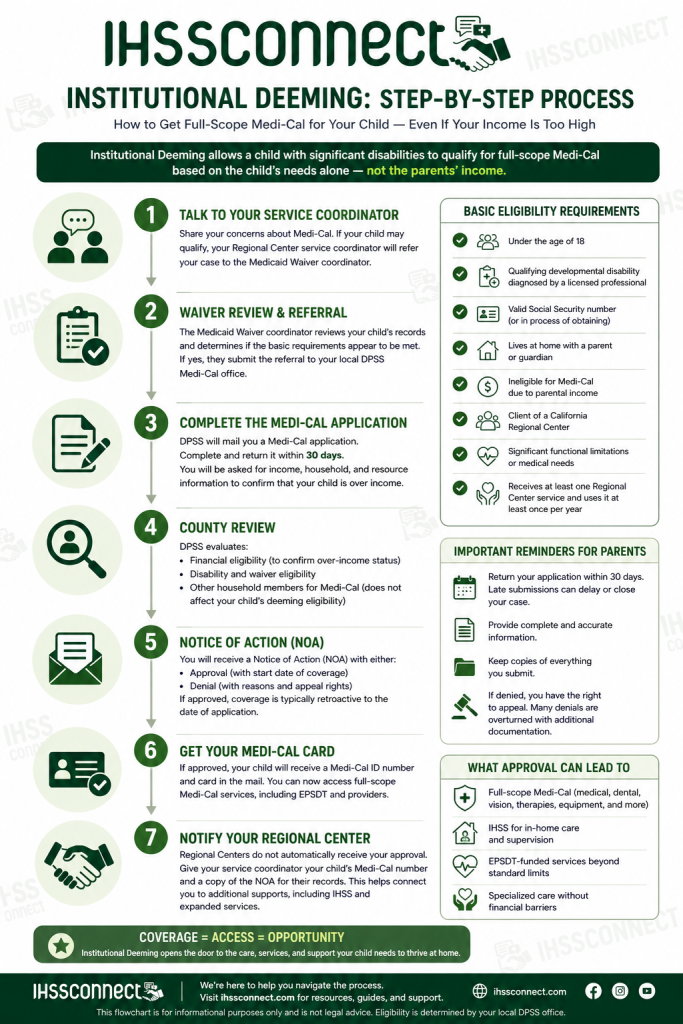
Step 1: Talk to Your Service Coordinator
Your Regional Center service coordinator is the starting point. If they believe your child may qualify, they will refer your case to the waiver or Medicaid coordinator.
Step 2: Waiver Review and Referral
The Medicaid Waiver coordinator reviews your child’s records and submits the referral to your local Department of Public Social Services (DPSS) or equivalent county office.
Step 3: Complete the Medi-Cal Application
You will receive a Medi-Cal application. This must be completed and returned within 30 days.
Important:
Even though Institutional Deeming is designed for over-income families, you will still be asked to provide full financial information. This is intentional — the county must confirm that your child does not qualify under traditional income rules.
Step 4: County Review
DPSS will:
- Evaluate financial eligibility (to confirm over-income status)
- Review disability and waiver eligibility
- Screen other household members for Medi-Cal (this does not affect your child’s deeming eligibility)
Step 5: Notice of Action (NOA)
You will receive a Notice of Action (NOA) with either:
- Approval (including start date of coverage), or
- Denial (with reasons and appeal rights)
If approved, Medi-Cal coverage is typically retroactive to the date of application.
What Happens After Approval
Once approved:
- Your child will receive a Medi-Cal ID number and card
- Coverage begins (often retroactively)
- You can immediately begin accessing services and providers
Important: Notify Your Regional Center
Regional Centers do not automatically receive your approval.
You should:
- Inform your service coordinator right away
- Provide your child’s Medi-Cal number
- Share a copy of the NOA for their records
This step is critical — many services (including IHSS coordination and additional funding supports) depend on confirmed Medi-Cal eligibility.
Common Mistakes Parents Make
Here are some of the biggest pitfalls — and how to avoid them:
1. Waiting to be told about the program
Many families qualify but are never informed. If your child is over income, ask directly about Institutional Deeming.
2. Missing the 30-day deadline
If you don’t return the application on time, your case may be closed and you’ll have to restart.
3. Under-documenting your child’s needs
Eligibility is not just about diagnosis — it’s about level of care required. Make sure your child’s IPP, medical records, and evaluations clearly reflect:
- Safety concerns
- Need for supervision
- Medical complexity
- Functional limitations
4. Not aligning documentation
Your Regional Center records, medical reports, and (if applicable) school IEP should tell a consistent story. Misalignment can slow or derail approval.
5. Not appealing a denial
If denied, you have the right to appeal. Many denials are overturned when additional documentation is provided.
How Institutional Deeming Fits Into the Bigger Picture
Institutional Deeming is often the gateway that unlocks a broader system of support. Once approved, families can more effectively access:
- Regional Center services (expanded through Medi-Cal funding)
- IHSS for in-home care and supervision
- EPSDT-funded therapies and equipment
- Specialized medical care without financial barriers
For many families, this is the moment where care becomes sustainable.
Institutional Deeming isn’t just a technical eligibility pathway — it’s a critical tool that allows children with significant needs to remain safely at home while receiving the level of care they truly require.
If your child is being denied Medi-Cal due to income, this is one of the most important programs you can explore.