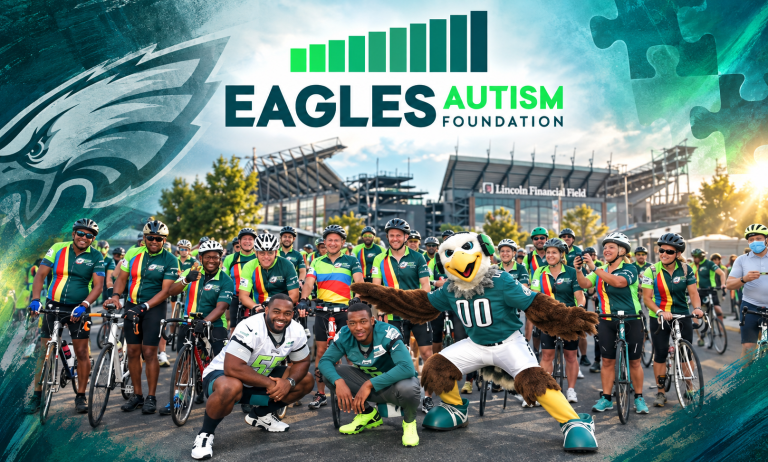
The Philadelphia Eagles are best known for football. Off the field, team owner Jeffrey Lurie and the team’s charity, the Eagles Autism Foundation, have spent years raising money for autism research and care, adding sensory supports at Lincoln Financial Field, and holding a bike ride, 5K, and sensory walk each May. The Foundation reports more than $56 million raised since 2018.
IHSS Connect was not paid to write this article, and it isn’t an endorsement of any sponsor or product. We’re covering it because much of it is useful well beyond Philadelphia: a working example of a sensory-inclusive stadium, research funding that has reached California institutions, and a fundraising event you can join from anywhere. Where something is Philadelphia-only, or where we couldn’t confirm a detail, we say so.
At a glance
- Raised since 2018More than $56 million (Foundation, May 2026)
- Latest Challenge · May 9, 2026$16 million+ announced on event day · 6,832 participants
- Grants announced Feb. 25, 2026$10.8 million for 54 projects (20 research, 34 community)
- Lurie family gift · June 2025$50 million to launch the Lurie Autism Institute
- At the stadiumKultureCity-certified sensory-inclusive; 500-sq-ft sensory room
- Next ChallengeSaturday, May 8, 2027 · starts and ends at Lincoln Financial Field
- The rideWawa Hoagie 10-Mile Ride · $150 registration · $500 fundraising minimum (ages 18+) or $350 (ages 13–17)
Figures are as announced by the Eagles and the Foundation. Verified September 20, 2026.
Who is behind it
Jeffrey Lurie is Chairman and CEO of the Philadelphia Eagles and the founder of the Eagles Autism Foundation. The Challenge’s website says autism is personal for him: there is autism in his own family. His family’s work also predates the team’s. According to Children’s Hospital of Philadelphia (CHOP) and CBS Philadelphia, his mother, Nancy Lurie Marks, founded the Nancy Lurie Marks Family Foundation in 1977 to help autistic people lead fulfilling lives.
The first Eagles Autism Challenge took place in May 2018. In June 2026, Lurie was named the recipient of the Stuart Scott ENSPIRE Award, which honors people who use sports to help the disadvantaged, for his work supporting the autism community.
The money: what has been raised
The Eagles Autism Challenge is the Foundation’s signature fundraiser. At the ninth Challenge, on May 9, 2026, the Foundation announced more than $16 million raised on event day, from 6,832 participants and nearly 40,000 donations. Fundraising stayed open through May 31, 2026. Since the first Challenge in 2018, the Foundation reports more than $56 million raised.
What each Challenge announced, and what was awarded next
| Challenge | Event-day total announced | Participants | Grants announced the next winter |
|---|---|---|---|
| 2024 7th Challenge · May 18, 2024 | $8.1 million+ | Nearly 6,000 | $8.1 million for 53 projects (January 2025) |
| 2025 8th Challenge · May 17, 2025 | $10 million+ | 7,266 | $10.8 million for 54 projects (February 2026) |
| 2026 9th Challenge · May 9, 2026 | $16 million+ | 6,832 | Not yet announced |
Fundraising stayed open until May 31 each year, so final totals may be higher. The Foundation says the February 2026 grants also drew on other fundraising during the year.
Flag: how to read the numbers
Every total in this article is what the Eagles or the Foundation announced, on the date shown. We did not add figures from different announcements together.
- Timing. Event-day totals were announced before fundraising closed on May 31. We could not find a final 2026 Challenge total.
- Raised is not the same as awarded. The $10.8 million announced on February 25, 2026 came from 2025 Challenge proceeds plus other Foundation fundraising. The 2026 money has not yet been announced as awarded; the last two grant rounds were announced in January and February of the following year.
- Running totals differ by release. The Foundation cited $50 million raised in February 2026 and $56 million in May 2026. One announcement counts from 2017; most count from 2018.
- A separate gift. The Lurie family’s $50 million gift is reported separately from the Foundation’s totals. We did not combine them.
The Foundation says 100% of participant-raised funds go to autism research and care programs.
Worth knowing: what “100%” covers
The Foundation says 100% of participant-raised funds go to autism research and care programs. That covers the money participants and their supporters raise toward the fundraising minimum.
- The registration fee is separate. It is non-refundable and non-deductible, and it does not count toward your minimum. The Challenge site does not say what it pays for.
- Taxes. The site says contributions may be tax deductible under IRC §170(c). Ask a tax professional about your own situation.
- Checking the charity. The Challenge site lists the organization’s EIN (81-5290310) and a Pennsylvania Department of State number (1-800-732-0999) for registration and financial information.
The Challenge isn’t the only source. The 2026 Eagles Radiothon, an auction of Eagles experiences and autographed items on SportsRadio 94WIP that ended September 3, raised a record $685,000 and counting, according to the Eagles.
A separate $50 million gift
In June 2025, a $50 million gift from the Lurie family launched the Lurie Autism Institute, a joint initiative of CHOP and Penn Medicine. CHOP calls it the largest single donation to academic medicine in the U.S. focused on autism research across the lifespan. The Institute says it will study, among other things, autism-related genes and their potential as treatment targets, how autism affects the brain across a person’s life, and why some autistic people speak very little. That gift is reported separately from the Foundation’s fundraising totals above.
What the research money funds
Each year the Foundation runs a competitive review. For its 2025 round it received 267 letters of intent, the most in a single year, and narrowed them to 52 full proposals. An independent panel of scientists reviewed them, led by Dr. Emanuel DiCicco-Bloom of Rutgers Robert Wood Johnson Medical School, with 23 other researchers. The result, announced February 25, 2026: $10.8 million for 54 projects. That is 20 research awards (13 pilot grants, four postdoctoral fellowships, and three three-year translational grants) and 34 community grants. Since 2018, the Foundation says it has invested more than $40 million in 223 research projects and community grants.
Projects on the Foundation’s 2025 list range widely. Examples, described from the Foundation’s own project titles:
- Children’s Hospital Los Angeles: biomarker research on depression and anxiety risk in autistic youth who also have intellectual disability.
- Children’s National: a randomized trial of single-session interventions for depression in autistic youth.
- University of Pennsylvania (postdoctoral fellowship): how community-based interventions affect the risk of hospitalization in autism.
- University of Iowa: comparing live and delayed telehealth delivery of behavioral support.
- University of Wisconsin–Madison: a translational project developing CRISPR-based gene correction.
Several California institutions have received Foundation research grants. The most recent round, announced in February 2026, included Children’s Hospital Los Angeles, Stanford University, and the University of California, San Francisco. The round announced in February 2024 included UC Davis and UCLA.
The Foundation’s community grants ($5,000 to $25,000) pay for local services. Examples from the 2025 list:
- A Step Up Academy: a student-run thrift store where transition-age autistic students practice job skills.
- No Limits Café: a paid, 10-week job-training program for adults with intellectual disabilities, including autistic adults.
- Christopher’s Hospital for Children: sensory carts and de-escalation tools for hospital units, plus training for providers.
- Elwyn: real-time translation earbuds so early-learning staff and families who speak different languages can talk day to day.
These grants go only to registered nonprofits in the Philadelphia area, so California organizations can’t apply. The Foundation’s research grants (pilot and translational) are open worldwide.
Autism research priorities are a fair thing to ask about. The federal Interagency Autism Coordinating Committee (IACC) has called for more research funding on adult life (including employment, housing, and health care), on evidence-based services, and on disparities. The Foundation’s portfolio includes both kinds of work: lab studies of genes and brain circuits next to research on mental health and hospital use, and community programs on jobs, language access, and sensory supports. These are research and community projects, not treatments you can get today.
At Lincoln Financial Field
The Eagles say game days can be hard for people with sensory sensitivities: loud music, lasers, and fireworks, and a no re-entry rule, which means guests who step out can’t come back in. The sensory room lets guests take a break and rejoin the game. Here is what the stadium has done.
A sensory room, open at every event
The 500-square-foot sensory room opened in August 2019. It is presented by CHOP and open to all guests at all stadium events. You’ll find it on the West Lower Suite level, through the elevators behind sections 105 and 205. The Eagles and KultureCity refreshed it in September 2023 with bean bags, light panels, activity panels, bubble walls, interactive light furniture, and tactile artwork made by an autistic artist. The Eagles say people with dementia, PTSD, anxiety, and similar conditions use it too. WHYY reported in 2019 that the Eagles were the first NFL team to create a fully dedicated sensory room inside its stadium; the Vikings and Jaguars opened similar rooms the following month.
Sensory bags, visual schedules, and trained staff
Lincoln Financial Field is certified sensory-inclusive through KultureCity, a nonprofit that certifies venues. When the program launched in 2019, about 700 game-day and full-time employees were trained to recognize sensory overload and respond to it. Guests can get a sensory bag at Fan Services. At launch, the bags held noise-canceling headphones, fidget tools, verbal cue cards, and weighted lap pads. Before an event, families can use a visual schedule the Foundation publishes, and the KultureCity app includes an interactive “social story” that previews the stadium experience.
Restrooms with adult changing tables
In May 2026, the Foundation announced it had finished upgrading three Lower Suites restrooms near the sensory room, working with the hygiene brand Tork. They now have adult changing tables, higher stall and urinal dividers for privacy, warm lighting, soothing music from a sound system controlled inside the sensory room, and odor control. The design drew on a survey of more than 70 members of the Foundation’s community. Two limits to keep in mind: it is three restrooms in one part of the stadium, and Tork is a commercial partner.
Before game day at Lincoln Financial Field
- 1
Download the KultureCity appIt includes an interactive “social story” that previews the stadium experience.
- 2
Find the visual scheduleThe Foundation posts a visual schedule for events so you know what to expect. Look on the Eagles Autism Foundation page.
- 3
Ask for a sensory bagSensory bags are available at Fan Services. Ask what is in stock (see the Flag in the bike ride section below).
- 4
Locate the sensory roomWest Lower Suite level, through the elevators behind sections 105 and 205. Open to all guests at all stadium events.
- 5
Use the upgraded restroomsThree restrooms near the sensory room have adult changing tables, higher dividers, warm lighting, and soothing music.
- 6
Plan breaks around no re-entryThe stadium does not allow re-entry, so the sensory room is the place to reset and come back.
The bike ride, and other ways to take part
The Challenge is a one-day event that starts and ends at Lincoln Financial Field. The 10th annual Challenge is Saturday, May 8, 2027, and registration is open at EaglesAutismChallenge.org. Registration for the ride, 5K, and Sensory Walk includes access to a Friday kick-off party and a Saturday finish-line celebration at Lincoln Financial Field, with food and drink both days.
The Wawa Hoagie 10-Mile Ride
Riders start at Lincoln Financial Field, ride through South Philadelphia to the Benjamin Franklin Parkway, circle Eakins Oval past the Philadelphia Museum of Art, and return to the stadium. The Foundation says the course uses a full road closure with increased police presence. The ride starts at 8:00 a.m. (times are subject to change). Riders 13 to 17 and adults 18 and up can register; children under 13 can’t ride. Helmets are required. Headphones, electric or motorized bikes, baskets, and side attachments are not allowed. There are rest stops and support (SAG) vehicles on the course, and a limited number of rental bikes are available through Fairmount Bicycles. Registration includes a cycling jersey, finisher’s medal, and gift bag.
Prefer to walk, or can’t be in Philadelphia?
The FreedomPay 5K Run/Walk starts at 8:30 a.m., and headphones are allowed. The West Sensory Walk starts at 9:00 a.m. It is a shorter, sensory-friendly alternative to the 5K, with reduced noise levels and multiple rest stops, and it finishes on the field. Children 3 to 12 can join the 5K or the Sensory Walk with a registered adult for a $25 fee and no fundraising minimum; children under 3 are free. Virtual participants can take part from wherever they are and fundraise the same way.
Four ways to take part in the May 8, 2027 Challenge
Wawa Hoagie 10-Mile Ride
Starts 8:00 a.m. · ages 13 and up
- Registration fee
- $150
- Fundraising minimum
- $500 (18+) · $350 (13–17)
- Registration includes
- Cycling jersey, finisher’s medal, gift bag, food and drink
Helmet required. No headphones, electric or motorized bikes, baskets, or side attachments. Children under 13 can’t ride.
FreedomPay 5K Run/Walk
Starts 8:30 a.m. · all ages
- Registration fee
- $50 (13+) · $25 (ages 3–12)
- Fundraising minimum
- $350 (18+) · $250 (13–17) · none for ages 3–12
- Registration includes
- T-shirt, finisher’s medal, gift bag, food and drink
Headphones are allowed. Children 3 to 12 join with a registered adult; under 3 is free.
West Sensory Walk
Starts 9:00 a.m. · all ages
- Registration fee
- $50 (13+) · $25 (ages 3–12)
- Fundraising minimum
- $350 (18+) · $250 (13–17) · none for ages 3–12
- Registration includes
- T-shirt, finisher’s medal, gift bag, food and drink
Shorter than the 5K, with reduced noise levels and multiple rest stops. Finishes on the field.
Virtual participant
From wherever you are
- Registration fee
- $25
- Fundraising minimum
- $350
- Registration includes
- See the Flag below: the Foundation’s pages differ
You fundraise the same way. Ask the Challenge what virtual registrants receive before you sign up.
Start times are subject to change. Confirm at EaglesAutismChallenge.org. Verified September 20, 2026.
What it costs
Two amounts apply. The registration fee is non-refundable and non-deductible, and it doesn’t count toward your minimum. The fundraising minimum is the amount you commit to raise. Ride: $150 fee, and a $500 minimum for adults or $350 for ages 13 to 17. 5K and Sensory Walk: $50 fee, and $350 for adults or $250 for ages 13 to 17. Virtual: $25 fee and a $350 minimum. Children 3 to 12 can join the 5K or Sensory Walk with a registered adult for $25 and no minimum.
Warning: registering commits you to a fundraising minimum
When you register, you agree to raise the minimum for your event. Your credit card stays on file. If you have not reached the minimum by May 31, 2027, the Foundation can charge the remaining balance on or after June 1, 2027.
- Registration fee. It is separate and non-refundable.
- No transfers. Registration can’t be given to someone else, even because of illness or injury.
- Deadlines. To cancel or change your participation, act before March 12, 2027 (5:00 p.m.). To switch events, email by April 1, 2027.
- Team pages. Team donations don’t count toward your personal minimum unless your team captain transfers them to you. Ask supporters to give on your individual page.
How to register
How to register, step by step
- Pick your event.Read the ride, 5K, Sensory Walk, and virtual pages at EaglesAutismChallenge.org.
- Register and pay the registration fee.You will enter a credit card. It stays on file for the fundraising minimum.
- Set up your fundraising page.Ask supporters to give on your individual page. Team donations don’t count toward your minimum unless your captain transfers them.
- Watch the change and cancel dates.Cancel or change your participation before March 12, 2027 (5:00 p.m.). Switch events by April 1, 2027.
- Show up on event weekend.A Friday kick-off party, then Saturday, May 8, 2027. The ride starts at 8:00 a.m. Bring a helmet.
- Finish fundraising by May 31, 2027.After that, the remaining balance can be charged to your card.
Key dates for the 2027 Challenge
- NowRegistration is open for the 10th annual Challenge.
- March 12, 2027 · 5:00 p.m.Last time to cancel or change your participation, as the FAQ words it.
- April 1, 2027Last day to switch to a different event by email.
- Saturday, May 8, 2027Challenge day at Lincoln Financial Field. Ride 8:00 a.m., 5K 8:30 a.m., Sensory Walk 9:00 a.m.
- May 31, 2027Fundraising deadline.
- On or after June 1, 2027Your card can be charged for any unmet minimum.
From the Challenge FAQ and the Eagles’ announcement. Verified September 20, 2026. Confirm before you register.
Supporting a family member
The FAQ says a support person who is coming to help a family member with a disability through the event can sign the waiver at the event ticket location and get a color-coded wristband. They don’t receive the participant shirt, medal, or bag. Non-participating family and friends can attend the Friday party and Saturday celebration with a guest pass: $10 per person for anyone 13 and older, free for children 12 and under. Each participant may bring one guest on Friday and two on Saturday.
Flag: confirm before you register or travel
These are the details we could not settle from the Foundation’s pages. A phone call to 215-339-6790 will.
- Event date wording. The FAQ gives Saturday, May 8, 2027, but calls it the “2026” Challenge in the same sentence, and some answers still mention 2026 dates. The Eagles’ announcement of the 10th annual Challenge confirms May 8, 2027.
- Adaptive cycles. The FAQ bans electric and motorized bikes and does not mention adaptive cycles or hand-cycles. If you use one, call before you register.
- Virtual participants. The FAQ says virtual registrants get a T-shirt, gift bag, and medal. The virtual page also lists event access and an autographed photo. Ask which is correct.
- Sensory bags. The 2019 launch listed noise-canceling headphones, fidget tools, verbal cue cards, and weighted lap pads. Current announcements mention sensory bags at Fan Services without listing what is in them.
- Times can change. The FAQ says start times are subject to change.
Other ways to help and learn more
- You can give any amount, or give to a participant’s page, without taking part. Use the Foundation’s donation page.
- Go to an All Abilities Clinic. These hands-on sessions at the Eagles’ facilities are for people ages 6 and up, with trained volunteers, smaller groups, visual schedules, and a quiet space. A parent or guardian must stay on site but doesn’t need a ticket. As of September 20, 2026, the Foundation lists a Cheer Clinic and a Drumline Clinic on October 24 and a S.T.E.M. Clinic on November 10, all at Lincoln Financial Field. Registration is first come, first served, so check the page for current dates.
- Learn more. The Challenge site, the Foundation’s page, and the annual impact reports list funded projects. Call 215-339-6790 or email info@eaglesautismfoundation.org.
- If you’re in California. Ask any venue you visit whether it is sensory-inclusive certified. KultureCity says it has certified more than 1,000 venues in six countries (as of 2023, per the Eagles).
Learn more or take part
You don’t have to be in Philadelphia. You can donate, sponsor a participant, or join the Challenge virtually.
Questions about the Challenge: 215-339-6790 · info@eaglesautismfoundation.org
Sources
- Philadelphia Eagles — “Eagles Autism Challenge celebrates another record-breaking year with more than $16 million raised” (May 9, 2026)— 2026 Challenge event-day total, 6,832 participants, nearly 40,000 donations, May 31 fundraising close, and the $56 million cumulative figure. (Read as a search excerpt; corroborated by NFL.com below.)
- NFL.com — “Eagles raise more than $16 million for autism research and care programs” (May 10, 2026)— Independent confirmation of the 2026 event-day total, participant count, donation count, and $56 million cumulative figure.
- Philadelphia Eagles — “A record-setting event: Eagles Autism Challenge raises more than $8.1 million” (May 18, 2024)— 2024 Challenge event-day total and participant count (table row).
- Sports Illustrated / Eagles Today — “Eagles’ 8th Annual Autism Challenge Another Big Success” (May 2025)— 2025 Challenge event-day total ($10 million), 7,266 participants, and event date (May 17, 2025). Secondary source; the Eagles’ own 2025 release was not retrieved.
- Philadelphia Eagles — “Eagles Autism Foundation contributes $10.8 million to fund 54 research & community projects” (Feb. 25, 2026)— The 2025 grant round: $10.8 million, 54 projects, 267 letters of intent, 52 full proposals, 20 research awards, 34 community grants, review panel, funded institutions (including CHLA, Stanford, UCSF), $40 million invested and 223 projects since 2018, and the source of the money (2025 Challenge proceeds).
- Philadelphia Eagles — “Eagles Autism Foundation contributes $8.1 million to fund 53 research and community projects” (Jan. 30, 2025)— The grant round announced after the 2024 Challenge (table row). Read as a search excerpt.
- Philadelphia Eagles — “Eagles Autism Foundation contributes $6.2 million to fund 34 research and community projects” (Feb. 1, 2024)— Earlier grant round; lists UC Davis and UCLA among funded institutions. Read as a search excerpt.
- Philadelphia Eagles — “Eagles Radiothon raises record-breaking $685,000 for autism research and care” (Sept. 4, 2026)— 2026 Radiothon total and format.
- CHOP Research Institute — “New Lurie Autism Institute to Advance Autism Discovery Across the Lifespan” (June 11, 2025)— The $50 million Lurie family gift, the Institute’s research focus, CHOP’s “largest single donation” description, and Nancy Lurie Marks’s 1977 foundation.
- CBS Philadelphia — “Philadelphia Eagles owner Jeffrey Lurie to be honored with Stuart Scott ENSPIRE Award at ESPYS” (June 30, 2026)— The 2026 ENSPIRE Award, what the award recognizes, and the May 2018 first Challenge.
- Eagles Autism Challenge — home page— Mission statement, the 100%-of-participant-raised-funds pledge, autism in Jeffrey Lurie’s family, EIN, and contact details.
- Eagles Autism Challenge — FAQ— Challenge date, start times, fees, fundraising minimums, deadlines, cancellation and change rules, ride rules, rental bikes, guest passes, support-person wristbands, and the virtual fee and minimum.
- Eagles Autism Challenge — Wawa Hoagie 10-Mile Ride— Ride route, full road closure, ages, what registration includes, the $150 ride fee, and the Pennsylvania registration contact.
- Eagles Autism Challenge — West Sensory Walk— Sensory Walk features (reduced noise, rest stops, finish on the field), fees, and child registration.
- Eagles Autism Challenge — Virtual Participant— Virtual registration, the $25 fee, and the inclusions listed on that page.
- Philadelphia Eagles — “10th Annual Eagles Autism Challenge set for Saturday, May 8”— Confirmation of the May 8, 2027 date and that registration is open. Read as a search excerpt.
- Eagles Autism Challenge — 2025 Impact (funded projects)— Project titles and community-grant descriptions (Children’s Hospital Los Angeles, Children’s National, University of Iowa, University of Wisconsin–Madison, A Step Up Academy, No Limits Café, St. Christopher’s, Elwyn).
- Eagles Autism Challenge — 2026 Funding Opportunities— Who can apply: worldwide research grants versus Philadelphia-area community grants ($5,000–$25,000).
- IACC — 2021–2023 Strategic Plan: Budget Recommendation— The federal committee’s call for more funding for lifespan issues, evidence-based services, and disparities.
- Philadelphia Eagles — “Eagles Autism Foundation and KultureCity Unveil Refreshed Sensory Room at Lincoln Financial Field” (Sept. 28, 2023)— Sensory room location, 2019 opening, 2023 refresh and equipment, who uses it, and the no re-entry explanation.
- WHYY — “Eagles build room in Linc for fans with sensory needs” (Sept. 2019)— August 4, 2019 opening, about 700 staff trained, sensory bag contents at launch, and “one of the first” framing. Read as a search excerpt.
- Lincoln Financial Field — A–Z Stadium Information— 500-square-foot room open at all stadium events, KultureCity certification, and the KultureCity app social story.
- Philadelphia Eagles — “Eagles Autism Foundation partners with Tork to expand accessibility efforts at Lincoln Financial Field” (May 7, 2026)— Completion of the three restroom upgrades. Read as a search excerpt.
- ISSA — “Tork and the Eagles Autism Foundation Partner to Deliver Inclusive Hygiene…” (April 13, 2026)— Restroom features, the survey of 70+ community members, the visual schedule, and sensory bags at Fan Services. This is a company press release.
- Eagles Autism Foundation — All Abilities Clinics— Clinic format, ages, parent/guardian rule, and fall 2026 dates.
- Eagles Autism Foundation — home page— Foundation phone and email, donation link, and where visual schedules are posted.
The Eagles and the Eagles Autism Foundation are the primary authority for event details, fees, dates, and program descriptions. Where a news outlet and the Foundation’s own page differ, the Foundation’s page governs. Where the Foundation’s pages disagree with each other, we say so.
About this article
IHSS Connect publishes this article for general information and education. It is not medical, legal, or financial advice. IHSS Connect is not affiliated with, sponsored by, or paid by the Philadelphia Eagles, the Eagles Autism Foundation, or any other organization named in this article. We are just super fans of the team and what they do for our community.
Event details, fees, dates, and programs change, sometimes without notice. Only the Eagles Autism Foundation can confirm what applies to the Eagles Autism Challenge, and only your own doctor, therapist, or care team can advise you about your health or care.
Questions about taking part: call the Eagles Autism Challenge at 215-339-6790 or visit EaglesAutismChallenge.org.
Figures reflect the Foundation’s announcements through September 2026. Verified September 20, 2026.