
If your IHSS hours were cut, your application was denied, or the services you asked for did not show up on your assessment, you can challenge it. The process is called a state hearing. You may also hear it called a fair hearing or simply an appeal. It is decided by an administrative law judge who works for the California Department of Social Services, not for the county that made the decision.
Two things shape most of what happens next: how fast you file, and how clearly you say what you disagree with. Filing itself takes about ten minutes and costs nothing. This guide covers the deadlines, every way to file, what happens after you do, and whether you need someone in your corner.
The short version
- Filing is free and takes about ten minutes. No lawyer required.
- 90 days to request a hearing, counting from the day after the date on your notice.
- File before the effective date on the notice to keep your current hours while you wait.
- Five ways to file: online, phone, email, mail, or through your county.
- A decision is due within 90 days of the day you filed.
- Free help exists — and paid advocates are worth considering for judgment-based cases.
Step 1: Find your Notice of Action
Every IHSS decision arrives as a Notice of Action, usually shortened to NOA. It is the piece of paper that says what the county decided, when the decision takes effect, and why. Do not throw it away, and do not wait to see whether things change on their own.
Three items on that notice control your appeal:
- The date of the notice. This starts your 90-day clock.
- The effective date of the action. This is the date your hours actually change. It controls whether you keep your current hours while you wait.
- The county address and any fax number printed on it. These are the ones to use, because they are current for your county.
The back of the notice is a form called the NA Back 9. It is the hearing request form. You can tear it off, fill it out, and send it in — that alone is a complete appeal. CDSS updated this form in 2023 to add online and email filing instructions, a place to say how you want your hearing held, and a list of local legal aid offices.
i Worth knowing
If you never received a Notice of Action, or the county simply stopped acting on your request, you can still file. The regulations let you appeal an inaction as well as an action.
Say it plainly in your requestThe county has not acted on my request for a reassessment made on [date].
Step 2: Know your two deadlines
Almost everyone knows about the 90-day deadline. The one that actually protects your hours is much shorter, and it is the one people miss.
the effective date on your notice
File by then and your IHSS stays at its current level until the judge decides. This is called aid paid pending. Counties must mail the notice at least 10 days ahead — so this is usually about a 10-day window.
from the day after the notice date
Miss it and you generally lose the right to appeal that decision. A late filing can still be accepted for good cause, but never past 180 days.
Sources: Welf. & Inst. Code § 10951; CDSS MPP §§ 22-001, 22-009, 22-072.5.
Deadline 1 — 90 days to file at all
State law gives you 90 days to request a hearing, counted starting the day after the date on your notice. Miss it and you generally lose the right to be heard on that decision.
There is a narrow second chance. If you file late but have good cause — a substantial and compelling reason that was outside your control — a judge can still take the case. The absolute outer limit is 180 days from the action. After that, the department cannot grant the request at all.
Deadline 2 — file before the change takes effect to keep your current hours
This is called aid paid pending. If you file your hearing request before the effective date printed on the notice, your IHSS stays at its current level while you wait for the decision. If you file after that date, your hours drop on schedule and stay dropped for months, even if you eventually win.
Counties are required to mail a notice at least 10 days before the effective date of a reduction, termination, or suspension. That is where the widely repeated “10-day rule” comes from. It is not really a 10-day deadline — it is a “before the effective date” deadline, and 10 days is usually all the runway you get.
! Flag
The 90-day deadline and the aid-paid-pending deadline are not the same deadline, and treating them as one is the most expensive mistake in this process. If your hours are being cut, look at the effective date on your notice and file before it. If that date has already passed, file anyway — you still have your 90 days, you just will not have your current hours while you wait.
Step 3: Pick one way to file
You do not need to use more than one. Any of these starts the case, and the date you file is the date that counts.
- Use the CDSS Appeals Case Management System at acms.dss.ca.gov. You can create an account to track documents, or choose “Submit Appeal without Account” if you would rather not. This gives you a confirmation on the spot, which is the strongest proof of your filing date.
- By phone. Call the State Hearings Division at 1-800-743-8525. TDD is 1-800-952-8349. Phone is the fastest option if your effective date is close, and it is also how you ask for an expedited hearing.
- By email. Send your request to SHDCSU@dss.ca.gov. Keep the sent message — it is your timestamp.
- By mail to the state. California Department of Social Services, State Hearings Division, P.O. Box 944243, Mail Station 9-17-442, Sacramento, CA 94244-2430. Use certified mail if the deadline is tight.
- Through your county. You can mail or hand-deliver the request to the county welfare department address on your notice. Counties are required to forward it. If you hand it in, ask for a date-stamped copy.
| Way to file | Where it goes | Best when |
|---|---|---|
| Online | acms.dss.ca.gov — create an account, or choose “Submit Appeal without Account.” | You want instant confirmation of your filing date. Strongest proof you filed on time. |
| Phone | State Hearings Division, 1-800-743-8525 TDD 1-800-952-8349 |
Your effective date is close. This is also how you ask for an expedited hearing. |
| SHDCSU@dss.ca.gov | You want a written record. Keep the sent message — it is your timestamp. | |
| CDSS State Hearings Division P.O. Box 944243, Mail Station 9-17-442 Sacramento, CA 94244-2430 |
You are sending the tear-off NA Back 9 form. Use certified mail if time is tight. | |
| Your county | The county welfare department address printed on your Notice of Action. | You can hand it in. Ask for a date-stamped copy before you leave. |
Pick one — you do not need to file more than once. Fax numbers vary by county and CDSS no longer publishes one, so if you fax, use the number printed on your own notice and call to confirm it arrived. Source: CDSS Hearing Requests.
What To Request
Required by CDSS
Leave any of these out and the request can stall.
- Your full name, address, and phone number
- The county that took the action
- The program — write IHSS
- A detailed reason you want a hearing
Add these in the same request
Adding them later costs you time you may not have.
- Your language and dialect if you need an interpreter — provided free
- Any disability accommodation you need to take part
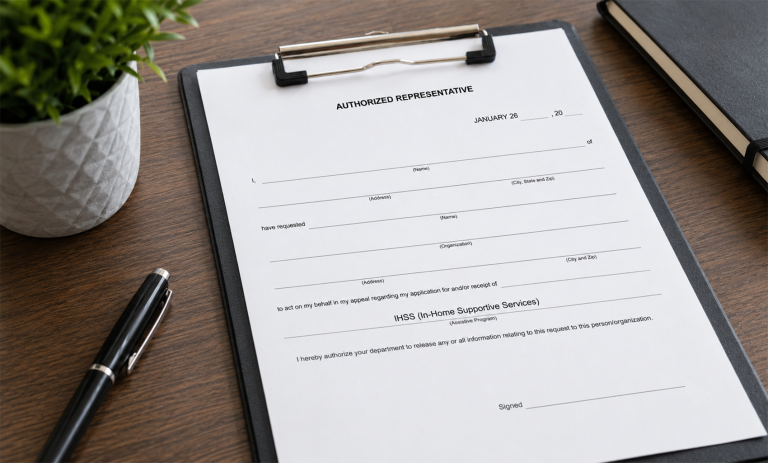
- The name and address of your representative, if someone will speak for you
- How you want the hearing held — phone, video, or in person
Do you have to do this with someone, or can you do it alone?
You can do it alone. There is no requirement to have a lawyer, and no filing fee. The state notice says plainly that you can have “a friend, relative, legal counsel or other person” help with your hearing — help is an option, not a condition. Many people file the request themselves and then look for support before the hearing date.
The problem is arithmetic
- The county made a clear math or coding error
- A service you receive was left off the assessment entirely
- Your notice arrived after the effective date
- The county never did a reassessment you requested
- You have documents that speak for themselves
The problem is judgment
- You are claiming protective supervision
- The dispute is over how many minutes a task “should” take
- The recipient is a child, or an adult with a cognitive disability
- Retroactive hours are on the table
- You have already lost once on the same issue
Filing on your own is very reasonable when the issue is narrow and documented: a math error, a service the county left off entirely, a notice that arrived after the effective date, or a reassessment the county never did.
Support tends to matter more when the case turns on judgment rather than arithmetic. Protective supervision claims, hourly task time disputes, and cases involving a child or an adult with a cognitive disability are all decided on how well the need is described and evidenced. Those are the cases where representation regularly changes the outcome.
Whoever helps you, they can be named as your authorized representative and can appear on your behalf. You do not have to be present if your representative is, though most people choose to attend.
Free help exists, and it is real help
Before you consider paying anyone, work the free options. Disability Rights California takes IHSS cases and publishes the IHSS Fair Hearings Guide, a step-by-step manual updated in June 2026 with worksheets you can fill out yourself. Their intake line is 1-800-776-5746 (TTY 1-800-719-5798). Regional legal aid offices, county Public Authorities, and Independent Living Centers also help with IHSS at no charge.
Free help first
You may not need to pay anyone at all
California has nonprofit organizations that take IHSS appeals at no cost, and several will represent you at the hearing itself:
- Disability Rights California — 1-800-776-5746 (TTY 1-800-719-5798). They also publish the IHSS Fair Hearings Guide, updated June 2026, with worksheets you can fill out yourself.
- Regional legal aid offices — coverage depends on your county.
- County Public Authorities and Independent Living Centers — free benefits counseling.
Legal aid capacity is limited and intake sometimes closes. Call as soon as you file, not the week before your hearing.
When paying for an advocate makes sense
Free programs are excellent and they are also oversubscribed. Legal aid offices triage, and an IHSS hours dispute often does not clear the bar at an office juggling evictions and benefit terminations. That is the gap many families run into.
This is where a number of consumers find a paid advocate worth the cost. A specialist who works IHSS cases every week carries knowledge that is not written down anywhere you can find it — how a particular county assesses a particular task, what a hearing judge tends to want documented, how to build a protective supervision record, which retroactive periods are worth pursuing. That is not available in a Facebook group, and it is not in the regulations. It is pattern recognition built from volume.
If you go that route, ask three questions before you sign anything: what exactly is included, how the fee is calculated, and whether the person will actually appear at your hearing. Get the answers in writing.
California Advocacy Group
An IHSS-focused advocacy firm based in Los Angeles, founded by Judith Kogan — an attorney and former civil rights litigator — and Eric Weingrad. Both are parents of children with disabilities who navigated these systems for their own families first. Their listed services include:
- IHSS applications and appeals
- Protective supervision claims
- Gathering school, hospital, and therapy records
- Documenting a disability for assessment
- Pursuing retroactive benefits
- Accompaniment to hearings, informal meetings, and mediation
They offer a free consultation, so you can find out what your case actually involves before you commit to anything.
Visit caadvocacygroup.com → or email support@ihssconnect.comPaid advocacy is one option among several — work the free resources above first, and ask any paid advocate what is included, how the fee is calculated, and whether they will appear at your hearing. California Advocay Group have financially sponsored the original creation of this platform. We thank them for their continued support.
What happens after you file
The timeline is set by law, and it is useful to know it, because a county that misses a step gives you grounds to ask for a postponement rather than going in unprepared.
- 1
Within 30 working days
Your hearing is scheduled
The state sets the hearing to begin within 30 working days of your request, and must send written notice of the time and place at least 10 days before it.
- 2
Anytime before
A county appeals worker may call
Counties often try to resolve cases before the hearing. This is a real opportunity — and nothing they offer is binding on you.
- 3
before the hearing
You can inspect your case file
Ask for it. This is where the assessment worksheet and the county’s time calculations live.
- 4
2 working days before
The county’s position statement arrives
Its written argument, due to you at least two working days ahead. If it does not arrive, that is good cause to ask for a postponement rather than going in blind.
- 5
Hearing day
The hearing itself
Usually an hour, by phone, video, or in person. It is not a courtroom. You explain what you need and why, the county explains its assessment, the judge asks questions.
- 6
Within 90 days of filing
The decision is issued
Every state hearing must be decided or dismissed within 90 days of the date you filed, unless you waive that or withdraw.
- 7
30 days after a win
The county has to comply
Including any retroactive hours owed. If it does not, call the State Hearings Division at 1-800-743-8525 — compliance is enforceable.
Settling before the hearing: conditional withdrawal
Many IHSS appeals never reach a judge. If the county offers to fix the problem — reassess you, restore hours, correct an error — you can withdraw the hearing on that condition. Put it in writing on the withdrawal form (DPA 315) and make sure the specific promise is written into it. The county then has 30 days to do what it agreed to.
! Flag
Never withdraw on a verbal promise. A plain withdrawal ends your case with nothing enforceable behind it — and if your 90 days have run out, you cannot refile.
A conditional withdrawal puts the county’s specific promise on the record, in writing, on the withdrawal form (DPA 315). The county then has 30 days to do what it agreed to. If it does not follow through, or the new assessment is still wrong, you can request a new hearing on the new decision.
If the decision goes against you
If the decision goes against you
Two paths remain. Both have hard deadlines, and both start the day the decision is issued.
Request a rehearing
Grounds include a decision inconsistent with the law, insufficient evidence in the record, a claim the judge did not address, or newly discovered evidence you could not have produced earlier.
Judicial review
A Writ of Administrative Mandate in Superior Court under Code of Civil Procedure § 1094.5. Filing fees can often be waived if you receive public benefits. This step realistically calls for a lawyer.
The option people overlook: if your needs have changed since the assessment, request a new assessment instead of fighting the old decision. A new assessment produces a new Notice of Action — and a fresh 90-day clock.
There is also a simpler option people overlook: if your needs have changed since the assessment, you can request a new assessment rather than fighting the old decision. A new assessment produces a new Notice of Action, and a new 90-day clock.
The short version
- Find your Notice of Action and read the date and the effective date.
- File before the effective date to keep your current hours. File within 90 days no matter what.
- Pick one method: online, 1-800-743-8525, SHDCSU@dss.ca.gov, mail, or your county.
- Say who you are, which county, “IHSS,” and two or three concrete sentences on what is wrong.
- Ask for an interpreter, an accommodation, and your case file if you need them.
- Call free legal help early. Consider a paid advocate if your case turns on judgment rather than arithmetic.
- Do not withdraw without getting the county’s promise in writing.
Sources
Every deadline, phone number, and address in this article traces to one of these.
- CDSS — Hearing Requests — filing methods, the ACMS portal, 1-800-743-8525, the CDSS mailing address and mail station, the 90-day filing window, and what a written request must contain.
- Welf. & Inst. Code § 10951 — the 90-day filing deadline, the good-cause exception, and the 180-day outer limit.
- Welf. & Inst. Code § 10952 — the 30-working-day scheduling rule, 10-day notice of hearing, and five-working-day case file inspection right.
- CDSS MPP Division 22 — State Hearings — § 22-001 timely notice (10 days before the effective date), § 22-009 filing limit, § 22-060 the 90-day decision deadline, § 22-072.5 aid paid pending.
- Disability Rights California — IHSS Fair Hearings Guide (June 15, 2026) — aid paid pending in practice, the two-working-day position statement rule, conditional withdrawals, rehearing, and judicial review.
- LA County DPSS — State Hearing Procedures (ASH 001) — the 90-day decision requirement, the county’s 30 days to comply, the SHDCSU@dss.ca.gov filing email, and the TDD line.
- LSNC Regulation Summaries — New NA Back 9 Form (ACL 23-81) — the 2023 form revision adding online and email filing and preferred hearing modality.
- California Advocacy Group — Our Services and Our Company — services, founders, Los Angeles location, and phone number. Company-published material, not independently verified.
- IHSS Connect — Where to Find Free Legal Help for IHSS Appeals in California — the companion guide to free legal aid by region.
CDSS is the primary authority throughout. Where county guidance and the statute or Division 22 regulations differ, the statute and regulations govern — and the address, fax number, and effective date printed on your own Notice of Action govern for your county.