
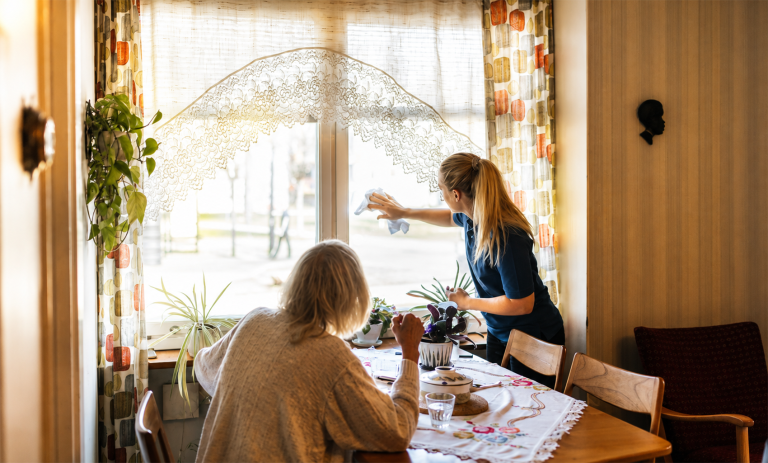
IHSS isn’t a one-size-fits-all benefit. It’s made up of specific services, each with its own definition, eligibility requirements, and rules for when it can be authorized. Domestic Services (MPP §30-757.11) is the category most people picture when they think of IHSS: routine housekeeping. But it has a specific, limited task list, a flat monthly hour cap instead of the sliding scale used for personal care, and — like several other services — a much narrower rule for minors than most parents expect.
This article covers what’s actually included, what’s deliberately excluded (and assessed under a different service instead), how the hours are capped, and why ordinary housekeeping usually isn’t an authorized IHSS service for a child living with a parent.
Domestic Services — At a Glance
- What it is: Routine housekeeping (MPP §30-757.11) — sweeping, dusting, kitchen and bathroom cleaning, and more.
- Hour cap: A flat 6.0 hours per month per household, not a rank-based weekly range.
- Not included: Heavy Cleaning, post-meal cleanup, laundry, and shopping — each its own service.
- For minors: Rated independent (Rank 1) at every age 0–17 — generally not assessed while living with a parent.
What Domestic Services Actually Covers (MPP §30-757.11)
The regulation limits Domestic Services to a specific list of tasks:
- Sweeping, vacuuming, washing, and waxing floor surfaces.
- Washing kitchen counters and sinks.
- Cleaning the bathroom.
- Storing food and supplies.
- Taking out the garbage.
- Dusting and picking up.
- Cleaning the oven and stove.
- Cleaning and defrosting the refrigerator.
- Bringing in fuel for heating or cooking from a fuel bin in the yard.
- Changing bed linen.
There’s also a catch-all: “miscellaneous domestic services” — the regulation names changing light bulbs, wheelchair cleaning, and changing or recharging wheelchair batteries as examples. This catch-all only applies when the social worker specifically identifies and documents the task as necessary for the recipient to remain safely at home — it isn’t a general license to authorize anything housekeeping-adjacent.
What's Not Domestic Services
Several tasks people assume are Domestic Services are actually assessed under a different category entirely:
- Thorough, one-time cleanup of hazardous debris or dirt is Heavy Cleaning (MPP §30-757.12) — a separate, narrowly-triggered service, not routine Domestic Services.
- Wiping the table, counters, stove, and sink right after a meal is Meal Clean-up, not Domestic Services — though the general cleaning of those same surfaces at other times is Domestic Services.
- Laundry and food/other shopping are their own “Related Services” categories, each with their own separate weekly time guideline.
Knowing these boundaries matters at assessment: describing a need as “cleaning” without specifying which category it falls into can lead to it being evaluated under the wrong service.
How Much Time You Can Get: The 6-Hour Monthly Cap
Domestic Services works differently from the personal-care services most IHSS articles cover. Bathing or meal prep use Functional Index ranks tied to a sliding hourly range. Domestic Services doesn’t — it’s one of the services CDSS classifies as having a time guideline without a rank-based range. Instead, the regulation sets a flat cap: no more than 6.0 hours total per month, per household, unless the recipient’s needs require an exception.
A social worker still has to determine that the recipient has a real functional limitation (a Functional Index rank of at least 2 for Housework) before authorizing any Domestic Services hours at all — a recipient who’s fully independent isn’t authorized this service just because they’d prefer help. But once that need is established, the amount authorized is measured against the flat 6-hour monthly ceiling rather than a rank-specific table.
The regulation doesn’t publish a specific list of exception criteria for Domestic Services the way it does for some other services. Exceptions are documented case by case, based on the recipient’s actual living situation and household — for example, a larger home with more square footage to clean, or a household size that generates materially more housework than the guideline anticipates. What matters is describing the specific reason more time is needed, not just requesting more hours generally.
If the recipient shares living space with others, Domestic Services for common areas is prorated among the housemates who use them — the same rule that applies to Heavy Cleaning. The living area is divided into space used solely by the recipient, space used in common with others, and space the recipient doesn't use at all. No time is authorized for areas the recipient doesn't use; for shared common areas, the recipient's need is their prorated share; for space used solely by the recipient, the assessment is based on their individual need (MPP §30-763.31).
Minors: Why Ordinary Housekeeping Usually Isn't an IHSS Service for a Child
This is the part of Domestic Services that surprises families the most, and it’s even more restrictive than the equivalent rule for meal preparation.
CDSS's Age Appropriate Guideline Tool rates Housework at Functional Index rank 1 — independent, not authorized — for every minor at every age, from birth through 17. Unlike Meal Preparation, which opens up to individualized assessment at 17, Housework never does under the standard guideline. The assumption behind the table is that routine housekeeping for a household with a minor child is a parental responsibility at every age, not just early childhood.
That reflects a broader rule, not just a quirk of one table. A parent has a legal duty under the Family Code to provide for their child’s care, and county guidance treats that legal duty as already meeting the need for Domestic Services, Heavy Cleaning, Yard Hazard Abatement, and Teaching and Demonstration when a minor lives with their parent — so these four services generally aren’t assessed for that household at all. This tracks the same standard CDSS applies elsewhere for children: IHSS pays for the gap between what a disabled child needs and what a parent would ordinarily be doing anyway, not for routine household tasks every parent handles regardless of a child’s disability.
What can still be authorized is something narrower and disability-specific — most often through the miscellaneous domestic services catch-all. Cleaning and maintaining a wheelchair, or recharging its batteries, is a documented example in the regulation itself, precisely because it isn’t a task most parents are already doing for a child of any age. The distinction is the same one that shows up across every IHSS service for minors: routine care that any parent provides isn’t compensable, but a specific, disability-linked task beyond that baseline can be.
Getting the Most Accurate Assessment
A few things help a social worker assess Domestic Services accurately, whatever the recipient’s age:
- Describe the home’s layout and size, and which areas are used solely by the recipient versus shared with others — this drives both the base assessment and any proration.
- If requesting time above the 6-hour cap, describe the specific circumstance driving that need, rather than asking generally for “more hours.”
- If a miscellaneous task like wheelchair cleaning or battery charging is needed, name it specifically — this catch-all only gets authorized when it’s identified and documented, not assumed.
- Remember the category boundaries: post-meal cleanup, one-time hazardous cleanup, and laundry/shopping are assessed elsewhere, even though they can feel like “housekeeping” in everyday language.
Sources
- MPP §§30-757, 30-763 — Program Service Categories; Service AuthorizationFull text for Domestic Services, the 6-hour monthly cap, and the proration rule.
- ACIN I-82-17 — IHSS Assessment Clarifications (Dec. 5, 2017)Confirms Domestic Services uses a flat monthly guideline, not a rank-based range.
- CDSS Age Appropriate Guideline Tool (rev. 3/27/2008)Housework rated Rank 1 at every age from birth through 17.
- CDSS State Hearings Division, Training Note 99-05-02CLegal standard limiting minor authorization to needs beyond routine parental care.
- LA County DPSS — Minor RecipientsCounty policy on the Family Code legal-duty rationale for minors living with a parent.
CDSS is the primary authority throughout. The LA County DPSS citation is county-level policy guidance — confirm the same standard applies in your county.