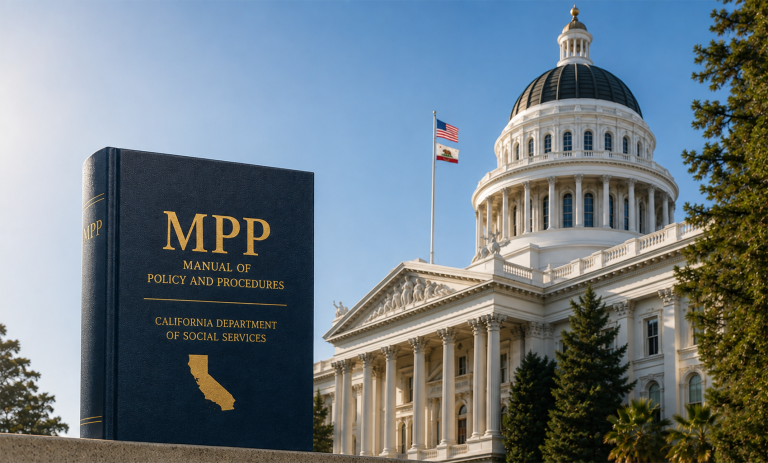
If you’ve ever seen a citation like MPP 30-757.14 on a Notice of Action, or heard a caseworker mention “the regs,” that’s the Manual of Policies and Procedures — the rulebook California’s counties are supposed to follow when they decide your IHSS hours. It’s public, it’s free to read, and it’s often the single most useful document you can bring to a fair hearing.
This piece explains what the MPP actually is, where the sections that matter for IHSS live, and how recipients, family caregivers, and advocates use the text itself — not just a caseworker’s summary of it — to check whether a county decision holds up.
At a Glance
- What it is: CDSS's Manual of Policies and Procedures — the official regulations for IHSS and other social service programs.
- Legal weight: Adopted through the state's rulemaking process; carries the force of law, not just internal guidance.
- Where IHSS lives: Division 30, Chapter 30-700. State hearing rules live in Division 22.
- Why it matters to you: Counties must decide your case according to it — and must give you the relevant sections on request, free or at cost.
What the MPP Actually Is
The Manual of Policies and Procedures is the California Department of Social Services’ (CDSS) official set of regulations for running programs like IHSS, CalWORKs, and CalFresh. CDSS adopts it through the state’s formal rulemaking process, which means it carries the force of law — the same legal weight as the Welfare and Institutions Code sections it implements, not just internal guidance.
Inside the manual, you’ll see two kinds of text. Regulation language is the binding rule. Passages marked HANDBOOK BEGINS HERE and HANDBOOK ENDS HERE are explanatory examples — useful for understanding how CDSS expects a rule to be applied, but not independently enforceable the way the regulation text above them is.
Worth knowing: If you're deciding whether to request a hearing, or getting ready for one, your county has to give you copies of the specific MPP sections relevant to your case — free, or at a charge tied to the cost of copying — on request. That's not a courtesy; it's the regulation itself (MPP § 22-051.3).
Where the MPP Sits in the Chain of Authority
The MPP doesn’t stand alone. It sits in a hierarchy, and knowing where it sits tells you how much weight a given piece of paper actually carries:
- Federal law and regulations set the outer bounds for programs that receive federal funding, like IHSS’s Medicaid-funded components.
- The Welfare and Institutions Code (the statute) is passed by the Legislature. It’s the underlying authority for IHSS.
- The MPP is the regulation CDSS adopts to implement that statute in day-to-day practice. It has the force of law.
- All County Letters (ACLs) and All County Information Notices (ACINs) are CDSS guidance to counties — they explain or implement the statute and the MPP, but they can’t create requirements that aren’t already in one of those two.
- County-specific procedure manuals, worker training materials, and phone-line scripts sit below all of that. They’re internal tools, not independently binding regulation.
Flag: The MPP can lag behind the law. When the Legislature changes a Welfare and Institutions Code section — through a new bill or a budget trailer bill — CDSS has to formally amend the MPP to match, and that process can take months or longer. If you find MPP text that seems to conflict with a newer statute or an ACL implementing a recent law change, the newer statute controls. A caseworker citing an older MPP section isn't necessarily citing the current law, and it's worth asking whether a more recent ACL or statute has updated it.
How the MPP Is Organized
The manual is organized into numbered Divisions, and IHSS lives inside a bigger structure shared with every other CDSS program. Division 30 covers social services benefit and service programs generally; within it, Chapter 30-700 — formally “Service Program No. 7: In-Home Supportive Services” — is the IHSS-specific chapter. Division 22 covers the state hearing process itself, which applies to IHSS hearings the same way it applies to CalFresh or Medi-Cal hearings.
Citations follow a Division-Chapter-Section.Subsection pattern. For example, 30-757.14(e) breaks down as: Division 30, Chapter 30-757 (“Program Service Categories and Time Guidelines”), subsection .14 (personal care services), item (e) (bathing, oral hygiene, and grooming specifically). Once you recognize the pattern, you can usually tell what a citation is pointing to before you even open the document.
How Recipients and Caregivers Actually Use It
None of this matters unless it changes what happens at your kitchen table or in a hearing room. Here are six situations where reading the actual regulation — not a summary of it — makes a practical difference.
- 1
Check the real task list
Domestic services are capped at 6 hrs/month unless your needs require an exception.
MPP § 30-757.11 - 2
“One-time only” heavy cleaning
Heavy cleaning can be re-authorized if living conditions become a safety threat — not only at initial grant.
MPP § 30-757.121 - 3
The reassessment clock
Reassessments happen every 12 months unless the county documents specific conditions to extend to 18.
MPP § 30-761.21, .215 - 4
Health care certification delays
The county must allow 45 days for your SOC 873 — and can't delay urgent cases while waiting.
MPP § 30-754.4, .61 - 5
Provisional approval ≠ Notice of Action
A provisional notice doesn't carry hearing rights. The real Notice of Action, after your full assessment, does.
MPP § 30-754.652, .653 - 6
Cite it at the hearing
ALJ decisions must identify the supporting evidence and regulations — so should your argument.
MPP § 22-061.5
1. Checking a service denial against the real task list
Domestic services (cleaning, laundry, taking out the trash) are capped at 6 hours total per month per household unless the recipient’s needs require an exception (MPP § 30-757.11). If you’re told a task simply isn’t covered, the service category sections in 30-757 spell out exactly what each category includes — it’s worth checking the actual list before accepting a blanket “we don’t cover that.”
2. Pushing back on “heavy cleaning is one-time only”
A common thing recipients are told is that heavy cleaning (removing hazardous debris or dirt) can only be authorized once, when IHSS is first granted. The regulation itself says more: the county also has authority to authorize heavy cleaning again if a recipient’s living conditions become a threat to their safety (MPP § 30-757.121). If your home has deteriorated and a caseworker says heavy cleaning is off the table because you already had it once, this is the section to point to.
3. Understanding the reassessment clock
Needs assessments generally happen every 12 months (MPP § 30-761.21, .212). A county can stretch that to 18 months, but only if it documents in your case file that a specific set of conditions is met — among them, that your living situation and your needs haven’t materially changed, and that you haven’t had a hospitalization in the previous three months (MPP § 30-761.215, .217). If your reassessment is overdue, or a county has extended it without any explanation on file, that’s a fair thing to ask about.
4. Health care certification delays
The county must allow 45 calendar days for your health care provider to return the certification form (SOC 873) before it can hold up your application on that basis (MPP § 30-754.4). And in specific situations — a hospital or nursing home discharge, or imminent risk of being placed out of your home — the county can and should authorize services before that certification arrives at all (MPP § 30-754.61, .62).
5. “Provisional approval” is not the same as a Notice of Action
If the county authorizes services on an emergency or provisional basis before your full in-home assessment, the notice they send you doesn’t carry hearing rights (MPP § 30-754.652). Once the in-home assessment actually happens, though, the county owes you a real Notice of Action — and that one does carry the right to a hearing (MPP § 30-754.653, cross-referencing §§ 10-116 and 10-117). If you received a provisional notice and were told there was nothing to appeal, it’s worth checking whether the full assessment has happened yet.
6. Citing it at the hearing itself
An administrative law judge’s decision has to “specify the reasons for the decision and identify the supporting evidence and regulations” (MPP § 22-061.5). Citing the specific section number that supports your position — rather than describing the problem in general terms — is standard practice in a state hearing, and it signals that you’ve engaged with the actual rule the county is supposed to be applying.
Where to Find the Text
CDSS posts the MPP on its own website, broken into large PDFs by division and chapter range. The IHSS-specific chapters live in the “Div. 30, Ch. 30-700 thru Sec. 30-764” document (see Sources below), with the rest of Division 30’s IHSS content continuing in a companion file. Navigation is not friendly — there’s no single searchable index, and it’s easy to end up on the wrong PDF.
Two things make it more workable. First, CDSS’s State Hearings Division maintains its own paraphrased-regulation index — built for administrative law judges, but publicly posted — that lets you work backward from a topic or problem to the section number that covers it, rather than reading an entire chapter cold. Second, as noted above, you can simply ask your county for the specific sections relevant to your case; they’re required to provide them.
Quick Reference: MPP Sections Worth Bookmarking
- 30-700 to 30-785Full IHSS/PCSP program rules — definitions, eligibility, services, hours
- 30-754Health care certification (SOC 873) — the 45-day rule and exceptions
- 30-757Service categories and time guidelines — what's covered, how exceptions work
- 30-759Application timelines, emergency services, intercounty transfers
- 30-761Needs assessment standards — the 12-month reassessment cycle
- 30-763Service authorization, including proration in shared living situations
- 10-116 / 10-117Notices of Action and the right to a state hearing — cross-program
- 22-000 et seq.State hearing procedures — deadlines, aid pending, rehearings
| MPP Section | What It Covers |
|---|---|
| 30-700 to 30-785 | Full IHSS/PCSP program rules — definitions, eligibility, services, hours |
| 30-754 | Health care certification (SOC 873) — the 45-day rule and exceptions |
| 30-757 | Service categories and time guidelines — what's covered, how exceptions work |
| 30-759 | Application timelines, emergency services, intercounty transfers |
| 30-761 | Needs assessment standards — the 12-month reassessment cycle |
| 30-763 | Service authorization, including proration in shared living situations |
| 10-116 / 10-117 | Notices of Action and the right to a state hearing — cross-program |
| 22-000 et seq. | State hearing procedures — deadlines, aid pending, rehearings |
Need help with your own case?
Reading the regulation is a strong start, but it isn't a substitute for someone who can look at your file. These resources can help:
Sources
- CDSS MPP, Division 30, Ch. 30-700 (IHSS) thru Sec. 30-764Program definition, health care certification, eligibility, service categories, needs assessment, service authorization
- CDSS MPP, Division 22, Chapter 22-000, State Hearing — GeneralRight to a state hearing, adequate notice, the county's duty to provide regulations on request, ALJ decision requirements
- CDSS State Hearings Division, Social Services Paraphrased Regulations IndexTopic-based index of MPP citations built for hearing officers
- CDSS Letters/Regulations — Legislation and RegulationsLanding page for browsing the full MPP by division
- Justice in Aging, In-Home Supportive Services: A Guide for AdvocatesSecondary source cross-referencing MPP citations used by legal advocates
About This Article
IHSS Connect publishes this article for general information and education. It is not legal advice, and reading it does not create an attorney–client relationship. IHSS Connect is not a law firm and is not affiliated with the California Department of Social Services, the Social Security Administration, or any county agency.
Regulations change, and the MPP is periodically amended to match new statutes and budget trailer bills. Only your county social services agency can decide what you are eligible for, and only a state hearing can formally resolve a dispute over that decision.
If a decision on your case looks wrong, or you want advice about your own situation, talk to someone who can look at your file:
- Free and low-cost legal help: LawHelpCA.org
- CDSS Public Inquiry and Response: 1-800-952-5253
- CDSS State Hearings Division: 1-800-743-8525 (TDD 1-800-952-8349)
Regulation citations reflect the MPP text posted by CDSS as of August 2026. Regulations are amended periodically — verify current section numbers and text before relying on a citation in a hearing. Verified August 2026.