IHSS isn’t a blank check for caregiving. It covers specific services, and each one has its own rules for what qualifies and how much time can be authorized. Two of those categories sit right next to each other in the regulation and cover overlapping ground: Routine Bed Baths (MPP §30-757.14(d)) and Bathing, Oral Hygiene, and Grooming (MPP §30-757.14(e)). Both involve washing the body. That’s exactly why they get confused.
They aren’t interchangeable, and understanding the difference matters at assessment — because in some cases, a recipient needs both, authorized side by side.
Bed Bath vs. Bathing/OHG — At a Glance
- Routine Bed Bath (d): Sponge bath in bed only — for recipients confined to bed.
- Bathing/OHG (e): Tub/shower bathing, plus oral hygiene and grooming.
- Key rule: Bed Bath replaces only the bathing piece — oral hygiene & grooming stay separate.
- Can overlap: Both can be authorized together if bed baths supplement occasional tub baths.
What Routine Bed Bath Covers (MPP §30-757.14(d))
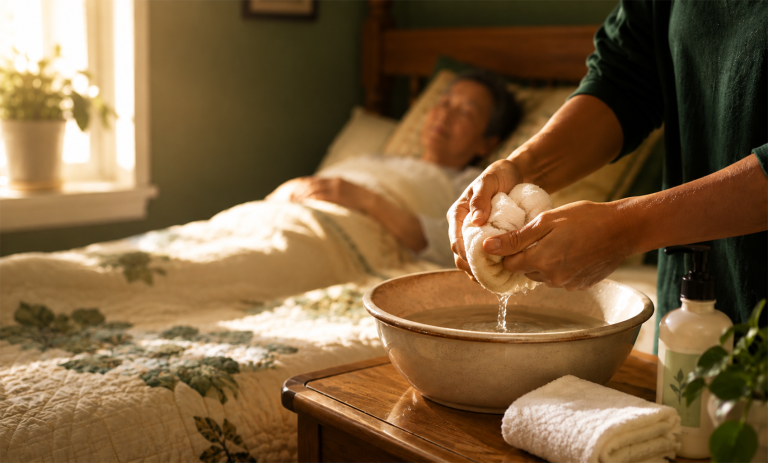
Routine Bed Bath means giving a recipient who is confined to bed a sponge bath in bed, rather than in a tub or shower. The regulation limits it to:
- Obtaining water and supplies for the bed bath, and putting them away afterward.
- Cleaning the basin or other materials used for the sponge bath.
- Washing, rinsing, and drying the body.
- Applying lotion, powder, and deodorant.
- Washing and drying hands, before and after.
That’s the entire scope. It’s specifically the bathing task, performed in bed instead of a tub or shower — nothing more.
What Bathing, Oral Hygiene, and Grooming Covers (MPP §30-757.14(e))
This service bundles three separate routines into one line on the assessment worksheet:
- Bathing: cleaning the body in a tub or shower, including getting in and out, managing water and supplies, and applying lotion, powder, and deodorant afterward.
- Oral hygiene: applying toothpaste, brushing teeth, rinsing the mouth, flossing, and caring for dentures.
- Grooming: combing and brushing hair, shampooing and drying hair, shaving, and fingernail/toenail care.
Notice that the Bathing component here is defined as happening in a tub or shower. That’s the key structural difference from Routine Bed Bath, and it’s what determines which service actually applies.
The Real Difference: Where the Bath Happens — and What It Replaces
Routine Bed Bath isn’t a separate, additional service layered on top of Bathing, Oral Hygiene, and Grooming. It exists because the Bathing component of MPP §30-757.14(e) specifically assumes a tub or shower. When a recipient is confined to bed and can’t use either, the bathing task itself moves to Routine Bed Bath instead — it replaces that one component.
What it doesn’t replace is Oral Hygiene and Grooming. Those two components of §30-757.14(e) have nothing to do with where the bathing happens, so they continue to be assessed under that service exactly as they would for anyone else. In practice, a recipient who is confined to bed can be authorized Routine Bed Bath for the bathing task and Bathing, Oral Hygiene, and Grooming for the oral hygiene and grooming tasks — two separate line items on the same case, covering two different pieces of the same overall hygiene routine.
The regulation also makes clear these aren’t always mutually exclusive by bed-confinement status alone. One of the factors a social worker considers is whether bed baths are needed in addition to baths in the tub or shower — for example, a recipient who manages a weekly or twice-weekly tub bath but needs a sponge bath in bed on the days in between.
Routine Bed Bath doesn't cover toothbrushing, hair care, shaving, or nail care — those stay with Bathing, Oral Hygiene, and Grooming regardless of whether the recipient bathes in bed or in a tub. If you're bed-confined and only Routine Bed Bath gets authorized, ask whether Oral Hygiene and Grooming have been separately assessed — they're a different service, not an included extra.
Functional Index Ranks and Hourly Task Guidelines
Both services use the same five-point Functional Index scale — Rank 2 (needs reminding) through Rank 5 (totally dependent) — but they’re ranked and authorized separately, with different weekly hour ranges. Because Routine Bed Bath covers only the bathing task, its guideline range runs lower than the combined Bathing, Oral Hygiene, and Grooming range, which has to account for three tasks instead of one.
Routine Bed Bath — hours/week
- Rank 2 — reminding only0:30–1:08–1:45
- Rank 3 — some hands-on help1:00–1:40–2:20
- Rank 4 — substantial help1:10–2:20–3:30
- Rank 5 — totally dependent1:45–2:38–3:30
| Functional Index rank | Low | Typical | High |
|---|---|---|---|
| Rank 2 — reminding/guidance only | 0:30 | 1:08 | 1:45 |
| Rank 3 — some hands-on help | 1:00 | 1:40 | 2:20 |
| Rank 4 — substantial hands-on help | 1:10 | 2:20 | 3:30 |
| Rank 5 — totally dependent | 1:45 | 2:38 | 3:30 |
Bathing, Oral Hygiene & Grooming — hours/week
- Rank 2 — reminding only0:30–1:13–1:55
- Rank 3 — some hands-on help1:16–2:13–3:09
- Rank 4 — substantial help2:21–3:13–4:05
- Rank 5 — totally dependent3:00–4:03–5:06
| Functional Index rank | Low | Typical | High |
|---|---|---|---|
| Rank 2 — reminding/guidance only | 0:30 | 1:13 | 1:55 |
| Rank 3 — some hands-on help | 1:16 | 2:13 | 3:09 |
| Rank 4 — substantial hands-on help | 2:21 | 3:13 | 4:05 |
| Rank 5 — totally dependent | 3:00 | 4:03 | 5:06 |
A recipient authorized for both services has their hours calculated separately and added together — the Bed Bath hours aren’t absorbed into or capped by the Bathing, Oral Hygiene, and Grooming range.
Exception Criteria: What Pushes Time Higher for Each
Both services allow exceptions above the standard guideline range when documented, but the specific triggers differ because the tasks differ:
- Routine Bed Bath exceptions: the recipient is confined to bed and sweats profusely, requiring frequent bed baths; the recipient’s weight requires more or less time; the recipient is combative.
- Bathing, Oral Hygiene, and Grooming exceptions: the provider’s constant presence is required; the recipient’s weight requires more or less time; the recipient has spasticity or locked limbs; a roll-in shower is or isn’t available; the recipient is combative.
Weight and combativeness show up as exception criteria for both — but frequency of bathing due to profuse sweating is specific to Routine Bed Bath, and mobility-related factors like locked limbs or roll-in shower availability are specific to Bathing, Oral Hygiene, and Grooming, since those relate directly to tub/shower access rather than bed bathing.
A Boundary Worth Knowing: Lotion vs. Medicated Cream
Both services include applying ordinary lotion, powder, and deodorant as part of routine bathing. That’s different from applying a medicated cream as treatment — for example, for a skin condition or pressure sore. Medicated cream application is assessed separately, as part of Care and Assistance with Prosthetic Devices (MPP §30-757.14(i)), not as part of either bathing service. If a recipient’s skin routine involves a prescribed medicated product rather than ordinary lotion, that’s worth describing specifically at assessment so it lands in the right category.
Getting the Most Accurate Assessment
A few things help a social worker sort these two services correctly:
- Say plainly whether the recipient bathes in bed, in a tub or shower, or both — this is the single fact that determines which service (or both) applies.
- If bed baths supplement occasional tub or shower baths rather than replacing them entirely, describe that pattern specifically, since the regulation accounts for exactly this situation.
- Describe oral hygiene and grooming needs separately from bathing, even for a bed-confined recipient — don’t assume they’re covered automatically just because Bed Bath is authorized.
- If frequent bathing is needed due to sweating, incontinence-related cleanup, or another specific medical reason, name that reason — it’s a recognized exception criterion for Routine Bed Bath, not just a preference for extra cleanliness.
Sources
MPP §30-757.14(d)–(e) — Program Service Categories and Time Guidelines: Routine Bed Baths; Bathing, Oral Hygiene, and Grooming (California Code of Social Services Standards Manual) — full regulatory text, hourly task guideline ranges, and exception criteria for both services
ACIN I-82-17 — IHSS Assessment Clarifications and New or Updated Tools (Dec. 5, 2017) — Functional Index rank descriptions and Hourly Task Guideline mid-range figures for both services
CDSS is the primary authority throughout this article. The “typical / mid-range” hour figures in both tables are the arithmetic midpoint of the regulation’s published low and high guideline hours — the same method CDSS’s own Annotated Assessment Criteria uses for Bathing, Oral Hygiene, and Grooming, applied consistently here to Routine Bed Bath as well, since CDSS hasn’t separately published a mid-range figure for that service.
About This Article
This article was published by IHSS Connect in September 2026 for general information and education. It is not legal advice, and reading it does not create an attorney–client relationship. IHSS Connect is not a law firm and is not affiliated with the California Department of Social Services or any county agency.
IHSS regulations change — through amendments to the Manual of Policies and Procedures (MPP), new All County Letters (ACLs) and All County Information Notices (ACINs), and state hearing decisions. The service definitions, hour guidelines, and rules described here reflect our research as of September 2026 and may no longer be current. Before relying on anything in this article, check the current MPP section or search for a more recent ACL or ACIN that may have updated it — or ask your county social worker directly.
If a decision on your case looks wrong, or you want advice about your own situation, talk to someone who can look at your file:
- Free and low-cost legal help: LawHelpCA.org
- CDSS Public Inquiry and Response: 1-800-952-5253
Researched and written in September 2026. Regulations cited reflect the MPP and ACLs in effect at that time.