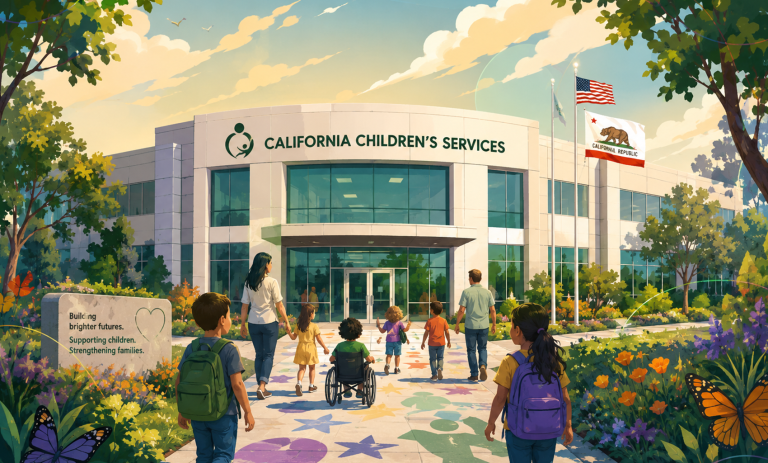
California Children’s Services (CCS) provides free occupational therapy, physical therapy, and durable medical equipment to children with qualifying conditions — but most families only find out by accident.
(Dec. 2025)
What Is California Children's Services?
California Children’s Services (CCS) is a state program — administered through county health departments and the California Department of Health Care Services (DHCS) — that coordinates and pays for medical care and therapy services for children and young adults under 21 years of age who have certain serious health conditions. It has existed in some form since 1927, making it one of the oldest public health programs in the state.
CCS is not a standalone insurance plan. It works alongside Medi-Cal and, in many counties, alongside a child’s existing managed care health plan. The program has two main components: the Case Management Program and the Medical Therapy Program (MTP).
- Specialist medical care
- Hospital and surgical services
- Prescription medications (CCS condition)
- Lab tests and X-rays
- Orthopedic appliances
- Durable medical equipment
- Care coordination by nurse case managers
- Physical therapy (PT)
- Occupational therapy (OT)
- Medical Therapy Conferences
- IEP attendance & school collaboration
- Home and school site visits
- Custom wheelchair and orthotic fitting
The Medical Therapy Program (MTP) has no financial eligibility requirement. Any child who qualifies medically can receive physical and occupational therapy at a Medical Therapy Unit (MTU) at absolutely no cost to the family — regardless of household income. This is not tied to Medi-Cal enrollment status. Yet it is routinely undisclosed at the point of diagnosis.
Who Is Eligible?
To qualify for the full CCS program, a child must meet four criteria. The Medical Therapy Program (OT/PT) uses the same medical and residency criteria but has no income requirement.
- Must reside in California
- Applied through the county where the child lives
- Moving counties? CCS transfers your file
- Medi-Cal enrolled (automatic pathway), or
- Adjusted gross income under $40,000/year, or
- Out-of-pocket medical costs exceed 20% of AGI
- Adopted children: income not required
- MTP therapy: no income requirement at all
- Under 21 years of age
- No lower age limit — newborns qualify
- Transition planning available ages 18–21
- Must have a CCS-eligible diagnosis
- Determined by county CCS nurse case manager
- Doctor referral or parent self-referral accepted
What Conditions Does CCS Cover?
CCS covers conditions that are physically disabling, chronic, or life-threatening, or that require medical, surgical, or rehabilitative services. The list below represents commonly covered conditions and is not exhaustive. Eligibility is determined case by case by the county CCS program based on regulations in Title 22 of the California Code of Regulations.
This is not an exhaustive list. Eligibility is determined case by case by the county CCS program. Learning disabilities alone do not qualify.
Learning disabilities alone are not a CCS-eligible condition. CCS covers physical disabilities and conditions requiring medical or rehabilitative services. If your child's situation involves both a physical disability and a learning profile, the physical component may still qualify independently.
What Is a Medical Therapy Unit (MTU)?
A Medical Therapy Unit (MTU) is an outpatient clinic — and this is the part that surprises most parents — located directly on a public school campus. MTUs are a partnership between the CCS Medical Therapy Program and local special education authorities, funded by state, county, and some federal sources.
Because MTUs are embedded in public schools, they are uniquely positioned to bridge medical and educational care. Therapists can observe your child in their school environment, attend IEP meetings, and provide therapy in the same building where your child learns every day. Services at the MTU are provided by pediatric specialists — therapists whose entire practice is focused on children with complex, chronic conditions.
Find Your County's CCS Offices & MTU
Every California county has a CCS program. In smaller counties, the program may be administered through a DHCS regional office in Sacramento, San Francisco, or Los Angeles rather than locally. Use the tool below to find the contact information for your county.
💡 MTUs are located inside public school campuses — your county CCS office will tell you which school your child's MTU is at. Official list of all county offices: dhcs.ca.gov → CCS → How to Apply.
How to Apply — Step by Step
The application process can feel daunting, but it is more straightforward than it appears. The single most important thing to know: do not wait. Services can only begin after CCS approves them, and there is no benefit to delaying. If your child is hospitalized, start the referral process within 24 hours.
If CCS denies your application or a specific service, you have the right to appeal. Contact your county CCS office for information on the appeal process. You also have the right to review your child's CCS records at any time by scheduling an appointment with your county office.
What Is the Whole Child Model?
As of 2025, California has been rolling out the Whole Child Model (WCM) — a delivery system change that shifts CCS administration from county offices to a child’s Medi-Cal managed care health plan. The goal is to consolidate all of a child’s care under one system and reduce confusion about who authorizes what.
If your child is enrolled in Medi-Cal in a WCM county, their CCS services are now authorized by their Medi-Cal managed care plan rather than the county CCS office. As of January 2025, the WCM expanded to additional counties including San Benito and Mariposa, and Kaiser Permanente began administering CCS services for its members in several counties. The county finder tool above will indicate whether your county is a WCM county.
The Medical Therapy Program (MTP) — meaning your child's PT and OT at the MTU — remains county-administered regardless of whether your county is in the WCM. The county still oversees all MTP therapy services and Medical Therapy Conferences, even in WCM counties.
Questions Parents Ask Most
The questions below come from real conversations families have when they first learn about CCS. They address some of the most common sources of confusion.
California Children’s Services exists precisely because children with serious medical conditions and their families should not have to navigate the healthcare system alone. The program coordinates specialist care, pays for treatments that would otherwise be unaffordable, and provides free physical and occupational therapy through school-based clinics — regardless of what a family earns.
The barrier is not eligibility. For thousands of California families, it is simply awareness. If your child has a qualifying condition, or if you’re not sure whether they might, the right move is to contact your county CCS office and ask. A referral costs nothing, and it can change what your child’s daily life looks like.
Sources & Verification
- California DHCS — CCS Program Overview: dhcs.ca.gov/services/ccs
- California DHCS — Medical Therapy Program: dhcs.ca.gov/services/ccs/Pages/MTP.aspx
- California DHCS — CCS How to Apply: dhcs.ca.gov/services/ccs/Pages/apply.aspx
- California DHCS — CCS Enrollment Data, December 2025
- California DHCS — CCS Whole Child Model: dhcs.ca.gov/services/ccs/Pages/CCSWholeChildModel.aspx
- Family Voices of California — CCS Whole Child Model Guide: familyvoicesofca.org/ccs-wcm
- Central California Alliance for Health — WCM Expansion January 2025: thealliance.health
- Health Net Provider Library — CCS Eligible Conditions (Title 22 CCR Sections 41515.2–41518.9)
- LA County Public Health — CCS Eligibility: publichealth.lacounty.gov/cms/CCS
- Santa Clara County Public Health — CCS Program: publichealth.santaclaracounty.gov
- San Diego County HHSA — CCS Medical Therapy Program: sandiegocounty.gov/hhsa
- Napa County — Medical Therapy Program / MTU: napacounty.gov/433
- Marin County Health — MTP/MTU: marinhhs.org/medical-therapy-program-mtp
Last reviewed: May 2026. Program details, county contacts, and WCM county assignments are subject to change. Always verify current information with your county CCS office or DHCS directly.