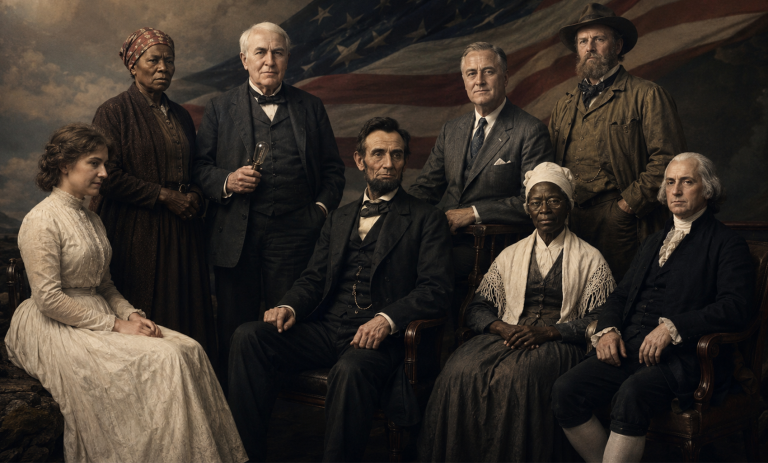
As America marks its 250th birthday, we look back at the patriots, inventors, and leaders whose disabilities were inseparable from the greatness they gave this nation.
IHSS Connect | America at 250 | Summer 2026
Built by Us All
A Written Celebration of American People With Impairments
IHSS Connect Editorial | June 2026
Two hundred and fifty years ago, a group of imperfect, often ill, often broken human beings decided to build something that had never existed before. The country they founded — and the one that has been expanded and re-argued and fought over ever since — was not built in spite of disability. In many cases, it was built through it: through the hard-won perspective that comes from navigating a world that was not designed for you.
The men and women profiled below lived centuries apart. They came from different races, classes, and circumstances. What connects them is that each carried a neurological or physical impairment that their era had no framework for, and each left a mark on this country that persists to this day. As we celebrate America’s 250th birthday, these are stories worth knowing — and worth claiming as our own.
James Madison
1751–1836
Epilepsy4th President · Father of the Constitution · Author of the Bill of Rights
The man who drafted the United States Constitution — the framework that has governed this republic for nearly two and a half centuries — battled epilepsy his entire life. James Madison was slight, frail, and periodically felled by seizures that his contemporaries described as “sudden attacks, somewhat resembling epilepsy.” Modern historians and medical experts, drawing on those same records, now affirm what was long dismissed: Madison lived with a mild form of epilepsy.
In his era, neurological disease carried a brutal stigma. Medical texts read like sorcery, and many communities believed seizure disorders were signs of demonic possession. Madison kept his condition largely private — not out of shame, but out of political necessity.
None of it stopped him. He played the central role in the Constitutional Convention of 1787, designed the system of checks and balances that separates American government from monarchy, and authored the Bill of Rights — ten amendments that remain the foundation of American civil liberties. He lived to 85, outlasting every other Founding Father.
Sojourner Truth
c. 1797–1883
Physical Disability — Injured HandAbolitionist · Women’s Rights Pioneer · Civil War Recruiter
Born into slavery in New York as Isabella Baumfree, the woman who would rename herself Sojourner Truth suffered a disabling injury to her right hand at the hands of an enslaver. The injury was severe enough that her final enslaver used it as a legal pretext to extend her bondage — claiming she had not yet produced sufficient work to earn the freedom he had promised. She escaped anyway, carrying her infant daughter.
Truth deliberately concealed her disabled hand in the photographic cards she sold to fund her speaking tours — a survival strategy in a world that equated disability with incapacity. Scholars, including Princeton historian Nell Irvin Painter and researchers published in the Disability Studies Quarterly, have documented both the injury and its erasure from her public image.
What she built despite that erasure was extraordinary. She sued in court and won the return of her son from illegal enslavement in Alabama — one of the first Black Americans to successfully take a white man to court. She delivered the “Ain’t I a Woman?” speech that reframed the women’s rights movement. She recruited Black soldiers for the Union Army. She met with Abraham Lincoln at the White House. She was disabled, she was illiterate, and she changed the country.
Harriet Tubman
c. 1822–1913
Temporal Lobe Epilepsy / TBIUnderground Railroad Conductor · Union Army Scout · Suffragist
As a teenager enslaved on a Maryland plantation, Harriet Tubman was struck in the head by a two-pound lead weight hurled by an overseer. The injury fractured her skull. She spent weeks unconscious — and for the rest of her life, she experienced seizures, sudden lapses into unconsciousness, vivid hallucinations, and intense chronic pain. Historians now believe she lived with temporal lobe epilepsy, caused by that traumatic brain injury.
She could fall unconscious mid-sentence and wake minutes later — a terrifying vulnerability for a woman leading freedom seekers through slave territory at night. And yet she led them. She made at least 13 missions into the South and guided approximately 70 enslaved people to freedom. Not one of them was recaptured.
During the Civil War, she served the Union Army as a spy, scout, and the first woman in American history to lead an armed military raid — the Combahee River Raid of 1863, which liberated more than 700 enslaved people in a single night. Tubman spoke openly about her symptoms throughout her life. She was disabled and she was extraordinary, and those facts are not in conflict.
“I never ran my train off the track and I never lost a passenger.”
Harriet Tubman
Abraham Lincoln
1809–1865
Clinical Depression16th President · Preserver of the Union · Emancipator
Abraham Lincoln called it “the hypo” — a black, bottomless melancholy that dogged him from young adulthood. He spoke of suicide as a young man. His friends feared for his life after emotional crises. His legal colleagues — John T. Stuart, William Herndon, Ward Hill Lamon — all independently documented what modern clinicians recognize as severe clinical depression.
Lincoln presided over the bloodiest conflict in American history at a time when his own mind was at war with itself. He led a divided government, buried a son, and navigated the moral catastrophe of slavery — all while fighting episodes of such profound despair that they alarmed those closest to him. He channeled those dark moods into humor, literature, and the moral clarity that produced the Emancipation Proclamation and the Gettysburg Address.
Historian Joshua Wolf Shenk has argued in Lincoln’s Melancholy that his depression was not incidental to his greatness — it shaped his capacity for empathy, his tolerance for ambiguity, and his resistance to the easy answers that destroy lesser leaders.
John Wesley Powell
1834–1902
Limb AmputationExplorer · Geologist · Founder, Smithsonian Bureau of Ethnology
On April 6, 1862, at the Battle of Shiloh, Union Army officer John Wesley Powell raised his right arm to signal his troops and was struck by a lead bullet. Field surgeons amputated the shattered forearm two days later. He was 28 years old. The wound caused excruciating phantom pain for the rest of his life.
Seven years later, Powell led nine men down the uncharted Colorado River in wooden boats — through the Grand Canyon, through rapids that had never been mapped, through canyons no expedition had documented. He did it with one arm. The USGS later described him as “apparently unhampered by the lack of his right forearm.” That phrase understates the reality: he navigated whitewater, camped in desert terrain, and collected scientific specimens for months, all while managing daily chronic pain.
Powell went on to found the Smithsonian Institution’s Bureau of Ethnology, direct the U.S. Geological Survey, publish the first systematic classification of Native American languages, and advocate for rational water policy in the American West — positions so ahead of their time that the West is still catching up. Lake Powell bears his name.
Thomas Edison
1847–1931
Severe Hearing LossInventor · Holder of 1,093 U.S. Patents
By the time he was 12 years old, Thomas Edison had lost nearly all of his hearing — the result of childhood ear infections and, most likely, scarlet fever. By adulthood he was nearly completely deaf. His Menlo Park laboratory, where he invented the phonograph, improved the light bulb, and helped build the motion picture industry, was built around a man who could not hear most of it.
Edison refused surgery that might have restored partial hearing, telling people he feared it would disrupt his ability to think. He learned to listen through bone conduction — biting the frame of his piano so that sound would travel through his skull — a technique evidenced by bite marks still visible on his Steinway. He called his deafness “not a handicap, but a help.”
His 1,093 patents remain a record. His inventions — electrical light systems, the phonograph, motion picture apparatus — didn’t just change American life. They changed the world. The Library of Congress notes that his hearing loss may have directly motivated him to design recording instruments more sensitive than the human ear.
Helen Keller
1880–1968
Deaf-BlindAuthor · Activist · Co-founder of the ACLU
At 19 months old, an illness — likely scarlet fever or meningitis — left Helen Keller both blind and deaf. She grew up in darkness and silence, communicating only through improvised signs, until teacher Anne Sullivan arrived when Keller was seven and began the painstaking work of connecting language to the world around her.
Keller graduated from Radcliffe College in 1904, becoming the first deaf-blind person to earn a bachelor’s degree. She went on to publish 12 books, co-found the American Civil Liberties Union, advocate for women’s suffrage and workers’ rights, travel to 35 countries speaking on behalf of the blind, and receive the Presidential Medal of Freedom from Lyndon B. Johnson in 1964.
She spent 44 years working for the American Foundation for the Blind. She was friends with Mark Twain and corresponded with presidents. She was a radical, a pacifist, and a suffragist — a woman whose politics often surprised those who preferred to remember her only as the child at the water pump. She was all of it, at once.
Franklin D. Roosevelt
1882–1945
Polio / Paralysis32nd President · New Deal · Commander-in-Chief in World War II
In August 1921, Franklin Roosevelt — then 39, a rising political star and former Assistant Secretary of the Navy — contracted polio. He lost the use of his legs permanently. He would never walk unassisted again.
Eleven years later, he was elected President of the United States. He went on to win four presidential elections — still the record — and to lead America through both the Great Depression and the Second World War. He created the New Deal, Social Security, and the regulatory architecture of the modern American economy. He died in office in 1945, four months before the Allied victory in Europe.
Roosevelt famously concealed the full extent of his disability from the public, allowing only a handful of photographs where his wheelchair or braces were visible. It was a different era — one in which disability was still considered disqualifying for public life. That contrast underscores what the disability community has always known: the accommodation wasn’t the miracle. The person was.
Their Stories Are Our Stories
The men and women above did not succeed in spite of their disabilities in some abstract, inspirational sense. They succeeded as full human beings — carrying real limitations and real pain — in a country that often had no language for what they lived with and no infrastructure to support them.
On this 250th birthday, what the disability community has always known deserves to be said plainly: this nation was built by people like us. It was shaped by minds that worked differently, bodies that moved differently, people who navigated the world without accommodations anyone had bothered to design. That is not a footnote to American history. It is American history.
The work of building a more accessible, more inclusive America is not a departure from the founding ideal. It is, in the most literal sense, its continuation.