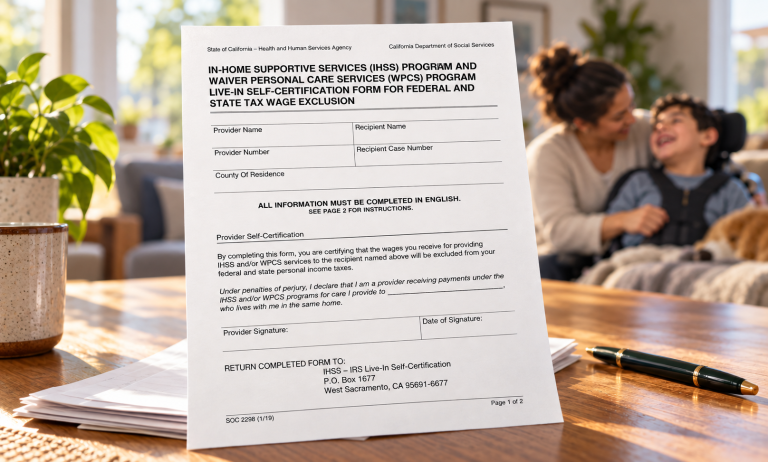
The SOC 2298 is a two-page form for IHSS providers who live with the person they care for. Once the State of California processes it, your IHSS wages are treated as excluded from federal and California income tax. The form is voluntary, it isn’t automatic, and it only works if what you certify is true.
This guide covers who should file it, how to fill it out and where to send it, what changes on your W-2, how the choice connects to tax credits, and what to do if you move out. It explains how the form works. It is not tax advice, and CDSS says its staff and county staff can’t give tax advice either.
SOC 2298 at a glance
- Official nameLive-In Self-Certification Form for Federal and State Tax Wage Exclusion (IHSS and WPCS programs)
- Form versionSOC 2298 (1/19), the version posted on CDSS’s site
- Who files itIHSS or WPCS providers who live in the same home as the recipient
- What it doesExcludes your IHSS/WPCS wages from federal and California income tax once it is processed
- What it doesn’t doChange Social Security and Medicare taxes
- Where it goesIHSS – IRS Live-In Self-Certification, P.O. Box 1677, West Sacramento, CA 95691-6677 (as printed on the form)
- Processing timeUp to 30 days after CDSS receives a complete form
- File every year?No, as long as you keep working for and living with the same recipient
- To undo itFile the SOC 2299 if the recipient no longer lives with you
What the SOC 2298 does
The SOC 2298 is a self-certification. You sign a statement, under penalties of perjury, that you are an IHSS and/or Waiver Personal Care Services (WPCS) provider receiving payments for care you give to a named person who lives with you in the same home. The form doesn’t ask you to attach proof, so the responsibility for getting the facts right is yours.
The exclusion comes from federal tax guidance. In IRS Notice 2014-7, issued January 3, 2014, the IRS said it would treat certain Medicaid waiver payments to individual care providers as “difficulty of care” payments that are excluded from gross income when the person receiving care lives in the provider’s home. That applies whether or not you’re related to the person you care for. CDSS says it received a ruling from the IRS on March 1, 2016 that IHSS wages paid to live-in providers are excluded too, and that the ruling applies to state income tax as well. CDSS began accepting the self-certification in January 2017.
Who should file it — and who shouldn’t
You may file it if you live in the same home as the person you provide IHSS to. Here is how that plays out in common situations.
You may qualify if:
- You and the recipient share a home, and it’s where you actually live. The IRS looks at where you live and carry on the routines of your private life, such as shared meals and holidays with family.
- More than one provider lives in the home. The IRS says each care provider living with the recipient can exclude their payments. The form has one provider name and signature line, so each provider needs their own copy.
- You live with more than one recipient. CDSS says you must send a separate form for each recipient.
It doesn’t apply if:
- You have a separate home where you live, even if you sleep at the recipient’s home several nights a week.
- You provide care somewhere the recipient doesn’t live.
The form says the recipient “lives with me in the same home.” The IRS test asks where you actually live and carry on the routines of your private life.
The IRS gives examples. A provider who moved into her mother’s home and has no other home qualifies. A provider who cares for an unrelated person and sleeps in that person’s home four nights a week, but spends weekends and holidays with family in a separate home, does not.
Because you sign under penalties of perjury, if your situation falls somewhere in between, get a tax professional’s opinion before you send the form.
Before you fill it out
CDSS says all requested information must be provided, and your wages stay taxable until a correct and fully completed form is processed. Gather these first.
Have these ready
- Your name, exactly as it appears on your IHSS paperwork
- Your provider number, found on your IHSS paperwork, such as the Provider Notification of Recipient Authorized Hours and Services and Maximum Weekly Hours, or your timesheet
- The recipient’s name and case number (the case number is on the same paperwork)
- The county where you and the recipient live
- A black ink pen. The form says to use only black ink and print clearly
- An envelope, and a way to mail the form without stapling or wrinkling it
How to complete and send the SOC 2298
- Get the form.Download the SOC 2298 from the CDSS website (link in Sources). Some counties also post translated versions, such as Spanish, Chinese and Armenian on Los Angeles County’s provider forms page. In any language, the form says all information must be completed in English.
- Fill in the top section.Print in black ink: your name, the recipient’s name, your provider number, the recipient’s case number, and the county where you both live.
- Complete the statement.Write the recipient’s name on the blank line in the certification, which says you provide care to that person “who lives with me in the same home.”
- Sign and date.Sign on the provider signature line and add the date. CDSS says the form must include both.
- Check it over.Make sure every field is filled in and easy to read. Don’t wrinkle or staple the form.
- Mail it.Send it to the address
printed on the form, and keep a copy for your records:IHSS
– IRS Live-In Self-Certification
P.O. Box 1677
West Sacramento, CA 95691-6677
CDSS says your wages continue to be treated as taxable until it processes a correct, fully completed form.
Neither the form nor CDSS’s instructions set a filing deadline, but every paycheck issued before processing is treated as taxable wages. If you qualify, file as soon as you can.
What changes after it’s processed
Once CDSS processes your form, your IHSS or WPCS wages are excluded from federal and California income tax. One form covers both; CDSS says you don’t send a separate one for each tax agency. You don’t have to re-file every year as long as you keep working for, and living with, that recipient.
Your W-2 will look different. Here’s how each part is affected:
| What | What the SOC 2298 does | Where you’ll see it on your W-2 |
|---|---|---|
| Federal income tax | Excludes your IHSS wages once the form is processed | Box 1 doesn’t include the excluded wages |
| California income tax | The same form covers it; there is no separate state form | Box 16 (state wages) doesn’t include them |
| Amount excluded | Shows the excluded amount on its own line | Box 12, code II. CDSS says this began with an IRS rule change in 2024 |
| Social Security and Medicare | Not changed by this form | Boxes 3 and 5 can still show your wages |
Earlier wages. Wages paid before your form was processed stay taxable, and they show up on your W-2 that way. When the form began in 2017, CDSS said it would not amend W-2s for wages paid before a provider’s form was received and processed, and its current page still says so. The IRS says you may be able to file an amended return (Form 1040-X) for an earlier year to exclude wages you reported as income, if the time to claim a refund hasn’t run out. That is generally three years from the date you filed or two years from the date you paid the tax, whichever is later.
With an amended return, the IRS asks you to include the recipient’s full name, third-party documents showing you and the recipient lived in the same home that year (such as a driver’s license, bank statement, medical bill or utility bill), and evidence that the recipient receives care under the program. Excluding the wages can also change credits you claimed that year, so run the numbers first.
Filing your tax return
IRS guidance, last reviewed April 29, 2026, addresses the W-2 question directly. If box 1 of your W-2 is blank or shows zeros, and you’re choosing not to count the payments as earned income for a credit, you don’t need to report the W-2 amounts on your return or attach the W-2. If you are counting them for a credit, the IRS’s instructions explain how to report the box 12, code II amount and then subtract it as nontaxable. Your tax software or preparer should handle the exact lines on the current year’s forms.
California’s return uses your federal adjusted gross income (AGI), and the Franchise Tax Board (FTB) says income for the care of someone you live with is excluded from it.
Excluded wages don’t count as taxable income, but credits like the Earned Income Credit (EIC) and the additional Child Tax Credit depend on earned income. The IRS says you may choose to include these payments in earned income when figuring those credits. It’s all or nothing: you include all of the payments or none of them, and the choice applies to tax years that are still open.
FTB says IHSS income may be excluded from taxable income and still counted as earned income for the California Earned Income Tax Credit (CalEITC). CDSS says this may allow you to qualify for CalEITC and other credits. It doesn’t say it will.
Whether counting the wages helps depends on your household’s whole tax picture, so it’s worth having a tax preparer run it both ways. If you already filed a year that is still open for refund claims, FTB says you need to file an amended return to change how the income was treated.
CDSS also points providers to a 2021 ruling by California’s Office of Tax Appeals on CalEITC and IHSS income, and to FTB’s IHSS page to see how it may affect them.
CDSS says the form applies only to federal and state income tax, so your W-2 can still show wages in box 3 (Social Security) and box 5 (Medicare).
Whether those taxes apply to you depends on who is treated as your employer and how you’re related to the recipient. IRS guidance says that when the care recipient is the employer, payments for services performed for a spouse or a child, or for a parent by a child under 21, generally aren’t subject to Social Security and Medicare taxes, and small yearly totals can fall below a threshold. The IRS points to Publication 926 for the details.
If you think these taxes were withheld by mistake, the IRS says to contact the agency that withheld them first.
If you stop living with the recipient
If the recipient no longer lives with you but you keep providing care, CDSS says to file the Live-In Self-Certification Cancellation Form (SOC 2299) with the Processing Center, and to file SOC 840, the change-of-address form, with your county IHSS office. The SOC 2299 asks for the same identifying details as the SOC 2298, plus your signature and the date. It states that you no longer live with the recipient and want the existing self-certification removed.
Because the SOC 2298 is signed under penalties of perjury, don’t let a change in living arrangements sit. CDSS’s page doesn’t say what happens if someone keeps the exclusion after they stop qualifying, or what to do if you stop caring for the recipient altogether. A tax professional can tell you how either would be treated on your return.
Don’t mix up these three forms
- SOC 2298 Live-In Self-Certification Use it whenYou live with the recipient and want your wages excluded from federal and state income tax. Where it goesThe state processing address printed on the form (P.O. Box 1677, West Sacramento).
- SOC 2299 Live-In Self-Certification Cancellation Use it whenThe recipient no longer lives with you, but you still provide care. Where it goesThe Processing Center, at the same P.O. box. Also file SOC 840 (change of address) with your county IHSS office.
- SOC 2279 Live-In Family Care Provider Overtime Exemption Use it whenThis is a separate form about overtime, not taxes. It isn’t covered in this article. Where it goesAsk your county IHSS office whether it applies to you.
Need help with your form or your taxes?
CDSS and county IHSS staff can’t give tax advice. For questions about your return, contact the IRS, the California Franchise Tax Board, or a tax preparer. For IHSS timesheet questions, CDSS lists the IHSS Service Desk at (866) 376-7066.
- CDSS: Live-In Provider Self-Certification Information — The state’s page on who can file, W-2 boxes, and cancelling
- IRS: Certain Medicaid Waiver Payments May Be Excludable From Income — IRS questions and answers, including amended returns and credits
- FTB: In-Home Supportive Services — How California treats IHSS income on your state return
- IHSS Connect: How to Get Taxes Taken Out of Your IHSS Paycheck — Our guide to withholding, W-4 and DE 4 forms
Need help with your form or your taxes?
CDSS and county IHSS staff can’t give tax advice. For questions about your return, contact the IRS, the California Franchise Tax Board, or a tax preparer. For IHSS timesheet questions, CDSS lists the IHSS Service Desk at (866) 376-7066.
- CDSS: Live-In Provider Self-Certification InformationThe state’s page on who can file, W-2 boxes, and cancelling
- IRS: Certain Medicaid Waiver Payments May Be Excludable From IncomeIRS questions and answers, including amended returns and credits
- FTB: In-Home Supportive ServicesHow California treats IHSS income on your state return
- IHSS Connect: How to Get Taxes Taken Out of Your IHSS PaycheckOur guide to withholding, W-4 and DE 4 forms
Sources
Sources reviewed September 2026. Verify current forms, addresses and figures with CDSS, the IRS and FTB before relying on them.
- CDSS — Live-In Provider Self-Certification Information — the January 2017 start date, the IRS ruling CDSS says it received on March 1, 2016, one form covering federal and state, up to 30 days to process, no yearly re-filing, a separate form for each recipient, SOC 2299 and SOC 840, W-2 boxes 1, 16, 12-II, 3 and 5, the earned income option, the reference to the 2021 Office of Tax Appeals ruling, and the statement that CDSS cannot give tax advice.
- CDSS — Form SOC 2298 (1/19), Live-In Self-Certification Form — the certification wording, form fields, black-ink and no-staple instructions, English-only requirement, and mailing address.
- CDSS — Form SOC 2299 (1/19), Live-In Self-Certification Cancellation Form — the cancellation wording, fields and return address.
- IRS — Certain Medicaid Waiver Payments May Be Excludable From Income (page last reviewed April 29, 2026) — the meaning of the provider’s home and its examples, multiple providers in one home, W-2 box 12 code II and when to report it, the earned income choice, amended returns, and Social Security and Medicare.
- IRS — Notice 2014-7, Internal Revenue Bulletin 2014-4 — the January 3, 2014 guidance treating qualified Medicaid waiver payments as difficulty of care payments, and that it applies to related and unrelated providers.
- Franchise Tax Board — In-Home Supportive Services (last updated September 24, 2025) — how the California return treats IHSS income, excluded income counted as earned income for CalEITC, and the amended return rule.
- Office of Tax Appeals — Appeal of Akhtar, 2021-OTA-118P — the 2021 ruling on CalEITC and IHSS income that CDSS refers to.
- Los Angeles County DPSS — IHSS Provider Forms — the translated versions of the SOC 2298 and the title of the SOC 2279. This is a county source, not a state one.
CDSS is the authority on the form and how IHSS processes it. The IRS and FTB control how your wages are treated on your tax return. Notice 2014-7 is IRS guidance published in the Internal Revenue Bulletin, not a statute. Where a county office or another website differs from these sources, the CDSS, IRS and FTB pages govern.
A note before you act on this information
We are not tax experts. This article is for general information only. It is not tax, legal, or financial advice, and reading it does not create a professional relationship between you and IHSS Connect.
Tax rules change, and how they apply depends on your own situation, including where you live, who you care for, your other income, and the tax year. Before you sign a form, file a return, or change how you report your income, talk with a qualified tax professional, such as a CPA, an enrolled agent, or a tax attorney.
We rely on published guidance from agencies such as CDSS, the IRS, and the California Franchise Tax Board, and we do our best to report it accurately. We can’t promise it reflects the latest changes or fits your circumstances. For official answers, contact the IRS or the Franchise Tax Board directly. CDSS has said its staff and county IHSS staff can’t give tax advice.