
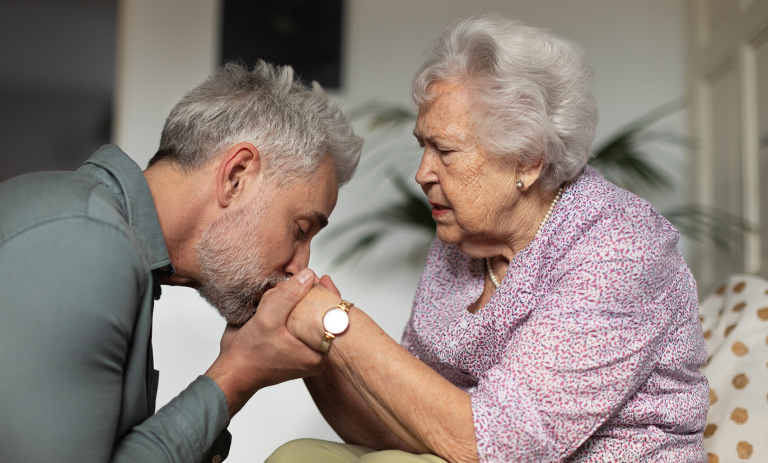
Almost everything published about IHSS protective supervision is written for parents of children — usually children with autism or an intellectual disability. If your mother has Alzheimer’s or your father has vascular dementia, most of that material will lead you to the wrong test, the wrong forms, and the wrong argument. The adult pathway is a different analysis, and it runs into a set of household rules that quietly reduce the hours families are paid for.
This guide covers the adult pathway end to end: the four findings a county has to make, the exclusions that sink most dementia claims, the two forms that usually decide the outcome, the spouse rule that costs married couples the most hours, and what to do inside 90 days if the answer is no. Every rule below is cited so you can put the citation in front of a social worker.
The short version
- Adults use a four-part test — mental impairment, non-self-directing, physically able to get into danger, and a 24-hour-a-day need.
- The Garrett v. Anderson steps do not apply to adults. That is the children's test.
- Fall risk will not qualify. The danger has to come from memory, orientation or judgment — not from balance.
- No injury is required. A documented propensity to place oneself in danger is enough.
- The SOC 821 is not the whole record and cannot be the sole basis for the decision.
- You have 90 days from the Notice of Action to request a state hearing.
What protective supervision actually pays for
Protective supervision is defined in state regulation as “observing recipient behavior and intervening as appropriate in order to safeguard the recipient against injury, hazard, or accident” (MPP § 30-757.17). It is available “for observing the behavior of nonself-directing, confused, mentally impaired, or mentally ill persons only” (MPP § 30-757.171).
Two things follow from that language, and they explain most denials:
- It is not a diagnosis benefit. A dementia diagnosis on its own authorizes nothing. The county is buying observation of specific behavior.
- It is a mind benefit, not a body benefit. The danger has to come from what the mind is doing — not from weak legs, poor balance, or an unstable medical condition.
The regulation also recognizes that the 24-hour need can be met through a combination of IHSS, alternative resources such as Community-Based Adult Services, adult day programs, senior centers and respite centers, and voluntary resources.
The four-part test for an adult
Under CDSS policy set out in All-County Letter 15-25 and applied by counties, an adult may be authorized protective supervision if the person:
A mental impairment or mental illness
Dementia qualifies. The diagnosis alone does not decide anything else.
Non-self-directing because of it
Unable to assess danger and the risk of harm, so likely to engage in activities that may cause self-harm.
Physically able to get into danger
Being in a wheelchair or bedridden is not automatically disqualifying.
A 24-hour-a-day need
Supervision must be needed around the clock for the person to remain safely at home.
All four have to be true. CDSS is explicit that “it is not sufficient for someone to just be mentally impaired/mentally ill, there must also be evidence that he/she is nonself-directing.”
What "non-self-directing" means
CDSS defines non-self-direction as “an inability, due to a mental impairment/mental illness, for individuals to assess danger and the risk of harm, and therefore, the individuals would most likely engage in potentially dangerous activities that may cause self-harm.” County policy breaks that into four capacities the person lacks:
- The ability to make decisions so as not to put themselves in danger
- The capacity to respond to changes in their environment
- The ability to understand alternatives and the risks involved
- The ability to accept the consequences of their decisions
For a person with moderate or advanced dementia, this is usually the easiest element to document — and the one families spend the least time on, because they assume the diagnosis speaks for itself. It does not. Write down what your parent decided, and what happened next.
The four-step Garrett v. Anderson analysis you will find in nearly every protective-supervision article — including the question of whether the person "needs more supervision than someone of the same age" — applies to minors only. An adult does not have to clear that step. If a county worker applies it to your parent, they are using the children’s test.
Adult pathway vs. the children's pathway
| Requirement | Adult recipient | Minor recipient |
|---|---|---|
| Mental impairment or mental illness | Required | Required |
| Non-self-directing | Required | Required |
| Physically able to engage in dangerous activity | Required | Required |
| Needs more supervision than a same-age person without impairment | Not required | Required (Garrett v. Anderson) |
| 24-hour-a-day need | Required | Required |
Where dementia claims get denied
MPP § 30-757.172 lists what protective supervision cannot be authorized for. Protective supervision shall not be authorized:
- For friendly visiting or other social activities;
- When the need is caused by a medical condition and the form of the supervision required is medical;
- In anticipation of a medical emergency;
- To prevent or control anti-social or aggressive recipient behavior;
- To guard against deliberate self-destructive behavior, such as suicide, or when an individual knowingly intends to harm himself/herself.
Two of those — the medical-condition exclusion and the medical-emergency exclusion — do most of the damage in dementia cases. ACL 15-25 gives the agency’s own examples: supervision to respond to a diabetic’s hypoglycemic episode is excluded, and supervision in anticipation of a heart attack in someone with congestive heart failure is excluded.
The line that matters most for older adults is this one, from ACL 15-25: the risk of harm that protective supervision covers “is different than the types of medical emergencies/medical conditions for which Protective Supervision is not available under MPP § 30-757.172, such as the potential to fall because the mentally impaired/mentally ill person experiences poor balance.”
If your application is built around fall risk, expect a denial
CDSS states directly that the risk protective supervision covers is different from “the potential to fall because the mentally impaired/mentally ill person experiences poor balance.” Falls are why most families start asking for help, and falls alone will not qualify.
Rebuild the application around what the mind is doing:
- Leaving a stove burner or faucet on
- Walking out the front door and not returning
- Drinking from a cleaning product bottle
- Taking a second and third dose of medication
- Letting a stranger into the house
- Pulling at a catheter or feeding tube
The exclusions do not cancel the whole claim
CDSS is clear that a person who shows both qualifying and excluded behaviors can still be eligible for the qualifying ones. Its example: someone who both attempts suicide and wanders “would be eligible for Protective Supervision to intervene to prevent wandering, but not to prevent suicide attempts.” So a denial letter that leans on one excluded behavior is not automatically the end of the analysis.
Supports a claim
- Wandering out of the home
- Unsafe use of appliances
- Ingesting things that are not food
- Pulling at a G-tube or catheter
- Unpredictable episodes at any hour
Excluded by regulation
- Falls caused by poor balance
- Watching for a hypoglycemic episode
- Watching for a heart attack
- Companionship or social visiting
- Deliberate self-harm or suicide risk
Showing an excluded behavior does not end the claim. CDSS instructs counties that a person who both attempts suicide and wanders is still eligible for protective supervision to prevent the wandering.
Being frail or in a wheelchair is not automatically disqualifying
The third element — physical ability to engage in dangerous activity — comes from Calderon v. Anderson (1996), where the court held that a plaintiff whose physical condition made it impossible to engage in any activity requiring intervention was not entitled to protective supervision. But CDSS instructs counties that “a mentally impaired or mentally ill individual who is bedridden, or in a wheelchair, is not necessarily incapable of engaging in activities that would require observation or preventative intervention,” offering the example of someone with the physical ability to pull at a G-tube.
Calderon also produced a limit that counties cite often: protective supervision “is not available merely to provide constant oversight in anticipation of environmental or medical emergency or exigent circumstances.” ACL 15-25 applies that to a common dementia scenario — a person who would not know how to exit the home during a fire is not eligible on that basis alone.
The 24-hour requirement when your parent has good days
MPP § 30-757.173(a) requires that “a need exists for twenty four-hours-a-day of supervision in order for the recipient to remain at home safely.” Dementia rarely presents as a flat 24-hour need, and this is where careful description matters. CDSS draws the line this way:
- Predictable behavior at particular times of day does not meet the requirement. If supervision is only needed at certain hours, “there is no Protective Supervision eligibility because there is not a 24 hour-a-day need.”
- Unpredictable episodic behavior does meet it — “as the need for supervision is constant.” The episodes must be “frequent and long enough that constant supervision is necessary.”
- Being alone briefly is not disqualifying. CDSS policy states that “leaving a recipient alone for some fixed short period of time, is not, by itself, a reason to deny Protective Supervision,” and that this applies “to adults and minors alike.”
This is the sharpest edge in a dementia case, and it cuts both ways. Describing your father’s confusion as "sundowning that starts around five" invites a county to read it as predictable and time-limited. If the accurate description is that the confusion is worse in the evening but can happen at any hour — he got up at 2 a.m. in March and was found outside — say it that way. Do not overstate it; a hearing will test the record against your own log. But do not let a piece of clinical shorthand do the describing for you. This is drafting advice reasoned from the CDSS text, not a rule of its own.
Nothing here is legal advice. Contact an attorney or advocate for help.
You do not have to wait for an injury
CDSS policy is explicit: “a person does not have to suffer actual injury to be eligible for Protective Supervision, but only have a history of a propensity for placing him/herself in danger.” The agency’s own example is a person with a documented history of non-self-direction who tends to open the front door and start walking away — who “does not necessarily have to make it into the street in order for this to be considered potentially hazardous behavior.”
This matters because the medical form the county sends your parent’s doctor asks the opposite question.
The SOC 821: the form that usually decides it
The SOC 821, “Assessment of Need for Protective Supervision for In-Home Supportive Services Program,” is the physician certification. Under MPP § 30-757.173(a)(1), the county requests it from a physician “or other appropriate medical professional” — and the regulation limits that to professionals “with a medical specialty or scope of practice in the areas of memory, orientation, and/or judgment.”
In practice that means a neurologist, geriatrician, geriatric psychiatrist, or memory-clinic clinician is a stronger signer than a general internist who sees your parent twice a year.
The form itself is short. It asks for a diagnosis and prognosis, then three checkbox scales:
- Memory — no deficit / moderate or intermittent deficit / severe memory deficit
- Orientation — no disorientation / moderate disorientation or confusion / severe disorientation
- Judgment — unimpaired / mildly impaired / severely impaired
Each has three ruled lines for an explanation, which is nowhere near enough room. Then two questions that carry real weight:
- “Are you aware of any injury or accident that the patient has suffered due to deficits in memory, orientation or judgment?”
- “Does this patient retain the mobility or physical capacity to place him/herself in a situation which would result in injury, hazard or accident?”
Question 2 is the Calderon element. If the doctor checks “No” there, the claim is in serious trouble, because the county reads it as a finding that your parent cannot physically get into danger. If your mother can still walk to the kitchen, open a door, or reach a medication bottle, that answer should be “Yes,” and the doctor should say why.
Question 1 is different. A “No” is not a denial ground — CDSS policy on propensity says so directly. Counties sometimes treat it as decisive anyway. That is the moment to quote ACL 15-25 back.
Health and Safety Code § 123114 prohibits health care providers and clinics from charging a patient a fee for completing forms related to eligibility for a public benefit program, which includes the SOC 821. CDSS asks that prohibited form fees be reported to its Policy and Operations Bureau at (916) 651-5350.
The SOC 821 is not the whole record
MPP § 30-757.173(a)(2)–(3) states the form “shall be used in conjunction with other pertinent information” and “shall not be determinative, but considered as one indicator.” If it is never returned, or comes back incomplete, “the county social services staff shall make its determination of need based upon other available information,” which the regulation and county policy list as:
- A Public Health Nurse interview
- Reports from a licensed health care professional
- Police reports — including welfare checks and missing-person calls
- Collaboration with Adult Protective Services, Linkages, or other social service agencies
- The social worker’s own observations
A dated behavior log you keep yourself is not on that list, but nothing excludes it, and it is the single most useful document families bring to an assessment. Record the date, the time, what happened, and what would have happened if no one had been there.
Two forms that quietly cost families hours
The three forms in a protective supervision case
| Form | What it is | What to watch |
|---|---|---|
| SOC 821 | Physician certification of need, completed by a clinician whose practice covers memory, orientation or judgment. | Question 2 asks whether your parent retains the physical capacity to get into danger. A “No” there usually ends the claim. |
| SOC 825 | The 24-hours-a-day coverage plan naming who is present when. | The form is labeled an optional county-use form. Anyone you name will be treated as covering those hours. |
| SOC 450 | Voluntary Services Certification — a signed statement that a person knows they can be paid and chooses not to be. | Nobody can be counted as a free resource without signing it. If a relative is listed as voluntary and no SOC 450 exists, say so. |
SOC 825 — the 24-hours-a-day coverage plan
The SOC 825 asks you to name the people covering the rest of the day and describe the schedule. It is worth knowing that the form is labeled, in its own footer, an “OPTIONAL COUNTY-USE FORM.” Counties commonly present it as mandatory.
Completing it honestly is fine and does not reduce hours by itself — the 24-hour plan is about safety coverage, and IHSS was never going to pay for all 24 hours. But whoever you write into the plan, the county will treat as covering those blocks. Name the people who are genuinely there.
SOC 450 — the voluntary services certification
This is the one most families have never heard of. MPP § 30-757.176 requires that county staff “obtain a signed statement from the provider(s) of record or any other person(s) who agrees to provide any In-Home Supportive Services (IHSS) or PCSP compensable service voluntarily.” The statement — Form SOC 450 — must show that the person “knows of the right to compensated services, but voluntarily chooses not to accept any payment, or reduced payment.”
In other words: nobody can be entered into your parent’s plan as a free resource unless they have personally signed for it. If the assessment narrative lists your brother as covering weekends “voluntarily” and there is no signed SOC 450 in the file, that is the specific thing to raise — by regulation number.
The often-quoted instruction not to "presume that services, which are otherwise compensable, will be provided voluntarily" sits in the part of ACL 15-25 that implements Garrett v. Anderson, and Garrett is a children’s case. For an adult, do not lead with Garrett. Lead with MPP § 30-757.176 and the SOC 450 signature requirement, which apply program-wide.
Nothing here is legal advice. Contact an attorney or advocate for help.
The spouse rule — the biggest hours difference in a dementia case
If your parents are married and living together, this is probably the rule that determines how much the family actually gets paid. It has no equivalent in the child cases, which is why it goes unmentioned in most protective-supervision writing.
A spouse who does not receive IHSS is presumed able to perform certain tasks unless they provide medical verification that they cannot.
An able spouse is presumed available except when out of the home for employment, health, or other unavoidable reasons.
When the spouse is unavailable for those reasons, a provider may be paid for protective supervision only if it must be provided during the spouse's absence.
A spouse may be paid for protective supervision when they leave full-time employment, or want to seek work but cannot because no other suitable provider is available.
In plain terms: a healthy spouse at home all day generally cannot be paid for protective supervision. A spouse who left a job to provide care — or who wants to work and cannot because no other suitable provider exists — can be. Adult children, siblings and other relatives are not covered by this rule at all.
Adult children, siblings, and other relatives are not covered by the able-and-available spouse rule. A live-in adult child can be paid to provide protective supervision.
Separately, living with someone is not by itself a reason to deny. Following Miller v. Woods (1983), CDSS repealed the rule that no protective supervision need could be assessed when a housemate was in the home (MPP § 30-763.9).
How the hours are actually calculated
Three rules drive the arithmetic, and the first one surprises almost everyone.
Check your own Notice of Action. Disability Rights California describes protective supervision itself as capped at 195 hours a month within the 283-hour combined ceiling. That figure is practice guidance rather than express regulation text, so read the calculation on your notice rather than assuming the number.
Protective supervision does not stack on hours already worked
MPP § 30-763.332: “For service authorization purposes, no need for protective supervision exists during periods when a provider is in the home to provide other services.” The hours a provider is already there doing personal care or meal preparation are not also protective-supervision hours.
The monthly caps
Total IHSS is capped by statute at 283 hours a month for a recipient found “severely impaired” and 195 hours a month for a recipient who is not (MPP §§ 30-765.111, 30-765.121, implementing Welfare and Institutions Code § 12303.4). “Severely impaired” generally means 20 or more hours a week authorized in personal care, paramedical services, meal preparation, and related meal cleanup — which most people with moderate to advanced dementia meet.
Disability Rights California describes protective supervision itself as capped at 195 hours a month, added to other authorized services up to a combined ceiling of 283 hours a month. Your Notice of Action should show the calculation; CDSS added a notice message specifically to explain how the protective-supervision hour figure was reached.
The 195-hour protective-supervision figure is moderately, not firmly, sourced. It is stated by Disability Rights California and implemented in the state payroll system, but we could not locate it as express text in the Manual of Policies and Procedures the way the 195/283 total caps appear. Treat the total caps as settled and the 195 protective-supervision figure as strong practice guidance. Read your own Notice of Action for the actual math on your case.
Nothing here is legal advice. Contact an attorney or advocate for help.
Proration was eliminated in 2020
MPP § 30-763.331 used to require that when two people in the same household both needed protective supervision, the need was treated as common and the hours split between them. The 2020–21 state budget eliminated that. Under ACL 20-111, effective July 1, 2020, proration is no longer applied to companion cases, and CDSS instructed counties that § 30-763.331 “will no longer be enforced” pending repeal.
Counties were told to fix existing cases no later than the next scheduled reassessment, or immediately on request from a recipient or their authorized representative. If both of your parents receive IHSS with protective supervision and the hours still look split, ask for the correction in writing.
One provider probably is not enough
State law limits an IHSS provider to 66 hours in a workweek, with narrow exemptions. A full 283-hour monthly authorization works out to roughly 65 hours a week — so a single family provider can technically cover it and has essentially no margin. Most families need a second enrolled provider, and CDSS told counties in ACL 20-111 to say so when hours increase.
If the county says no
Protective supervision denials are appealable, and the deadlines are short.
Two deadlines that are easy to miss
- Get the denial in writing. If a social worker told you no verbally, request the Notice of Action. The 90-day clock runs from the notice.
- Request a state hearing within 90 days of the notice (Welfare and Institutions Code § 10951(a)(1)). A late request can be accepted for good cause, but never past 180 days.
- If this is a reduction or termination of hours your parent already has, request the hearing within 10 days of the notice to keep the current hours during the appeal. Aid paid pending continues existing services — it does not create hours on a first-time denial, because there is nothing yet to continue.
- Request by phone at 1-800-743-8525 (voice and TDD), by fax at (916) 651-5210, online, by mail, or by completing the request on the back of the Notice of Action.
- Request the case file in writing — the assessment narrative, the SOC 821 in the file, and any SOC 450 signed on your parent’s behalf.
- Get help. Disability Rights California and county legal aid programs handle IHSS hearings at no cost.
What to bring
What to bring to the assessment or the hearing
- A dated behavior log covering 30 to 60 days: date, time, what happened, and what would have happened without intervention
- A completed SOC 821 signed by a clinician whose practice covers memory, orientation or judgment
- Emergency room records, police or welfare-check reports, missing-person calls, and any Adult Protective Services reports
- The county's Notice of Action and the assessment narrative from the case file
- Evidence that no other suitable provider is available, if the spouse rule applies
- Any SOC 450 in the file, and confirmation of who signed it
- A dated behavior log covering 30 to 60 days: date, time, what happened, what would have happened without intervention
- A completed SOC 821 signed by a clinician whose practice covers memory, orientation, or judgment
- Emergency room records, police or welfare-check reports, missing-person calls, Adult Protective Services reports
- The county’s Notice of Action and assessment narrative
- Anything showing why no other suitable provider is available, if the spouse rule is in play
This article describes rules, not your case. IHSS decisions turn on individual facts, and county practice varies. Where a county policy manual and the state regulation appear to differ, the regulation and the statute govern — but the way to win that argument is with the citation in hand, not with a general objection.
Where to get help
Free assistance is available for protective supervision denials and IHSS hearings.
- Request a state hearing1-800-743-8525Voice and TDD. Fax: (916) 651-5210
- Legal helpDisability Rights CaliforniaStatewide protection and advocacy agency
- Your county IHSS officeCDSS county directoryAssessments, reassessments and case files
Sources
Every rule in this article is traceable to one of the following.
- CDSS All-County Letter 15-25 (2015)The four-part adult test, the exclusions and CDSS's own examples, fluctuating behavior, and propensity vs. actual injury.
- CDSS Manual of Policies and Procedures, §§ 30-757, 30-763, 30-765Regulation text for the definition, the 24-hour need, the SOC 450 requirement, the spouse rules and the hour caps.
- CDSS All-County Letter 20-111 (2020)Elimination of proration for companion cases effective July 1, 2020. Copy hosted by Alta California Regional Center.
- SOC 821 — Assessment of Need for Protective SupervisionThe form's exclusion list, the three checkbox scales and the two certification questions.
- SOC 825 — Protective Supervision 24-Hours-A-Day Coverage PlanCoverage-plan requirements and the form's designation as optional county use.
- SOC 450 — Voluntary Services CertificationThe signed acknowledgment required before anyone is counted as a free resource.
- Los Angeles County DPSS, IHSS Policy: Protective SupervisionThe adult test as a county applies it and the definition of non-self-directing.
- Disability Rights California — Protective SupervisionAdvocacy guidance on eligibility and documentation.
- Disability Rights California — Calculating HoursThe 195-hour protective supervision figure and the 283-hour combined ceiling.
- Disability Rights California — IHSS Fair Hearings GuideHearing preparation and aid paid pending.
- Marshall v. McMahon (1993) 17 Cal.App.4th 1841Upholding the limitation of protective supervision to non-self-directing recipients.
- Calderon v. Anderson (1996) 45 Cal.App.4th 607The physical-capacity requirement and the limit on oversight in anticipation of emergencies.
- Welfare and Institutions Code § 10951The 90-day hearing deadline and the 180-day outer limit for good cause.
- CDSS — IHSS Overtime, Travel Time and Wait TimeThe 66-hour provider workweek maximum and its narrow exemptions.
- Health and Safety Code § 123114The prohibition on charging patients to complete public benefit eligibility forms.
CDSS is the primary authority throughout. Where county guidance and the statute differ, the statute governs.