California has no shortage of funding to help people stay safely in their homes — the problem is that this funding is scattered across half a dozen agencies, and most families don’t know where to start. This guide maps every major program, tells you who qualifies, what they actually cover, and where the catches are.
IHSS Connect — Resource Guide
How to Get Free Home Modifications in California
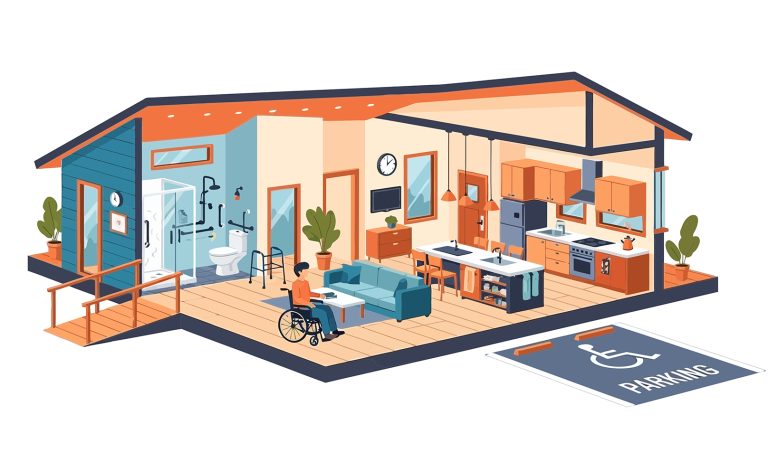
Wheelchair ramps, roll-in showers, ceiling lifts, door widening, smart-home technology — programs exist to help pay. Most families never hear about them.
Last updated: June 2026
Share on Facebook
Bookmark this guide
Jump to section
Many California families are eligible for far more assistance than they realize. The problem is that valuable programs are administered by different agencies, use different eligibility rules, and are rarely explained in one place. This guide serves as a roadmap, helping you understand what's available, who qualifies, what services are covered, and how the programs work together.
Interpreter services: Most agencies listed in this guide are required by law to provide free interpreter services in your language. When you call, ask for an interpreter before the conversation begins — you do not need to speak English to apply for any of these programs.
Program-by-program breakdown
Regional Centers (DDS)
California Department of Developmental Services
If your family member has a qualifying developmental disability — cerebral palsy, intellectual disability, epilepsy, autism, or a related condition that began before age 18 — your Regional Center may fund home modifications as part of an Individual Program Plan (IPP). One documented case involved a Regional Center funding nearly $180,000 in modifications including widened doorways, automatic door openers, and exterior ramps for a client with cerebral palsy. Funding is real and can be substantial, but it must be written into the IPP, and the Regional Center will typically hire its own contractor to assess scope.
Developmental disabilities, onset before age 18
Ramps, door widening, bathroom mods, lifts
Must be in your IPP — ask explicitly
Medi-Cal HCBS Waivers
Home and Community-Based Services — DHCS
California's Medi-Cal program offers several HCBS waivers — including the Home and Community Based Alternatives (HCBA) Waiver — that list home modifications as a covered benefit. These are formally called "Environmental Accessibility Adaptations" (EAAs) and can include wheelchair ramps, grab bars, roll-in shower conversions, and bathroom modifications. Approval requires documented medical necessity and must be part of your care plan. You must apply through the waiver agency serving your county and may be placed on a waiting list.
Medi-Cal enrollees with qualifying functional need
Ramps, grab bars, roll-in showers, door widening
Waiting lists exist; medical necessity required
California Children's Services (CCS)
DHCS — Children under 21 with serious medical conditions
CCS covers medical services for children and young adults under 21 with conditions like cerebral palsy, cancer, heart defects, traumatic injuries, and sickle cell. CCS does not directly fund home modifications as a standard benefit — however, if your child is enrolled in a 1915(c) HCBS waiver, modifications may be covered when medically necessary to prevent institutionalization. CCS is the gateway; talk to your case manager about waiver enrollment. Families with incomes above $40,000 may still qualify if medical expenses are significant.
Under 21 with CCS-eligible condition
Via HCBS waiver enrollment only
CCS alone does not cover home mods directly
VA Grants for Veterans
Specially Adapted Housing (SAH) + Special Home Adaptation (SHA)
Veterans with qualifying service-connected disabilities have access to the most generous home modification grants available. The Specially Adapted Housing (SAH) grant provides up to $121,812 to buy, build, or modify a home. The Special Home Adaptation (SHA) grant provides up to $23,444 and can be used for a home owned by a family member. There is also a Home Improvements and Structural Alterations (HISA) grant of up to $6,800 for service-related disabilities. None of these need to be repaid. If you or a family member served, this is the first place to look.
Veterans with service-connected disabilities
SAH: up to $121,812 · SHA: up to $23,444
SAH requires ownership or planned ownership of the home
Rebuilding Together + Area Agencies on Aging
Nonprofit programs — free or low-cost for qualifying homeowners
Rebuilding Together operates local affiliates across California providing free home repairs and accessibility upgrades for low-income homeowners, seniors, and people with disabilities. Services vary by affiliate but can include grab bars, ramps, handrails, and safety modifications. Area Agencies on Aging (AAA) in many counties also fund home modification programs — some using USDA Section 504 grants (up to $10,000 for rural homeowners) and others using Older Americans Act funding. Your local AAA is one of the most underused resources in California.
Low-income homeowners, seniors, people with disabilities
Grab bars, ramps, handrails, safety modifications
Availability and capacity vary by county and affiliate
CalHome + CDBG (HCD Programs)
California Dept. of Housing and Community Development
HCD funds local agencies and nonprofits through the CalHome program and Community Development Block Grant (CDBG) to support home rehabilitation for low- and very-low income homeowners. These funds go to local housing agencies and nonprofits, which then administer assistance in their communities — not to individuals directly. Check your city or county housing department to find what is available locally. In 2025, HCD made approximately $27 million available through CDBG.
Low- and very-low income homeowners
Rehabilitation, safety repairs, accessibility upgrades
Apply through local agencies, not HCD directly
Important — Medicare: Standard Medicare does not cover home modifications like ramps or roll-in showers. They are classified as home improvements, not durable medical equipment. Some Medicare Advantage plans may offer supplemental benefits — check your specific plan. Do not assume Medicare will pay.
Pro tip — stacking programs: You can combine funding sources. A Regional Center client who also has Medi-Cal may be able to use Regional Center funding for structural modifications and an HCBS waiver for assistive technology. Ask each agency explicitly whether their funding can be combined with others. They will not volunteer this.
Your action checklist
Steps to get home modifications funded
0 of 7 completed
Common questions
We rent. Are we eligible for any of these programs?
Some programs cover renters — but you will need written landlord permission for structural changes. HCBS waivers and Regional Center funding can sometimes apply in rentals. Rebuilding Together typically serves homeowners only.
What exactly counts as a home modification?
Covered modifications typically include: wheelchair ramps and lifts, roll-in showers and accessible bathrooms, door widening, ceiling track lift systems, grab bars, handrails, non-slip flooring, and sometimes smart-home devices that support independence. Aesthetic upgrades do not qualify.
How do I prove medical necessity?
Your doctor, occupational therapist, or physical therapist must document in writing that the modification is necessary for safe mobility, independent living, or to prevent institutionalization. Get this in writing before you apply anywhere.
Is there anything faster than these programs?
Your local Center for Independent Living (CIL) often has the fastest access to assistive devices and minor modifications. Some Area Agencies on Aging run quick-response programs for fall prevention items like grab bars. Find your nearest CIL at ilru.org.
Disclosure: Program availability and funding levels change. Eligibility rules, waiting lists, and grant amounts vary by county and are subject to state and federal budget decisions. Verify all details directly with each agency before making any financial or care decisions based on this guide. IHSS Connect does not administer any of the programs listed above.
Need help navigating care in California?
IHSS Connect matches caregivers and care recipients statewide — across all 58 counties.