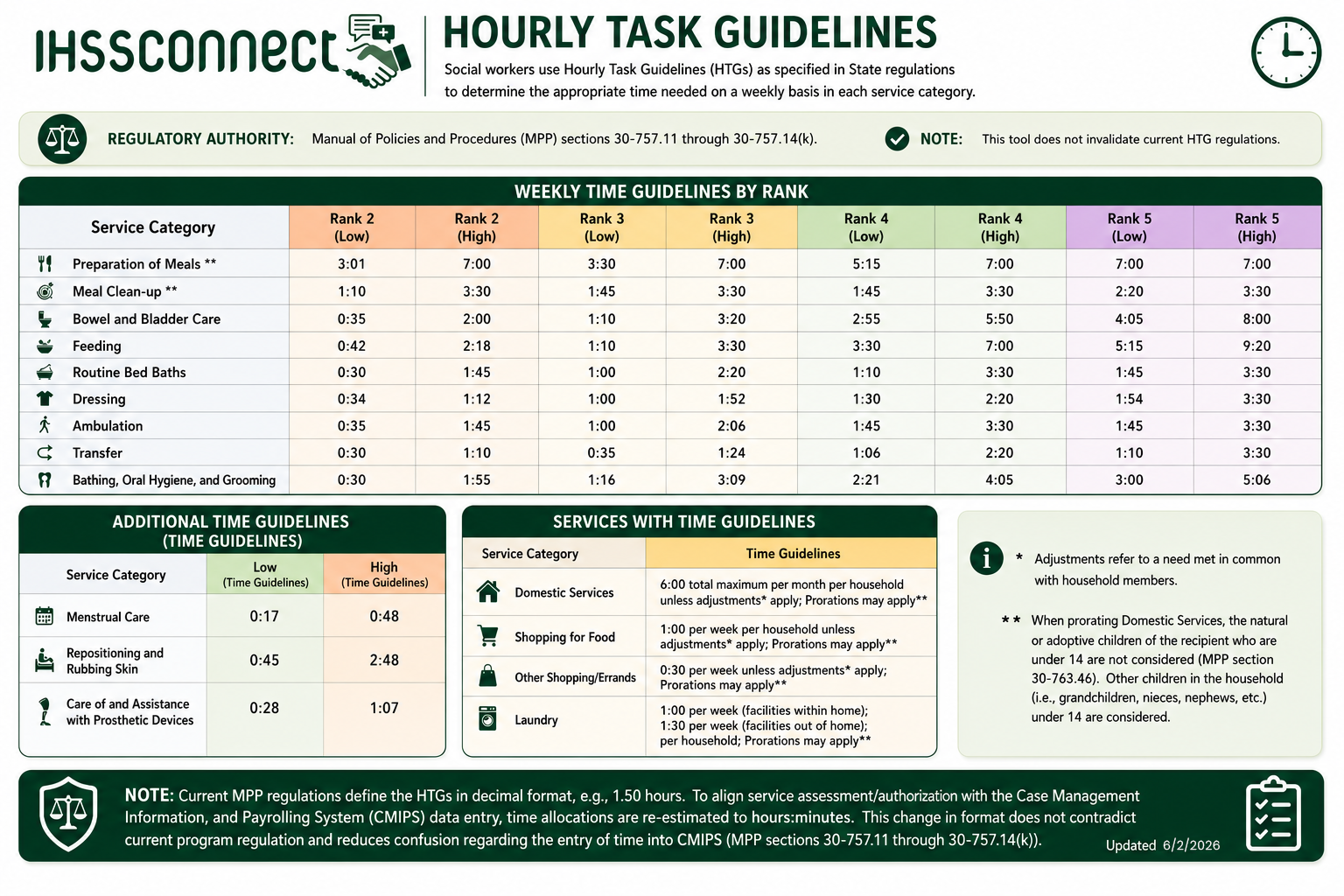

Social workers use the IHSS Hourly Task Guidelines (HTGs) to decide how much weekly time to authorize for each personal care service. The time depends on your Functional Index (FI) rank for that service, a scale from 1 (independent) to 5 (can’t do it at all), plus rank 6 for certain paramedical services.
Download the chart below, or scroll down for a text version, what each rank means, and how to ask for more time than the guideline when you need it.
IHSS Hourly Task Guidelines
PNG image · Updated 6/2/2026

The Hourly Task Guidelines, in text
Times are hours:minutes per week. A rank of 1 means you’re independent in that task, so no time is authorized for it.
Preparation of meals
- Rank 2
- 3:01 – 7:00
- Rank 3
- 3:30 – 7:00
- Rank 4
- 5:15 – 7:00
- Rank 5
- 7:00
Meal clean-up
- Rank 2
- 1:10 – 3:30
- Rank 3
- 1:45 – 3:30
- Rank 4
- 1:45 – 3:30
- Rank 5
- 2:20 – 3:30
Bowel and bladder care
- Rank 2
- 0:35 – 2:00
- Rank 3
- 1:10 – 3:20
- Rank 4
- 2:55 – 5:50
- Rank 5
- 4:05 – 8:00
Feeding
- Rank 2
- 0:42 – 2:18
- Rank 3
- 1:10 – 3:30
- Rank 4
- 3:30 – 7:00
- Rank 5
- 5:15 – 9:20
Routine bed baths
- Rank 2
- 0:30 – 1:45
- Rank 3
- 1:00 – 2:20
- Rank 4
- 1:10 – 3:30
- Rank 5
- 1:45 – 3:30
Dressing
- Rank 2
- 0:34 – 1:12
- Rank 3
- 1:00 – 1:52
- Rank 4
- 1:30 – 2:20
- Rank 5
- 1:54 – 3:30
Ambulation
- Rank 2
- 0:35 – 1:45
- Rank 3
- 1:00 – 2:06
- Rank 4
- 1:45 – 3:30
- Rank 5
- 1:45 – 3:30
Transfer
- Rank 2
- 0:30 – 1:10
- Rank 3
- 0:35 – 1:24
- Rank 4
- 1:06 – 2:20
- Rank 5
- 1:10 – 3:30
Bathing, oral hygiene, and grooming
- Rank 2
- 0:30 – 1:55
- Rank 3
- 1:16 – 3:09
- Rank 4
- 2:21 – 4:05
- Rank 5
- 3:00 – 5:06
| Service | Rank 2 | Rank 3 | Rank 4 | Rank 5 |
|---|---|---|---|---|
| Preparation of meals | 3:01 – 7:00 | 3:30 – 7:00 | 5:15 – 7:00 | 7:00 |
| Meal clean-up | 1:10 – 3:30 | 1:45 – 3:30 | 1:45 – 3:30 | 2:20 – 3:30 |
| Bowel and bladder care | 0:35 – 2:00 | 1:10 – 3:20 | 2:55 – 5:50 | 4:05 – 8:00 |
| Feeding | 0:42 – 2:18 | 1:10 – 3:30 | 3:30 – 7:00 | 5:15 – 9:20 |
| Routine bed baths | 0:30 – 1:45 | 1:00 – 2:20 | 1:10 – 3:30 | 1:45 – 3:30 |
| Dressing | 0:34 – 1:12 | 1:00 – 1:52 | 1:30 – 2:20 | 1:54 – 3:30 |
| Ambulation | 0:35 – 1:45 | 1:00 – 2:06 | 1:45 – 3:30 | 1:45 – 3:30 |
| Transfer | 0:30 – 1:10 | 0:35 – 1:24 | 1:06 – 2:20 | 1:10 – 3:30 |
| Bathing, oral hygiene, and grooming | 0:30 – 1:55 | 1:16 – 3:09 | 2:21 – 4:05 | 3:00 – 5:06 |
Services with a set time, not a rank range
Domestic services
- Time
- Up to 6:00 per month, per household
Laundry
- Time
- 1:00 per week (in the home) or 1:30 (out of the home)
Shopping for food
- Time
- 1:00 per week
Other shopping and errands
- Time
- 0:30 per week
Menstrual care
- Time
- 0:17 – 0:48 per week
Repositioning and rubbing skin
- Time
- 0:45 – 2:48 per week
Care of prosthetic devices
- Time
- 0:28 – 1:07 per week
Times shared with other people in the home can be split (prorated). The regulations list these times in decimal hours, such as 1.50 hours; we’ve converted them to hours:minutes (1:30), which matches how time is entered in CMIPS.
What each Functional Index rank means
Your social worker gives a separate rank for each service. Ranks look at how you function most of the time, including cognitive and emotional needs, not only physical ability.
- 1Independent. You can do the task safely without help. No time is authorized.
- 2Verbal help. You can do the task but need reminders, guidance, or encouragement.
- 3Some hands-on help. You can do part of the task but need some direct physical help.
- 4Substantial help. You can do only a small part of the task, with a lot of help.
- 5Can’t do it. You can’t do the task at all, with or without help.
- 6Paramedical. Used when meal prep, feeding, respiration, or bowel, bladder, and menstrual care are provided as paramedical services. A signed SOC 321 must be on file.
For a deeper look at how ranks are assigned, and how children are compared with same-age peers, read our guide to Functional Index rankings and Hourly Task Guidelines.
The guidelines are a starting point, not a cap
California’s regulations say each service follows its time guideline unless your needs require an exception. That works both ways: you can be authorized more time, or less, than the range shows.
- When an exception is required. Exceptions must be made when they’re needed for you to live independently or stay safely in your home.
- Your rank isn’t the only factor. The Functional Index rank is a contributing factor, but not the only one, in setting time for a task.
- The reason must be written down. The social worker has to document why an exception was made.
- Limits still apply. Exceptions can’t push your total past the monthly maximum of 195 or 283 hours, depending on your case. And time can’t be added because a provider works slowly.
How to use this chart
- Before your assessment, find each service you need help with and note the range for the rank you expect. Our free IHSS time estimator can add it up for you.
- Write down what really happens. If a task takes longer than the range, note why: resistance, safety risks, repeated steps, or two people needed. Specifics matter more than “needs help.”
- After you get your Notice of Action, compare each service’s time with the chart. A rank that seems too low, or time below the range with no explanation, is worth asking about.
- If something looks wrong, you can ask the county for a reassessment or file an appeal. Watch the deadline on your notice.
Frequently asked questions
What are the IHSS Hourly Task Guidelines?
They are statewide time ranges that IHSS social workers use to decide how much weekly time to authorize for each personal care service, based on your Functional Index rank for that service.
Are the Hourly Task Guidelines a maximum?
No. The regulations allow exceptions, for more or less time, when your needs require it. An exception must be made when it is needed for you to stay safely in your home. Your total hours still cannot go past the monthly maximum of 195 or 283 hours.
Why is there no time for rank 1?
Rank 1 means you can do the task safely on your own, so no time is authorized for that service.
What does Functional Index rank 6 mean?
Rank 6 is used when meal preparation, feeding, respiration, or bowel, bladder, and menstrual care are provided as paramedical services. A signed SOC 321 form must be on file before paramedical services can be authorized.
Why does the chart use hours and minutes instead of decimals?
The regulations list the guidelines in decimal hours, such as 1.50 hours. Converting them to hours and minutes, such as 1:30, matches how time is entered in CMIPS, the IHSS case system.
How much time is allowed for domestic services?
Domestic services are limited to 6 hours per month per household, unless an exception applies. The time may be split among people who share the home.
Read more
More guides from IHSS Connect
- IHSS Functional Index Rankings and Hourly Task Guidelines in California→
- IHSS Time Estimator: Be Prepared for the Home Assessment→
- How to Get More IHSS Hours: A Step-by-Step Guide→
- Meal Preparation and Meal Clean-Up: The Two IHSS Services Parents Get Wrong Most Often→
- Bathing, Oral Hygiene, and Grooming: The IHSS Service That's Actually Three→
- Domestic Services: What IHSS's Housekeeping Category Actually Covers→
Sources
- CDSS — IHSS Assessment and Authorization Training, Part I (PDF)HTG documentation worksheet with time ranges by rank
- CDSS — Hourly Task Guidelines regulation text (PDF)Exceptions, documentation, set time limits, and monthly maximums
- Disability Rights California — IHSS Assessment Criteria Worksheet (PDF)Time ranges by rank and services with set times
- Disability Rights California — IHSS In-Home and Self-Assessment GuideWhat each Functional Index rank means
- Los Angeles County DPSS — Reinstatement of Functional Rank 6When rank 6 is used and the SOC 321 requirement
- Orange County Social Services Agency — IHSS Needs Assessment (PDF)Services covered by HTGs and exception rules
About this guide
This IHSS Connect reference summarizes California’s IHSS Hourly Task Guidelines and Functional Index ranks for recipients, parents, and providers. The chart was published in June 2026. The text version, rank definitions, and FAQ were added and fact-checked against state and county sources in November 2026.
!Important: please read
This guide is general information, not legal advice.
- Your hours are set by your county. The ranges on this page don’t guarantee any number of hours. Your social worker decides based on your individual needs.
- Guidelines aren’t limits. You may be authorized more or less time than a range shows. Always ask why if your time looks wrong.
- Deadlines matter. If you disagree with a decision, follow the appeal deadline on your Notice of Action.
- Rules change. This guide reflects state rules as we understand them as of November 2026.
Spot something out of date? Let us know and we’ll check it.