How many IHSS hours
could you qualify for?
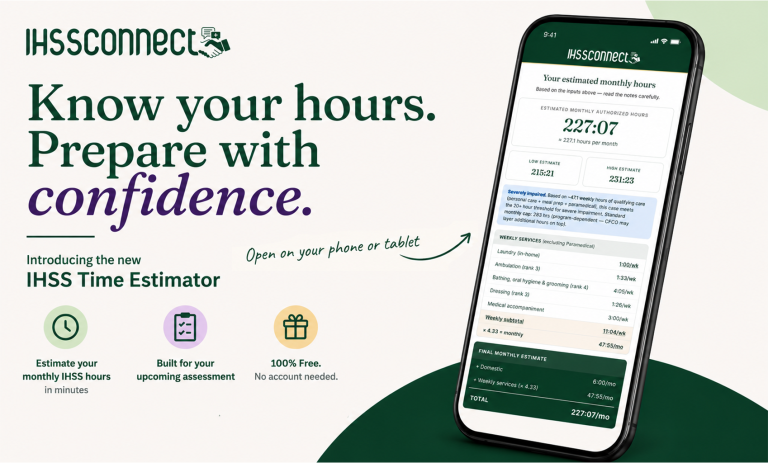
Estimate your potential monthly authorized hours below.
How It Works
- Pick the Functional Index rank that best describes the recipient's need for each task.
- Fill in extra details where asked (laundry location, household size, paramedical hours, etc.).
- If a service isn't needed, simply skip it — don't pick a rank.
- Your estimated monthly hours appear at the bottom. Tap to see the full breakdown and download a PDF.
Understanding the Functional Index Rankings
IHSS uses a 1–5 scale (plus Rank 6 for paramedical services) to describe how much help a person needs with each task. A county social worker assigns a rank per service category during your in-home assessment. Here's what each rank means under CDSS regulations (MPP §30-756.1):
For recipients under 18 (minors)
Children's IHSS needs are measured against what a neurotypical child of the same age would require. The need must be extraordinary — beyond typical parenting and beyond what any same-age child would need help with. A 4-year-old needing help with bathing isn't extraordinary; a 12-year-old needing the same help may be. This is where many families experience frustration during assessments, especially for younger children where it can be difficult to demonstrate that the need exceeds typical age-appropriate care. Keep a detailed daily log of tasks and behaviors to document the difference.
Services typically not covered for minors: Domestic Services, Laundry, Shopping & Errands, and Meal Prep & Cleanup are usually not authorized for children — parents are expected to provide these as part of normal parenting. Exceptions can be made when there is extraordinary need due to impairment — for example, a medically prescribed diet, excessive soiling of clothing and bedding requiring additional laundry, or other documented circumstances that exceed typical parental responsibilities.
Extraordinary need can override the standard rankings
In most cases, extraordinary need — documented evidence that a recipient requires more time than the standard Hourly Task Guidelines allow — can result in additional hours being authorized beyond what this tool estimates. This is determined by the County during their initial and annual assessments and is called an exception to the HTG. Examples include severe incontinence requiring extra cleanup, medically prescribed diets requiring complex meal prep, mobility issues that lengthen ordinary tasks, and many others. Document these needs carefully when speaking with your social worker.
Fine-tuning each estimate. Every IHSS task has a range of authorized time at each rank. Once you pick a rank, you can fine-tune each service with the Low / Mid / High toggle that appears underneath — useful when one service is at the low end of its range and another is at the high end. The default is Mid (the midpoint of each range).
This is an estimating tool — not a guarantee.
The SOC 873 — Health Care Certification Form must be completed by a licensed health care professional (M.D., D.O., physician assistant, nurse practitioner, etc.) as part of every new IHSS application. The county uses this form to confirm that the applicant has a medical condition that prevents them from living safely at home without assistance. Without it, your application cannot move forward.