
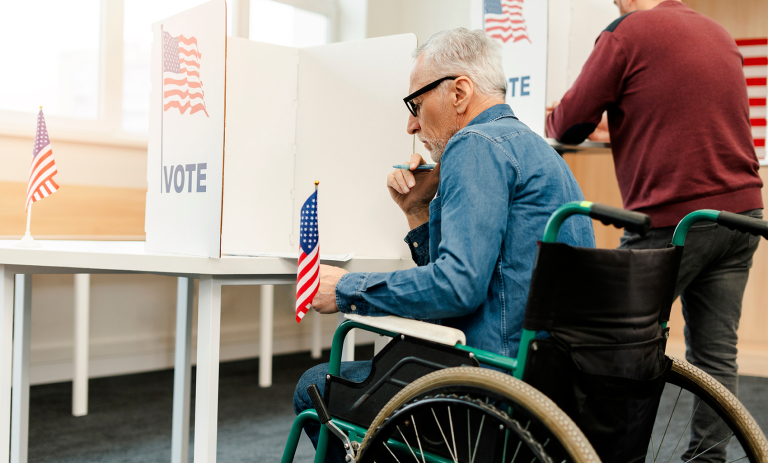
California’s general election is Tuesday, November 3, 2026. Voters will decide 14 statewide propositions. Several of them touch the money and services that IHSS recipients, providers, WPCS workers, and regional center families depend on, though not always in the way campaign ads suggest.
We read the Official Voter Information Guide, the Legislative Analyst’s Office (LAO) analysis of every measure, and the full legal text of the measures most tied to Medi-Cal. This guide explains what each one would actually do for our community. IHSS Connect does not endorse any proposition, candidate, or party. Our role is to help you vote with accurate information.
All 14 propositions at a glance
Grouped by how they could reach IHSS, WPCS, and regional center households. None of them changes those programs' rules directly.
Medi-Cal money
- Prop 40 One-time 5% tax on billionaires; 90% for health care Could add billions for Medi-Cal. IHSS is an allowed use, not a guaranteed one.
- Prop 41 Audits of new special taxes; spending-limit rule Can block Prop 40 if it gets more yes votes.
- Prop 42 Bans new taxes on owning personal property Can block Prop 40 if it gets more yes votes.
- Prop 3 Makes the 2012 high-income tax permanent Keeps $5–15 billion a year in the state budget after 2031.
Clinic access
- Prop 44 Nonprofit community clinics must spend 90% on care Some clinics might close, per the Legislative Analyst.
Voting access
- Prop 39 Voter ID in person; ID digits on mail ballots Which IDs count, and accommodations, decided later.
Budget structure
- Prop 2 Bigger rainy day fund More savings for downturns; less spent in good years.
- Prop 43 Two-thirds vote for voter-proposed local special taxes Could lower future local revenue.
- Prop 1 $11.25 billion housing bond Includes some supportive housing; $500–600 million a year to repay.
Little or no direct link
- Prop 4 Public financing of election campaigns
- Prop 5 Changes recall elections
- Prop 37 Loans for buyers of new homes
- Prop 38 Bonds for immunology research
- Prop 45 Faster environmental review
Source: Official Voter Information Guide and Legislative Analyst's Office, November 3, 2026, General Election. IHSS Connect does not endorse any proposition.
The short answer
No proposition on this ballot changes IHSS, WPCS, or regional center law. None of them names these programs. What the ballot can change is:
- How much money the state has for Medi-Cal, which pays for IHSS (Props 40, 41, 42, 3, and 2)
- Whether some community health clinics stay open (Prop 44)
- How you prove who you are when you vote (Prop 39)
Why a state ballot measure can reach your IHSS hours
IHSS is a Medi-Cal benefit. The California Department of Health Care Services tells recipients directly that they must renew their Medi-Cal to keep IHSS. WPCS is paid through the Home and Community-Based Alternatives (HCBA) waiver, which is also part of Medi-Cal, and regional centers draw part of their funding from a Medi-Cal waiver as well.
Medi-Cal is paid for with both federal and state dollars. According to the LAO, the state plans to spend about $250 billion this year from its main account, the General Fund, and about one-third of that goes to health and human services, mostly Medi-Cal. Anything that adds to or takes away from state revenue can eventually show up in Medi-Cal decisions. That is the thread that connects most of this ballot to your household.
The measures with the most at stake
Proposition 40: A one-time tax on billionaires, mostly for health care
What it does. People worth $1 billion or more who lived in California on January 1, 2026 would pay a one-time state tax equal to 5% of their net worth. The tax would be due in 2027, and they could spread payments over five years for an added charge. Real estate, pensions, and retirement accounts would generally not be taxed.
Where the money goes. After administrative costs, 90% goes to a health account and 10% goes to K–14 education and food assistance, including CalFresh. The health account can be used to restore federal or state funding cuts, protect Medi-Cal and other coverage for low- and moderate-income people, support safety-net providers, and prevent facility closures or service cuts. The Legislature can spend up to $22.5 billion a year from the health account, and the money cannot be used to replace existing state funding for health care.
How much. The LAO says the state would probably collect tens of billions of dollars spread over several years, but the amount and timing are very hard to predict. It also estimates the state could lose less than $1 billion a year in ongoing income tax if some billionaires leave or change how they report income.
How fast. The measure sends legal challenges on a fast track. Courts are directed to make every effort to decide them by April 1, 2027 (Sacramento Superior Court) and November 1, 2027 (California Supreme Court). Even if Prop 40 passes, this money would not arrive overnight.
Who is on each side. Supporters include SEIU United Healthcare Workers West, the union behind the measure, and disability groups such as Disability Voices United. Opponents listed in the official guide include the California Primary Care Association, which represents community health centers, along with the California School Boards Association and the California Taxpayers Association. Health care organizations are on both sides.
Propositions 41 and 42: The two measures that can cancel Prop 40
Prop 41 would require the State Auditor to review programs that would receive money from new special taxes, both before a voter initiative reaches the ballot and every four years after a new tax passes. It could also stop the state from leaving new special-tax spending outside its constitutional spending limit. The LAO says the overall money effect is unknown.
Prop 42 would ban new taxes on owning financial assets or other personal property and would limit taxes that reach back in time. The LAO says this could make future state revenue lower, but it is unclear when or by how much.
The link. The LAO warns that if Prop 41 or Prop 42 receives more yes votes than Prop 40, courts could find that they conflict, and Prop 40 might not take effect even if a majority of voters approve it.
Proposition 44: Community clinics must spend 90% of revenue on care
What it does. It applies to private nonprofit safety-net clinics, the federally qualified health centers many low-income Californians use. Those clinics currently report spending about 80% of their revenue on health care services, on average. Prop 44 would require at least 90%, leaving no more than 10% for everything else. The Attorney General would define what counts. A clinic that falls short would pay a penalty equal to the gap; it could get the money back if it complies within five years. Clinics could ask for a temporary waiver in some cases.
Why it matters here. These clinics mainly serve low-income and uninsured people, including Medi-Cal members. The LAO says some clinics that cannot meet the new minimum might close instead, with uncertain effects on state and local costs. For people who rely on a nearby clinic for primary, dental, or mental health care, a closure is a real loss of service.
Who is on each side. SEIU United Healthcare Workers West placed it on the ballot. Opponents listed in the official guide include the California chapter of the American Academy of Pediatrics, the California Medical Association, the California Academy of Family Physicians, and the California School Nurses Organization.
Proposition 3: Making the 2012 high-income tax permanent
What it does. It makes permanent the higher income tax rates on high earners (individuals earning over about $371,000, adjusted each year) that voters approved in 2012 and extended in 2016. Without Prop 3, those rates expire in 2031. The LAO says this keeps $5 billion to $15 billion a year in the state budget. Roughly 40% goes to schools and community colleges; the rest goes to other state programs, with part set aside in reserves.
The Medi-Cal piece. The measure’s text keeps an existing rule: in years when this tax brings in more than schools need to meet their constitutional minimum, half of the extra, up to $2 billion a year, goes to the Department of Health Care Services for Medi-Cal care for children and their families. That amount can be reduced in a declared budget emergency.
What it means for our community. Nothing in Prop 3 is aimed at IHSS. Its main effect for adults who use IHSS is that it avoids a large drop in state revenue starting in 2031, when Medi-Cal and every other program would otherwise compete for a smaller budget. That is our reading of the budget math, not a stated purpose of the measure. Supporters include the California Teachers Association and the California State PTA; opponents include the California Taxpayers Association and the California Hispanic Chambers of Commerce.
Your vote itself: Proposition 39 (voter ID)
What it does. In-person voters would show government-issued ID. Mail voters would write the last four digits of a government ID number, the one they chose in their voter registration, on the ballot envelope. Ballots would be counted only after the voter’s identity is verified. Elections officials would make “best efforts” to confirm that everyone on the voter rolls is a U.S. citizen. The state would give a free voter ID card to anyone who asks.
What is not decided yet. The Legislature would have to pass laws spelling out which IDs count and other details. The measure itself does not say how it would accommodate voters who cannot travel to get an ID or who need help completing their ballot envelope.
Cost and positions. The LAO estimates state and local costs of tens of millions to low hundreds of millions of dollars a year. Supporters listed in the official guide include The Transparency Foundation and the Howard Jarvis Taxpayers Association. Opponents include ACLU California Action; the ACLU of Southern California says the new requirements would fall especially hard on voters with disabilities.
Prop 39 is on this ballot, so it does not change how you vote in this election.
Measures that shape the budget
Proposition 2: A bigger rainy day fund
The state would keep saving until its rainy day fund reaches 20% of General Fund taxes, up from 10%, and would keep making extra debt payments through 2040. The LAO says reserves would be higher, making the budget somewhat easier to balance when revenue drops. The tradeoff: money saved in good years is not spent in those years. Reserves are what the state draws on before it has to cut programs in bad years.
Proposition 43: Two-thirds vote for voter-proposed local special taxes
Starting January 1, 2027, any new, increased, or extended local tax for a specific purpose that voters propose would need a two-thirds vote instead of a simple majority. The LAO says local tax revenue could be lower in the future. We found nothing tying this measure to the county share of IHSS costs.
Proposition 1: $11.25 billion housing bond
Of this, $10 billion would be repaid from the General Fund. It includes $7.2 billion for affordable rental housing, part of which would go to supportive housing with on-site services. The LAO estimates repayment at $500 million to $600 million a year for about 25 years.
Measures with little or no direct link to our community
- Prop 4: allows public financing of election campaigns.
- Prop 5: changes the recall process for statewide officers.
- Prop 37: creates a loan program for middle-income buyers of qualified new homes.
- Prop 38: authorizes bonds for immunology medical research.
- Prop 45: speeds up environmental review for certain projects.
Voting with a disability: what is available now
Key dates
- October 5, 2026 Counties begin mailing ballots by this date.
- October 19, 2026 Last day to register to vote online. After this, you can still register and vote in person at your county elections office or a polling place (same-day registration).
- November 3, 2026 Election Day. Polls are open 7:00 a.m. to 8:00 p.m. A mailed ballot must be postmarked on or before this day.
Voting with a disability
Options available in every California county for the November 3 election.
- Vote at home with a screen reader or other tools. Remote Accessible Vote-by-Mail (RAVBM) lets you mark your ballot privately on your own device, then print it, sign the envelope, and mail it or drop it off. It cannot be returned electronically. Request it through My Voter Status on the Secretary of State's website or from your county elections office.
- Sign without guessing. Mail ballot envelopes have punched holes that show a voter with low vision where to sign.
- Vote in person, accessibly. Every polling place and vote center must be accessible and have accessible voting machines. Curbside voting lets you park as close as possible to the voting area.
- Track your ballot. Sign up at WheresMyBallot.sos.ca.gov for email, text, or voice updates.
- Read the guide your way. The Official Voter Information Guide is available in American Sign Language, audio, and large print.
Questions about voting?
Secretary of State Voter Hotline · TTY 711
Questions? Call the Secretary of State’s Voter Hotline at (800) 345-VOTE (8683), or TTY 711. You can also contact your county elections office.
How we put this together
We relied on the Official Voter Information Guide, the Legislative Analyst’s analyses, and the full text of Propositions 3 and 40. When a claim comes only from a campaign or an advocacy group, we say so. We report which organizations support or oppose each measure; we do not endorse any of them.
Sources
- Official Voter Information Guide: Propositions (CA Secretary of State) — the list and official titles of all 14 measures; supporters and opponents named in each summary
- Prop 40: Analysis by the Legislative Analyst — how the tax works, the 90/10 split, revenue estimates, the possible income tax loss, and the Prop 41/42 conflict
- Prop 40: Text of Proposed Law (PDF) — allowed uses of the health account, the $22.5 billion yearly cap, the no-supplanting rule, the expedited court timeline, and the absence of any mention of IHSS, WPCS, or regional centers
- Prop 40: Summary, supporters and opponents — opponents listed in the official guide
- Latino Times: Prop 40 will use money to support Medi-Cal, supporters say (Aug. 29, 2026) — Disability Voices United among Prop 40 endorsers (secondary source)
- Prop 41: Analysis by the Legislative Analyst — audit requirements, spending-limit change, unknown net effect, and the conflict with Prop 40
- Prop 42: Analysis by the Legislative Analyst — the ban on new personal property taxes, limits on retroactive taxes, and the conflict with Prop 40
- Prop 44: Analysis by the Legislative Analyst — the 80% current average, the 90% rule, penalties, waivers, and possible clinic closures
- Prop 44: Summary, supporters and opponents — opponents listed in the official guide
- CalMatters: Proposition 44, clinic funding — SEIU-UHW placed the measure on the ballot
- Your guide to Proposition 44 (Yahoo News) — the $1.7 billion penalty estimate and that it came from a California Primary Care Association study
- Prop 3: Analysis by the Legislative Analyst — the $5–15 billion yearly range, the 2031 expiration, and the roughly 40% school share; state General Fund size and the health and human services share
- Prop 3: Summary, supporters and opponents — the $371,000 income threshold and the organizations on each side
- Prop 3: Text of Proposed Law (PDF) — the Medi-Cal allocation for children and families, its $2 billion cap, and the budget-emergency exception
- Prop 39: Analysis by the Legislative Analyst — in-person and mail ID rules, citizenship verification, the free voter ID card, the need for follow-up laws, and costs
- ACLU SoCal 2026 Voter Guide — the opposing argument that Prop 39 would especially burden voters with disabilities
- Prop 2: Analysis by the Legislative Analyst — the 20% rainy day fund target, debt payments through 2040, and the effect on reserves
- Prop 43: Analysis by the Legislative Analyst — the two-thirds vote rule starting January 1, 2027, and possible lower local revenue
- Prop 1: Analysis by the Legislative Analyst — the $11.25 billion bond, the $7.2 billion for rental housing including supportive housing, and repayment costs
- DHCS: IHSS and Medi-Cal flyer (PDF) — IHSS recipients must renew Medi-Cal to keep IHSS
- CA Secretary of State: Make a Plan to Vote — ballot mailing date, registration deadline, postmark rule, RAVBM, curbside voting, and accessible polling places
- CA Secretary of State: Remote Accessible Vote-by-Mail — how RAVBM works and how to request it
- CA Secretary of State: Vote by Mail — Where's My Ballot tracking
- California Online Voter Registration — same-day registration after the deadline
- CA Secretary of State: Elections contact information — Voter Hotline numbers and TTY 711
The Official Voter Information Guide, the Legislative Analyst's analyses, and the measures' own text are the primary authorities throughout. Where a campaign or advocacy group is the only source for a claim, the article says so.
About this article
IHSS Connect publishes this article for general information and education. It is not legal advice, and it is not a recommendation on how to vote. IHSS Connect does not endorse any proposition, candidate, or party, and is not affiliated with the California Secretary of State, the Legislative Analyst’s Office, or any county agency.
Ballot measures can be challenged in court, and how a measure is carried out depends on later decisions by the Legislature and state agencies. Only your county elections office can answer questions about your registration or your ballot.
For help with voting: Secretary of State Voter Hotline (800) 345-VOTE (8683), TTY 711. For help with your IHSS case, contact your county IHSS office.
Information reflects the Official Voter Information Guide for the November 3, 2026, General Election. Verified October 2026. Published October 7, 2026.