If you’ve been dreading your next annual IHSS reassessment because of the in-person visit itself — clearing your schedule, making sure the home is presentable, coordinating around your provider or your child’s school day — there’s real news for you: since late 2024, California has made it permanently possible for many recipients to do that reassessment by phone or video instead.
But “permanently possible” is not the same as “available to everyone, whenever they want.” This article walks through exactly who can use the telehealth option, how a telehealth reassessment actually works, and — just as important — the specific things it cannot do, so you know what to expect before you ask your county about it.
Telehealth reassessment, at a glance
Where This Option Came From
Telehealth reassessments started as a pandemic accommodation. From March 2020 through February 2023, California’s declared state of emergency let counties conduct IHSS assessments and reassessments by phone or video to reduce COVID-19 exposure risk. When the emergency ended, in-person reassessments resumed by default — but both recipients and counties had seen enough benefit that the state moved to keep a version of it permanently.
The California Department of Health Care Services submitted a State Plan Amendment (SPA 23-0005) asking the federal government to authorize a permanent telehealth reassessment option under Medicaid rules. That amendment was approved on May 1, 2024. CDSS then issued All County Letter (ACL) 24-72 on October 8, 2024, laying out the policy and eligibility criteria, followed by ACL 25-55 on July 24, 2025, which reiterated the option while emphasizing that counties still have to meet the same state and federal accuracy and program-compliance requirements. According to a county-employee union’s account of state training briefings, statewide staff training ran through August and September 2025, with the option rolling out to recipients by the end of that September.
Mar 2020 – Feb 2023
COVID-19 emergency accommodation
Counties allowed to conduct assessments/reassessments by phone or video.
May 31, 2023
DHCS submits SPA 23-0005
Asks CMS to permanently authorize a telehealth reassessment option under Medicaid.
May 1, 2024
Federal approval
CMS approves the State Plan Amendment.
Oct 8, 2024
ACL 24-72 issued
CDSS sets the policy and the 10 stable-care-needs eligibility criteria.
Jul 24, 2025
ACL 25-55 issued
Reiterates the option; emphasizes counties must still meet accuracy/compliance rules.
Aug–Sep 2025
Statewide staff rollout
Per a county-employee union account, training ran through the summer with rollout by late September.
Who Qualifies: The 10 “Stable Care Needs” Criteria
Telehealth reassessment isn’t a blanket right — it’s limited to recipients CDSS considers to have “stable care needs.” Per ACL 24-72, that means meeting all of the following at the time of reassessment:
- Age 19 or older
- No Adult Protective Services incidents since the last reassessment
- No documented health/safety concerns or suspicion of fraud
- No 24+ hour hospitalization/facility stay or multiple ER visits in the last 3 months
- No gap in provider services in the last 6 months
- No change of residence since the last reassessment
- Lives with others, if help is needed due to a memory/judgment/orientation impairment
- No authorized representative currently directing care
- Does not require a protective supervision assessment/reassessment
- No complex paramedical needs
Worth knowing
Telehealth is only available for reassessments — never a first-time IHSS assessment. You must have already completed one in-person initial assessment and at least one in-person reassessment first. A recipient who turns 18 needs one in-person reassessment after their birthday before telehealth becomes an option.
How a Telehealth Reassessment Actually Works
A telehealth reassessment isn’t a shortened or informal version of the process — CDSS guidance requires counties to handle it the same way as an in-person reassessment, just conducted remotely. A few specifics worth knowing:
- You’re still expected to be in your home environment during the call, even though the worker isn’t physically there.
- If the worker can’t visually observe you or your living space over video (or the call is audio-only), they must ask detailed questions to gather the same information they’d otherwise have observed, and document it in your case file.
- All standard forms are still required, and any form that needs an original signature still needs one — telehealth doesn’t waive that.
- If you have a language or communication barrier, the county must ensure your comfort and provide translation services or auxiliary aids, the same as they would in person.
The Limits: What Telehealth Reassessment Can't Do
This is the part that matters most if you’re hoping telehealth solves every visit-related frustration. It solves one specific thing — your annual reassessment — and only under narrow conditions.
It can’t replace a program-integrity or QA visit
This is the single most important limit. An Unannounced Home Visit is a separate legal process, triggered by a specific program-integrity concern (see WIC §12305.71(c)(3)), and CDSS guidance is explicit that telehealth cannot substitute for one.
Flag
Telehealth reassessment cannot be used for quality assurance or program integrity home visits (CDSS ACL 24-72). Choosing a phone or video reassessment does not exempt you from — or protect you from — an Unannounced Home Visit if your case is otherwise flagged for one. The two processes are entirely separate.
It’s capped at every other year
Even for recipients who qualify every time, an in-person reassessment is still required at least every other cycle. You cannot stay on telehealth indefinitely — the state has built in a recurring in-person check.
It doesn’t apply to protective supervision
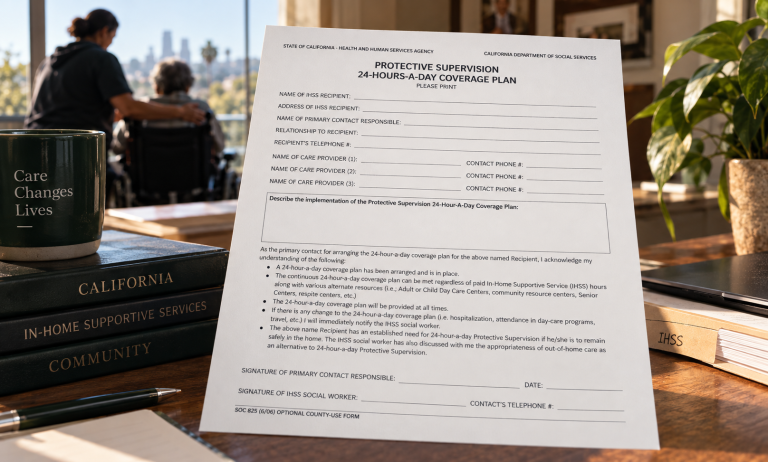
If your case involves an assessment or reassessment for protective supervision — 24-hour supervision for a memory, judgment, or orientation impairment that puts someone at risk of harm — telehealth is off the table entirely. That determination has to be made in person.
It’s opt-in, not opt-out of process
Choosing telehealth doesn’t waive the Notice of Action requirement, the documentation standard, or any of your appeal rights. Whatever the reassessment concludes — more hours, fewer hours, or no change — you still get the same written notice and the same right to a state hearing you’d get from an in-person visit.
In practice, it may depend on staff availability too
CDSS describes eligibility in objective terms — you either meet the 10 criteria or you don’t. But a county-employee union representing eligibility workers described the rollout differently in an August 2025 update to its members: telehealth appointments, in their account, happen “only if the recipient agrees and if the social worker agrees to provide it.”
That’s a labor-advocacy account of an implementation still ramping up, not a CDSS policy statement, so treat it as a real possibility rather than a guarantee either way: even if you meet every stable-needs criterion, don’t be surprised if a county still schedules an in-person visit for scheduling or staffing reasons of its own.
How to Actually Ask For It
- Contact your county IHSS social worker or your county’s IHSS office ahead of your next scheduled reassessment.
- Ask specifically about the “Telehealth Reassessment Option” and whether your case currently meets the stable-needs criteria.
- If you’re told no, ask which specific criterion is the issue — it may be temporary (like a recent hospitalization) and could clear by your next cycle.
- Either way, you can always choose an in-person reassessment instead. Nothing about asking for telehealth puts your in-person option at risk.
If It Doesn't Work Out the Way You Expected
If your county denies a telehealth request you believe you qualify for, or a telehealth reassessment itself doesn’t go the way you expected — hours changed unexpectedly, or you felt rushed through questions you’d normally answer in person — you have the same rights you’d have after any reassessment: ask for the reasoning in writing, and appeal through a state hearing if you disagree with the outcome.
Worth knowing
A denied telehealth request is not a denial of services — it just means your reassessment happens in person instead. Your underlying right to be reassessed, and to appeal the result, isn't affected either way.
Want to ask your county about telehealth reassessment?
Start with your assigned social worker — these are backup contacts if you need them.
- IHSS Service Desk1-866-376-7066
- CDSS Public Inquiry & Response1-800-952-5253
- IHSS Fraud Hotline (DHCS)1-888-717-8302
- Free legal helpLawHelpCA.org
About This Article
IHSS Connect publishes this article for general information and education. It is not legal advice, and reading it does not create an attorney–client relationship. IHSS Connect is not a law firm and is not affiliated with the California Department of Social Services or any county agency.
Program rules, timelines, and procedures change — sometimes without much advance notice. Only your county IHSS office can tell you why a specific visit or reassessment happened in your case.
If a visit or reassessment in your case seems wrong, or you want advice about your own situation, talk to someone who can look at your file:
- Free and low-cost legal help: LawHelpCA.org
- IHSS Service Desk for Providers & Recipients: 1-866-376-7066
- CDSS Public Inquiry and Response: 1-800-952-5253
- IHSS Fraud Hotline (DHCS): 1-888-717-8302
Verified October 2026.
Sources
- CDSS ACL 24-72 — the 10 stable-care-needs criteria and call procedure requirementscdss.ca.gov — ACL 24-72 PDF
- IHSS Telehealth Assessments — LSNC Regulation Summaries — plain-language walkthrough of ACL 24-72reg.summaries.guide/2024/11/ihss-telehealth-assessments
- IHSS — LSNC Regulation Summaries (ACL 25-55 update) — July 2025 updatereg.summaries.guide/2025/09/ihss-telehealth-assessments-2
- Justice in Aging — IHSS Program Summary — independent corroboration of the stable-needs criteriajusticeinaging.org/in-home-supportive-services-californias-personal-caregiving-program
- SPA 23-0005 (DHCS to CMS, May 31, 2023) — federal Medicaid authorization pathwaydhcs.ca.gov — SPA 23-0005 PDF
- WIC § 12305.71 — statutory basis for Unannounced Home Visits, which telehealth cannot replacecodes.findlaw.com/ca/welfare-and-institutions-code/wic-sect-12305-71
- IHSS Telehealth Reassessment — UPE, Local 1 — county-employee union account of the 2025 rolloutupe1.org/post/ihss-telehealth-reassessment
CDSS is the primary authority throughout. Where a labor-advocacy or legal-aid secondary source and a CDSS All County Letter differ, the ACL governs — secondary accounts are noted as such above.