Care Log: Free Daily Care Journal for Caregivers & Families

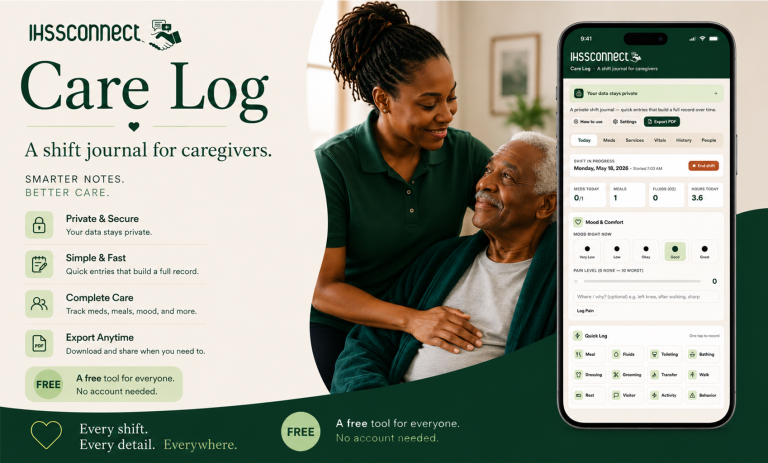
Caregiving moves fast — and important details can easily get forgotten. Care Log helps caregivers keep organized daily notes about routines, behaviors, medications, appointments, symptoms, and care needs right from their phone or tablet. Always free to use and no account with IHSS Connect required.

Care Log  ·  A shift journal for caregivers
Your data stays private
Everything you log is saved only in this browser on this device. Nothing is uploaded anywhere — not to IHSS Connect, not to a server, not to the cloud. To share with family or a doctor, use Export PDF.
A private shift journal — quick entries that build a full record over time.
Shift in progress
Today
Meds today
0/0
Meals
0
Fluids (oz)
0
Hours today
0.0
Mood & Comfort
0
Quick Log
One tap to record
Note
Voice-typing works in your phone keyboard
Today's timeline
0 entries
No entries yet today. Tap any quick-log button or start a shift above.
Add each scheduled medication once. The list shows up every shift so you can tap to log when given.
Scheduled medications
Today's doses
Mark the services authorized for this Recipient. Check the categories where IHSS has authorized time for care. This list reminds you what to focus on each shift — you only need to set it once.
Domestic Services
Personal Care Services
Other Authorized Services
Log vitals as often or as little as needed. All readings appear in the timeline and the exported PDF.
Blood pressure
Blood glucose
Weight & temperature
Sleep
Date range
Range summary
All entries
This information stays on your device only. The Care Recipient's health information you enter below is stored locally in this browser. Nothing is sent to IHSSConnect, our servers, or anywhere else. Use Download Backup to save a copy you control.
Care Recipient
Caregiver (You)
Backup & Restore

Your log lives in this browser. Download a backup file regularly — especially before clearing browser data or switching devices.

Log entry

Add medication

How to use the Care Log

Your data stays private. Everything you log is saved only in this browser on this device. Nothing is uploaded anywhere.
Quick start — 4 steps
1
Fill in the People tab first
Enter the care recipient's name, conditions, allergies, doctor, and emergency contact. Add your own name and IHSS provider number. This info appears on every PDF you export, so doctors and social workers can see who the log is about.
2
Add medications in the Meds tab
Tap Add medication once for each scheduled medication. Enter the name, dose, and times of day (like 08:00, 20:00). After that, the doses show up automatically every shift, and you just tap Taken or Refused.
3
Log throughout your shift on the Today tab
Tap Start shift when you arrive. Use the mood and pain controls, the one-tap Quick log chips (meal, fluids, bathing, transfer, etc.), and the Note field for anything specific. Tap End shift when you leave.
4
Export a PDF anytime
Go to the History tab, pick a date range (last 7 days, this month, etc.), and tap Export PDF. You'll get a clean clinical-style document you can email, print, or hand to a doctor or social worker.
What each tab does
Today — your shift dashboard

The main page where you log everything as it happens. Includes mood, pain, one-tap activity chips, a free-text note field with an incident-flag button, and a live timeline of today's entries.

Meds — medication schedule and tracking

Add each scheduled medication once. The tool shows you today's doses automatically and lets you mark each as taken or refused with one tap. Refused medications are highlighted in the PDF.

Tasks — IHSS-authorized task checklist

Check off the IHSS-authorized tasks you complete each shift (domestic services, personal care, paramedical, etc.). Tasks reset every day and are recorded in your timeline and the PDF.

Vitals — blood pressure, glucose, weight, temperature, sleep

Log vitals whenever you take them. All readings flow into the timeline and the PDF, so doctors can spot trends over time.

History — past entries and PDF export

Pick a date range to see all your entries grouped by day, with summary stats (meals, fluid intake, medication adherence, incidents, etc.). This is also where you export the PDF or download a CSV.

People — profiles and backup

Information about the care recipient and you, the caregiver. Also has Download Backup (save a copy of all your data), Restore (load a backup), and Wipe (erase everything).

Common questions
Why log every shift?

Three reasons: (1) a written record helps doctors and family see patterns and changes over time, (2) if anyone ever questions your hours or care quality, a contemporaneous log is your best evidence, (3) it makes hand-offs to other caregivers smooth and consistent.

What's an "incident"?

Anything unexpected or concerning: a fall, a new bruise, refusing food or medication, an unusual mood change, a visit from another caregiver, an ER trip. When you flag something as an incident, it gets a red highlight in the PDF and its own summary section.

Will I lose my data if I close the browser?

No. Your data is saved in this browser on this device, so it'll be here next time you visit this page. But if you clear browser data, switch devices, or use a different browser, the data won't follow. Use the Download Backup button regularly — especially before clearing browsing data — to save a copy you can restore later.

Can I use this on my phone?

Yes. The tool is designed to work on phones and tablets. For the best experience, add this page to your home screen so it opens like an app: on iPhone use Share → Add to Home Screen, on Android use the three-dot menu → Add to Home screen.

How do I share my log with family?

Tap Export PDF, pick a date range, and save it as a PDF. You can email it, text it, print it, or upload it anywhere you'd share any other document.

Does this replace my IHSS timesheet?

No. This is a separate care log for your own records and to share with doctors, family, and social workers. You still submit your IHSS timesheet the usual way. However, having a detailed daily log is very useful if your hours are ever audited or questioned.

Settings

Your data never leaves this browser. To share with family or your social worker, use Export PDF.

Saving Your Care Log — IHSSConnect Guide
IHSSConnect  ·  Care Log

Keeping Your Data Safe on a Phone or Tablet

A simple guide to downloading, storing, and restoring your Care Log backup — so your records are never lost.

Everything stays on your device — nothing is uploaded to a server
6 sections  —  tap any section to expand
1 What “Download Backup” actually does
The log is saved as a .json file
When you tap Download Backup in the People tab, the Care Log packages everything — all entries, medications, people profiles, authorized services, and settings — into a single file named something like ihss-care-log-backup-2025-05-18.json. Think of it like a complete snapshot of the entire log at that exact moment.
It only captures the moment you tap it
The backup file is a one-time snapshot. Any entries added after downloading are not automatically included. Download a fresh backup after any important shift — especially if a fall, medication refusal, or behavior incident was logged.
2 Where does the file go on my phone?
iPhone & iPad
Safari or Chrome on iOS
  • 1
    A share sheet appears right after tapping Download Backup
  • 2
    Tap "Save to Files"
  • 3
    Choose On My iPhone (local) or iCloud Drive (all Apple devices)
  • 4
    Tap Save — find it later in the Files app
Best option: iCloud Drive — safe even if your phone is lost or damaged.
Android Phones & Tablets
Chrome or Firefox
  • 1
    File downloads automatically to your Downloads folder
  • 2
    Open the Files app to find it
  • 3
    Look for the name starting with ihss-care-log-backup-
  • 4
    Optional: move it to Google Drive for safekeeping
Best option: Google Drive — accessible from any device.

The easiest method for most caregivers: email it to yourself

After downloading on iPhone, tap Mail or Gmail in the share sheet and send the file to your own address. On Android, open Files, long-press the backup file, and share it to your email app.

Now the backup lives in your inbox with a clear timestamp. If you ever switch phones, lose your device, or clear your browser — open that email from any device, save the attachment, and restore.

This is the most reliable method for caregivers less comfortable with technology. Emails don’t disappear when you swap phones.

3 How to restore from a backup file

Step-by-step restore

Open the Care Log and go to the People tab.

Tap Restore from File. Your phone’s file picker opens.

Navigate to where you saved the file: Downloads, Files app, iCloud Drive, or open your email first, save the attachment, then find it in Downloads or Files.

Tap the ihss-care-log-backup-[date].json file. A confirmation shows the entry count and Care Recipient’s name so you can verify it’s the right file.

Confirm the restore. All previous entries, medications, and profile information load immediately.

Restoring replaces everything currently in the browser
Any entries made after the backup was created will be overwritten. Example: backed up Monday, restored on Friday — Tuesday through Thursday entries are gone. If you want to keep newer entries, download a fresh backup before restoring.
4 Your data does NOT transfer automatically between devices
This is the most important thing to understand

If you log on your phone Monday and open the Care Log on a different device Tuesday, that device starts completely empty. The Backup and Restore feature is the only bridge between devices.

Why this happens

The Care Log stores everything inside your browser using a feature called localStorage — like a notebook that lives inside one specific browser on one specific device. Opening the Care Log anywhere else shows a completely different, empty notebook.

These are NOT the same log: Safari on your iPhone  ≠  Chrome on your iPhone  ≠  Chrome on your tablet  ≠  Your co-caregiver’s phone
The fix: always use the same browser on the same device Pick one browser (Safari on iPhone, Chrome on Android) and always open the Care Log there. Back up regularly.
Two caregivers sharing one Care Recipient?
Each caregiver keeps their own log on their own device. To share a week’s records: the first caregiver downloads a backup and emails it to the second, who restores it. Establish a handoff routine — download and email the backup at the end of each caregiver’s week.
5 Practical advice: when to back up
After any serious incident — fall, ER visit, behavior episode

Whenever something significant happens — a fall, a trip to the ER, a severe behavior episode, a medication refusal — download a backup immediately after logging it. This creates a timestamped record that is very difficult to dispute later, and ensures the entry is preserved even if something happens to your phone that night.

At the end of each week, as a habit

Build a routine of downloading a backup every Friday evening or every Sunday before the new week starts. Email it to yourself and leave it in your inbox. Seven days of logs in a single file is a reasonable amount — not so much you’d lose everything if something went wrong, and not so frequent it becomes a burden.

Before clearing browser data or switching phones

Any time you plan to clear your browsing history, clear your cache, or do a factory reset — download a backup first. Also download before upgrading to a new phone. The upgrade process does not transfer browser localStorage, so you’ll need to restore from the backup file once set up on the new device.

Before a doctor’s appointment or social worker visit

When you need to present records, use the Export PDF feature in the History tab for the actual document. It’s also good practice to download a backup right before exporting — that way you have a complete machine-readable copy of all your data at that exact point in time.

Simple step-by-step for caregivers new to smartphones

Go to the People tab. Tap Download Backup. When the share sheet appears, tap Mail or Gmail. Type your own email address. Tap Send.

Your data is now in your email. To restore later: open that email from any device, tap the attachment, save it to Files (iPhone) or Downloads (Android), then go to the Care Log’s People tab, tap Restore from File, and find the saved file.

6 Make the Care Log feel like a native app
Add to Home Screen — iPhone
Opens without browser bar
  • 1
    Open the Care Log in Safari
  • 2
    Tap the Share button (box with arrow) at the bottom
  • 3
    Scroll down and tap "Add to Home Screen"
  • 4
    Tap Add — it appears on your home screen like any app
Add to Home Screen — Android
Works in Chrome
  • 1
    Open the Care Log in Chrome
  • 2
    Tap the three-dot menu (⋮) in the top right
  • 3
    Tap "Add to Home screen"
  • 4
    Tap Add — the Care Log icon appears on your home screen
Why this helps protect your data
When you add the Care Log to your home screen via Safari on iPhone, it opens in its own isolated window — separate from your regular Safari tabs and less likely to be cleared when you clear browsing history. Always download regular backups regardless, since no shortcut protects against a factory reset or a lost device.

Share

Next Story

Why Some IHSS Protective Supervision Cases Get Denied — Even When the Child Clearly Needs It

Few things feel more frustrating for a parent than hearing their child was denied Protective Supervision through IHSS after years...

The Conversations That Make or Break an IHSS Provider Relationship

One of the hardest parts of being an IHSS provider has nothing to do with timesheets, lifting, bathing, cooking, or...

IHSS Sick Time Explained: What California Providers Need to Know

One of the most common surprises for new IHSS providers is learning that they may qualify for paid sick leave....