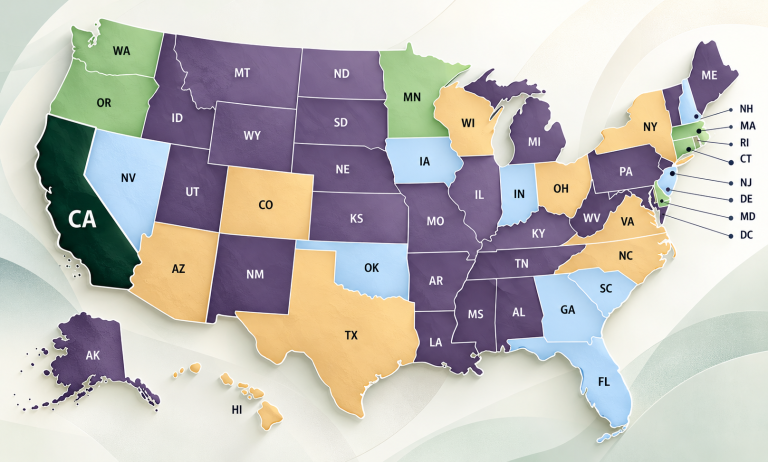
People ask us this constantly, usually after a hard week with their county worker: doesn’t some other state just do this better, or at least do this too? The honest answer is that no other state runs a program that is a legal or structural copy of California’s In-Home Supportive Services. But every state pays for some kind of in-home personal care through Medicaid, and most let people choose and direct their own caregiver — the question is how close that comes to what IHSS actually does.
This piece breaks down the real differences between IHSS and the personal-care programs other states run, and ends with a lookup tool so you can find the closest equivalent to IHSS wherever you or a family member live.
The national picture, at a glance
- 46 states + DCrun at least one 1915(c) HCBS waiver — the most common vehicle for in-home attendant care outside California
- ~710,000people were on a state HCBS waiver waiting list nationally in 2024, per KFF/CRS
- 40 monthsaverage wait on those lists in 2024 — IHSS's core benefit isn't delivered through a capped waiver
The short answer
There is no 50-state version of IHSS. IHSS is a specific combination of California authorities — an optional Medicaid state plan personal care benefit, the Community First Choice option under Section 1915(k) of the Social Security Act, and a Section 1915(i) state plan amendment — all administered together, county by county, under one name and one set of forms. Other states build their own combinations of the same federal building blocks, but almost none of them stack the pieces the way California does, and the resulting programs vary enormously in eligibility, hours, and who can be hired as a paid caregiver.
How the other 49 states compare to California's IHSS
Every state funds in-home care through Medicaid. Only 10 others use Community First Choice, one of the building blocks of IHSS.
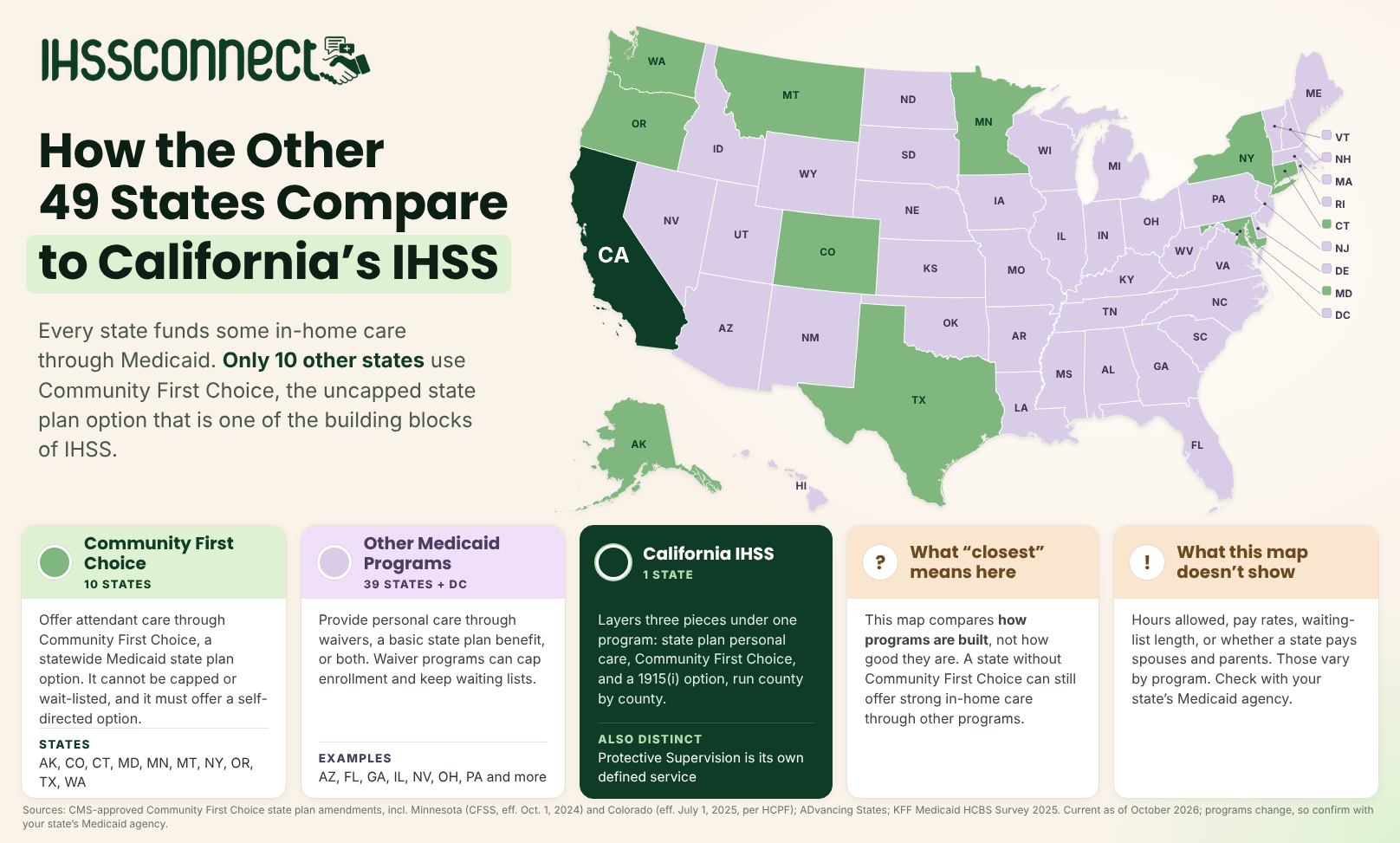 Tap the map to view full size
Three ways other states' programs differ from IHSS, even when the coverage sounds similar
1. Entitlement vs. a capped waiver with a waiting list
The single biggest practical difference is whether the program can put you on a waiting list. As of FY2023, 46 states and DC operated at least one Section 1915(c) home- and community-based services waiver — the waiver authority most states use to fund in-home attendant care — and states are legally allowed to cap how many people a 1915(c) waiver serves. In 2024, 40 states reported waiting lists for these waivers, totaling an estimated 710,000 people nationwide, with an average wait of 40 months. Waits ran shorter for people with mental illness (about 6 months) and longer for people with intellectual or developmental disabilities (about 50 months).
IHSS’s core personal-care service is delivered mainly as a state plan benefit layered with Community First Choice, not as a capped 1915(c) waiver. Under federal law, states cannot cap enrollment or maintain a waiting list for a state plan benefit the way they can for a 1915(c) waiver.
Worth knowing: This isn't the same as saying IHSS has no delays. Assessment appointments, hour redeterminations, and provider onboarding can all take time. What it means is that eligible Californians aren't turned away and placed on a list simply because the program has run out of funded slots — something that is a real and common outcome in states that rely on 1915(c) waivers for personal care.
2. Who is allowed to be a paid caregiver
Federal Medicaid rules treat spouses and parents of minor children as “legally responsible relatives” and generally bar paying them under the plain Section 1905(a)(24) state plan personal care benefit. States can only pay legally responsible relatives by layering in additional authority — a 1915(c) waiver, a 1915(i) or 1915(j) state plan option, or Community First Choice. According to KFF’s most recent 50-state Medicaid home care survey, only 6 states allow payment to legally responsible relatives through the plain state plan benefit, versus 40 states that allow it through one or more waiver programs.
IHSS is built with the added authorities that make paying a spouse or a parent of a minor child possible, and it does so routinely — which is a big part of why paid family caregiving feels ordinary in California’s program and often isn’t available at all, or is available with narrower restrictions, in states running only the bare-bones state plan benefit.
3. Protective Supervision as its own, separately defined service
California’s IHSS regulations (MPP §30-757.1) define Protective Supervision as a distinct service — paid observation and monitoring for a recipient who cannot recognize danger because of a cognitive impairment or mental health condition, separate from and in addition to hands-on personal care. It carries its own hour ceiling and its own documentation standard.
Flag: This research pass did not find another state that names and separately hour-weights pure safety supervision as its own service category the way California does. That is an observation from this scan of the national landscape, not a claim that we reviewed every state's regulations line by line — if your state has an equivalent, its state Medicaid agency is the place to confirm it.
| Dimension | Most other states | California IHSS |
|---|---|---|
| Enrollment | Often a capped 1915(c) waiver — can wait-list eligible people | State plan benefit + Community First Choice — cannot be capped or wait-listed |
| Paying a spouse or a parent of a minor child | Barred under the plain state-plan benefit; possible only where a state adds waiver/1915(i)/(j)/(k) authority (6 states via state plan, 40 via waiver, per KFF) | Routinely allowed under IHSS's layered authorities |
| Safety-only supervision | Typically folded into general personal-care hours, if covered at all | Protective Supervision is its own, separately hour-weighted service (MPP §30-757.1) |
Enrollment
Paying a spouse or a parent of a minor child
Safety-only supervision
What other states typically call their version of IHSS
Program names vary by state, but almost everything you’ll find falls into one of these federal buckets:
- State plan personal care services (Section 1905(a)(24)) — an optional Medicaid benefit for personal-care assistance, sometimes self-directed, sometimes not.
- Community First Choice (Section 1915(k)) — a state plan option, similar in spirit to part of IHSS, that funds attendant services and cannot be capped.
- Section 1915(c) or 1915(i) home- and community-based services waivers — the most common vehicle nationally, frequently with a self-directed or “consumer-directed” option, but capable of being capped and wait-listed.
- Section 1115 demonstration waivers — used instead of 1915(c) by Arizona, New Jersey, Rhode Island, and Vermont.
One naming quirk worth knowing: Colorado’s Medicaid program also uses the name “In-Home Support Services (IHSS).” It has no connection to California’s program and works differently — don’t assume a search result for “IHSS” is about California’s program.
Worth knowing: Colorado's Medicaid program also uses the name “In-Home Support Services (IHSS).” It has no connection to California's program and works differently — don't assume a search result for “IHSS” is about California's program.
Find the closest program in your state
The tool below lists the state Medicaid agency’s own program name and page for every state and DC, organized by the categories above. Search or select a state to see what’s available there.
Find your state’s closest program to IHSS
Pick a state to see its personal-care programs, what type each one is, and a link to the agency page.
Nothing selected yet.
Green tag = Community First Choice, the state plan option shown in green on the map above.
What to actually ask for when you contact another state's Medicaid agency
- Ask specifically about “state plan personal care services,” “Community First Choice,” and “self-directed” or “consumer-directed” attendant care — these are the phrases that get you to the right department.
- Ask whether the program you’re describing has a waiting list, and if so, how long it currently runs — don’t assume Medicaid eligibility means immediate services.
- If you need to pay a spouse or a parent caring for their own minor child, ask directly whether that state’s program allows payment to “legally responsible relatives” — the answer changes by program, not just by state.
- If safety supervision (rather than hands-on care) is the primary need, ask how that state’s assessment accounts for supervision-only needs — some fold it into general personal care hours rather than naming it separately.
Flag: Program names, agency URLs, and waiting-list status change often and were current as of this research pass (September 2026). Confirm directly with the state agency before relying on any detail here, especially anything involving a waiting list or an application deadline.
About this article
IHSS Connect publishes this article for general information and education. It is not legal advice, and reading it does not create an attorney–client relationship. IHSS Connect is not a law firm and is not affiliated with the California Department of Social Services, any other state’s Medicaid agency, or any county or state agency.
Program rules, dollar amounts, and waiting-list status change — sometimes without notice. Only the Medicaid agency in your state can tell you what you are eligible for; for California’s IHSS specifically, only your county social services agency and CDSS can make that determination.
If a decision on your case looks wrong, or you want advice about your own situation, talk to someone who can look at your file:
- Free and low-cost legal help: LawHelpCA.org (California) or your state’s legal aid directory
- Your state’s Medicaid / HCBS ombudsman or member services line (the lookup tool links to each state’s program page)
- California CalFresh/IHSS: CDSS Public Inquiry and Response, 1-800-952-5253
Figures on waiver counts and waiting lists reflect the most recent published national surveys as of September 2026 (CRS, citing KFF’s FY2024 survey; KFF’s 2024 home care survey). Verified September 2026.
Flag: Program names, agency URLs, and waiting-list status change often and were current as of this research pass (September 2026). Confirm directly with the state agency before relying on any detail here, especially anything involving a waiting list or an application deadline.
Sources
- Applied Self-Direction – Self-Direction Programs — program names and agency links used in the lookup toolhttps://appliedselfdirection.com/self-direction-programs/
- CRS Report R48519 (Apr. 2025) — 1915(c) waiver count and 2024 waiting-list figureshttps://www.congress.gov/crs-product/R48519
- KFF, Medicaid Home Care & Family Caregivers (2025) — legally-responsible-relative payment ruleshttps://www.kff.org/medicaid/how-do-medicaid-home-care-programs-support-family-caregivers/
- CDSS – IHSS program overview — IHSS's combined federal authoritieshttps://www.cdss.ca.gov/inforesources/ihss
- Disability Rights California – Protective Supervision — Protective Supervision definitionhttps://www.disabilityrightsca.org/publications/in-home-supportive-services-protective-supervision
CDSS is the primary authority for California's IHSS throughout this article. For every other state, that state's own Medicaid agency is the authority.