IHSS isn’t one open-ended benefit — it’s a defined list of services, each with its own regulatory definition and its own time guideline. Welfare and Institutions Code §12300 sets the program’s purpose, and the Department of Social Services’ Manual of Policies and Procedures (MPP) breaks that purpose down into roughly two dozen named service categories, from domestic chores to paramedical care. A social worker can only authorize hours inside those categories.
One line on the assessment worksheet — Bathing, Oral Hygiene, and Grooming (MPP §30-757.14(e)) — actually bundles three separate personal-care routines into a single service. That’s useful to understand before your assessment, because each of the three has its own scope, and knowing where the lines fall helps you describe your need accurately.
Bathing, Oral Hygiene, and Grooming — At a Glance
- What it is: One IHSS service (MPP §30-757.14(e)) that covers three routines: bathing, oral hygiene, and grooming.
- Who gets hours: Anyone ranked 2–5 on the Functional Index for this task at their IHSS assessment.
- What it excludes: Getting to/from the bathroom (that's Ambulation) and toenail clipping (see flag below).
- Reassessed: At least once every 12 months, face-to-face, in your home.
What This Service Actually Covers
Bathing
Cleaning the body in a tub, shower, or sponge bath: getting a basin of water, managing faucets and water temperature, getting in and out of the tub or shower, and reaching the head and body to soap, rinse, and dry. It also includes applying lotion, powder, and deodorant afterward.
Oral hygiene
Applying toothpaste, brushing teeth, rinsing the mouth, flossing, and caring for dentures.
Grooming
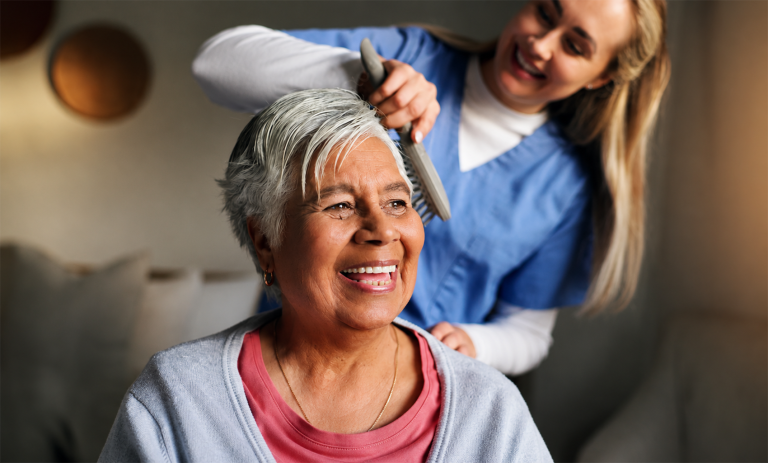
Combing and brushing hair, shampooing and drying hair, shaving, and fingernail and toenail care — with one carve-out covered in the flag below.
A related but separate category: if you’re confined to bed and can’t use a tub or shower, Routine Bed Baths (MPP §30-757.14(d)) covers a sponge bath given in bed. It’s assessed using the same functional ranking as bathing, oral hygiene, and grooming, but it’s its own line on the SOC 293 needs assessment form.
One more boundary worth knowing: getting to and from the bathroom itself isn’t part of this service — it’s assessed separately, under Ambulation.
Toenail and fingernail clipping — actually cutting the nail with scissors or clippers — is excluded from IHSS by regulation (22 CCR §51350(f)), regardless of functional need. Filing and general nail care can be authorized as grooming. If nail trimming is medically contraindicated (common with diabetes or poor circulation), the task moves into Paramedical Services instead of being excluded. For most recipients, actual clipping is a Medi-Cal benefit performed by a podiatrist when medically necessary — not an IHSS task.
Who Qualifies: The Functional Index Ranks
A social worker doesn’t ask whether you have a diagnosis — they assess how safely and independently you can complete each task. For this service, they assign a Functional Index (FI) rank from 1 to 5:
- Rank 1 — Independent. You bathe, brush your teeth, and groom yourself safely without help. No hours are authorized.
- Rank 2 — You can do it, but need reminding or intermittent monitoring to maintain hygiene. No hands-on help required.
- Rank 3 — You can generally bathe and groom yourself, but need hands-on help with specific parts — getting in or out of the shower, shampooing, or reaching certain areas.
- Rank 4 — You need substantial hands-on help with most or all of bathing, oral hygiene, and grooming, and would be at risk if left alone.
- Rank 5 — You’re totally dependent on someone else for bathing, oral hygiene, and grooming.
Each rank (2 through 5) maps to a range of weekly hours, called the Hourly Task Guideline (HTG). The current statewide ranges for this service:
Hourly Task Guidelines — Bathing, Oral Hygiene & Grooming
- Rank 2 — verbal reminding0:30–1:13–1:55 /wk
- Rank 3 — some hands-on help1:16–2:13–3:09 /wk
- Rank 4 — substantial help2:21–3:13–4:05 /wk
- Rank 5 — totally dependent3:00–4:03–5:06 /wk
| Functional Index rank | Low | Typical | High |
|---|---|---|---|
| Rank 2 — verbal reminding only | 0:30 | 1:13 | 1:55 |
| Rank 3 — some hands-on help | 1:16 | 2:13 | 3:09 |
| Rank 4 — substantial hands-on help | 2:21 | 3:13 | 4:05 |
| Rank 5 — totally dependent | 3:00 | 4:03 | 5:06 |
HTG ranges are a starting guide, not a hard ceiling or floor. Under Welfare and Institutions Code §12301.2, a social worker can authorize time outside the range — called an exception — whenever it's necessary for you to remain safely in your home. If your situation is genuinely outside the typical range (a heavier bathing routine, a combative episode, a larger-bodied recipient who needs more time), say so and ask that it be documented as an exception in your case file.
How to Describe the Need to Your Social Worker
The assessment is a conversation plus an in-home visit — not a diagnosis review. What actually drives your rank and hours is a description of what happens, task by task, without help. A few things that make that conversation more productive:
- Describe the specific task, not the general problem. “I can wash my chest and arms, but I can’t reach my back or lower legs, and I’ve slipped getting into the tub twice this year” gives a social worker something to rank. “I need help bathing” doesn’t.
- Mention both good days and bad days. If your ability varies — more fatigue on flare days, better grip in the morning — the assessment is supposed to reflect your functioning for the majority of the week, so both ends of that range matter.
- Separate reminding from hands-on help. If you can physically do the task but forget or need direction to start it, say that explicitly — that’s Rank 2 territory. If you need someone to actually do part of the task, describe which part.
- Bring medical documentation if you have it. It isn’t required for most cases, but a note from your doctor describing functional limitations (not just a diagnosis) can support your description, especially at reassessment if your condition has changed.
Your first assessment happens when you apply. After that, a social worker is required to have face-to-face contact with you in your home at least once every 12 months to reassess your needs — though some counties can extend that interval by up to six months. Between assessments, if your needs change, you can ask your county for a reassessment rather than waiting for the annual visit.
Checklist: Describing the Need to Your Social Worker
- Describe the specific task, not the general problem. "I can wash my chest and arms, but I can't reach my back or lower legs, and I've slipped getting into the tub twice this year" gives a social worker something to rank. "I need help bathing" doesn't.
- Mention both good days and bad days. The assessment is supposed to reflect your functioning for the majority of the week, so both ends of that range matter.
- Separate reminding from hands-on help. If you can physically do the task but need direction to start it, say so — that's Rank 2 territory. If you need someone to do part of the task, describe which part.
- Bring medical documentation if you have it. Not required for most cases, but a note describing functional limitations can support your description, especially at reassessment.
Stand-by time — a provider simply being present in case you need help — isn't an authorized IHSS task on its own. But if you're ranked at Level 2 because you need verbal reminding or encouragement to bathe or groom, that reminding time is billable under this service. The distinction matters when you're describing your need: "someone needs to remind me to shower" is compensable; "someone needs to be in the house while I shower" generally is not, unless it's tied to a specific safety risk you can describe.
Examples That Commonly Support This Service
Social workers rank function, not conditions — but certain functional patterns come up often enough that it helps to recognize them in your own routine:
- Limited grip strength or dexterity that makes holding a toothbrush, razor, or shampoo bottle difficult or unsafe.
- Balance problems or a documented fall risk getting in or out of a tub or shower.
- Reduced range of motion that makes it hard to reach your back, feet, or the back of your head to wash or groom.
- Vision loss that makes shaving, applying lotion, or checking for skin issues unsafe without another person present.
- Memory or cognitive changes that mean you can physically complete the task but need reminding to start or finish it.
- Fatigue or endurance limits that make a full bathing and grooming routine unsafe to complete alone, even if you can do parts of it.
None of these require a specific diagnosis to qualify — what matters is how the limitation shows up in the actual task, described in enough detail for a social worker to assign a rank and document it.
Sources
- ACIN I-82-17 — IHSS Assessment Clarifications and New or Updated Tools (Dec. 5, 2017)Task definitions, Functional Index rank descriptions, and current HTG hour ranges.
- ACL 08-18 — Phase One IHSS Social Worker Training Academy Q&A (April 23, 2008)Toenail clipping exclusion, oral hygiene clarification, 12-month reassessment rule.
- Welfare & Institutions Code §12300Statutory basis for IHSS as a defined list of services.
- Welfare & Institutions Code §12301.2Authority for exceptions to Hourly Task Guideline ranges.
- 22 CCR §51350(f)Regulatory exclusion of toenail/fingernail clipping from grooming.
CDSS is the primary authority throughout. Where a secondary source and CDSS guidance differ, CDSS guidance governs.