If your IHSS hours get cut, denied, or terminated and you want someone else to speak for you at the state hearing, the form that does that job is the DPA 19. It’s not the same form you may have already filled out to let a family member help manage your case day to day — that’s a different form, and it doesn’t cover a hearing.
This article walks through what the DPA 19 actually authorizes, when California law requires it, when it isn’t your only option, and who can’t be named as your representative.
Does the DPA 19 apply to you?
The DPA 19 is only for one thing: naming someone to speak for you at a state hearing on your IHSS case.
- ✓Use a DPA 19 if you've requested a state hearing and want someone else to represent you there.
- ✗Don't use a DPA 19 for everyday IHSS help — applications, service changes, redeterminations. That's the SOC 839.
- ✗Don't use a DPA 19 just to authorize someone to sign timesheets. That's the SOC 839A.
What the DPA 19 Actually Does
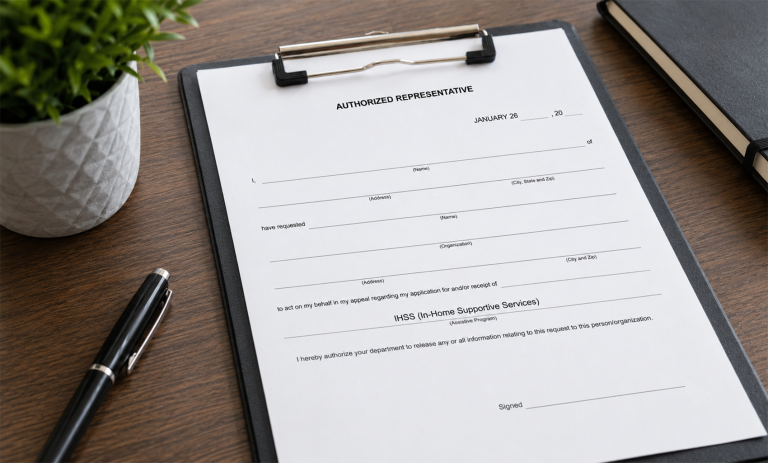
The DPA 19, titled “Authorized Representative,” is a California Department of Social Services (CDSS) form. It exists because of a specific legal right: under Welfare and Institutions Code § 10950, anyone dissatisfied with a county action on their public social services case — including IHSS — can request a state hearing “in person or through an authorized representative.” The DPA 19 is the written way to exercise that right.
Once signed and given to the Administrative Law Judge (ALJ), a DPA 19 lets your representative:
- Present your case and evidence at the hearing
- Call and question witnesses
- Receive information about your case from CDSS
- Receive the hearing decision
Worth Knowing: The Authorization Outlasts the Hearing Date
Under MPP § 19-005.02, unless you limit it or revoke it, a DPA 19 stays in effect through the final decision on that hearing issue — not just for the day of the hearing itself. It ends automatically on the date of the claimant's death.
The Form Everyone Confuses It With: SOC 839
Most of the confusion around the DPA 19 comes from a different, more commonly used form: the SOC 839, IHSS Designation of Authorized Representative. If you’ve already designated a family member or friend to help with your IHSS case — filling out paperwork, talking to your social worker, handling a redetermination — that’s very likely the SOC 839, authorized under WIC § 12300.3.
The SOC 839 is broad for day-to-day program purposes, but the statute that created it is explicit about its limit. WIC § 12300.3(c) states that this designation “shall not authorize representation for an administrative hearing.” That line is doing a lot of work: it means the person you’ve named on your SOC 839 cannot walk into your fair hearing and speak for you — not because county staff are being difficult, but because the law that created the SOC 839 carved hearings out of it on purpose.
Flag: A SOC 839 Alone Won't Get Your Rep Into the Hearing
If your only authorized representative paperwork on file is a SOC 839, you do not yet have anyone authorized to represent you at a hearing. You need a separate DPA 19 for that.
There’s a third, related form worth knowing about so you don’t reach for the wrong one: the SOC 839A designates someone to sign timesheets and other provider-related documents (TPRD signatory) — a narrower job than either of the other two. None of these three forms substitute for each other.
When You Actually Need a DPA 19
You need to designate a hearing representative when:
- You’ve requested a state hearing on an IHSS Notice of Action (a denial, reduction, or termination of hours), and
- You want someone other than yourself — a family member, an advocate, an attorney, or a legal aid representative — to speak on your behalf at that hearing.
A written DPA 19 is the standard way to do this, but it isn’t the only recognized way. A 2020 DHCS eligibility letter describing CDSS State Hearings Division practice lists several valid methods for confirming an authorized representative for a hearing: the electronic hearings system, a telephonic appointment made when the hearing is set up, the written DPA 19, or a designation the judge accepts at the hearing itself.
Worth Knowing: The Paper Form Isn't Your Only Option
A written DPA 19 is the standard, reliable way to name a hearing representative, but state hearing practice also recognizes a telephonic appointment made when your hearing is set up, a designation through the electronic hearings system, or a designation the judge accepts at the hearing itself. That flexibility comes from a Medi-Cal-focused DHCS letter describing State Hearings Division policy generally, not an IHSS-specific written directive — so treat the written DPA 19 as the reliable option and the others as backups if you're in a time crunch.
When You Don't Need One
- You’re representing yourself at the hearing — no form needed.
- Your case involves only ordinary IHSS program tasks (applying, changing services, a redetermination) and not a hearing — that’s what the SOC 839 is for.
- You only need someone to sign timesheets or other provider-related paperwork — that’s the SOC 839A.
One more scenario is easy to get backwards: if the applicant or recipient themselves is incompetent, comatose, or otherwise unable to act on their own behalf, they cannot be the one signing a DPA 19 to appoint someone. In that situation the case needs a legal representative — a court-appointed guardian or conservator, or, for a minor, a parent or county-recognized decision-maker — acting on the claimant’s behalf, rather than a DPA 19 signed by someone who isn’t legally able to sign it.
Who Can't Be Named as a Hearing Representative
For DPA 19 hearing representation specifically, state policy (MPP § 63-402.63, referenced in CDSS hearing procedure) restricts anyone convicted of an Intentional Program Violation (IPV) of the CalFresh program from serving as an authorized representative, unless they meet a narrow exception.
Flag: Two Different Background-Check Rules — Don't Mix Them Up
The DPA 19's disqualification (an Intentional Program Violation of CalFresh) is not the same rule that applies to the SOC 839, which disqualifies people with certain Tier 1 or Tier 2 convictions (child or elder/dependent adult abuse, benefits fraud, specified violent or sex-offense felonies) from serving as an IHSS authorized representative. The two forms are governed by different sections of state policy — don't assume a rule that applies to one automatically applies to the other.
You Still Have to Show Up — or Someone Does
Warning: You Still Have to Show Up
Naming a representative does not excuse you from the hearing. CDSS’s own instructions for the DPA 19 are direct on this point: if no appearance is made at the scheduled time — by you or your representative — the entire matter can be dismissed. Your own appearance is also described as helpful to the judge even when you have a representative, since you’re the one who knows your care needs firsthand.
How to File It
- Get the DPA 19 from the CDSS State Hearings website (cdss.ca.gov/inforesources/State-Hearings) or your county IHSS office.
- Fill in the assistance program (IHSS), your information, and your representative’s information, and sign and date it.
- Bring the signed form to your hearing and give it to the Administrative Law Judge — or submit it earlier along with your hearing request.
- To request or check on the hearing itself: call the CDSS State Hearings Division at (800) 743-8525 (TDD: (800) 952-8349), or mail your request to California Department of Social Services, State Hearings Division, P.O. Box 944243, MS 9-17-37, Sacramento, CA 94244-2430, or fax it to (833) 281-0905.
You generally have 90 days from the county’s action to request a state hearing at all (WIC § 10951) — the DPA 19 itself has no separate deadline, but it only matters once a hearing is on the calendar.
SOC 839 vs. DPA 19, at a Glance
Let's Compare the Two
How to File the DPA 19
- Get the form from the CDSS State Hearings website or your county IHSS office.
- Fill in the assistance program (IHSS), your information, and your representative's information — then sign and date it.
- Bring the signed form to your hearing and give it to the Administrative Law Judge, or submit it earlier with your hearing request.
Phone: (800) 743-8525 • TDD: (800) 952-8349
Fax: (833) 281-0905
Mail: CDSS State Hearings Division, P.O. Box 944243, MS 9-17-37, Sacramento, CA 94244-2430
You generally have 90 days from the county's action to request a hearing (WIC § 10951).
Sources
- WIC § 12300.3 — IHSS Authorized RepresentativeStatutory basis for the SOC 839 and the hearing-representation exclusion.
- WIC § 10950 — Right to a State HearingThe right to a hearing "in person or through an authorized representative."
- County of Orange SSA Policy 1003Distinguishes SOC 839/839A/839B from the DPA 19; AR eligibility rules.
- LA County DPSS ePolicy — Authorized Representative DesignationCurrent county policy; links to the CDSS DPA 19 PDF.
- LA County DPSS ePolicy — ASH 003MPP basis for DPA 19 scope, duration, and the CalFresh IPV disqualification.
- DHCS Eligibility Division Information Letter 20-28Describes other CDSS-recognized AR-designation methods.
- CDSS Forms Transmittal — DPA 19Source for the dismissal warning and hearing-day instructions.
- Disability Rights California — IHSS Fair Hearings GuideCurrent State Hearings Division contact methods.
About this article. IHSS Connect publishes this article for general information and education. It is not legal advice, and reading it does not create an attorney–client relationship. IHSS Connect is not a law firm and is not affiliated with the California Department of Social Services, the CDSS State Hearings Division, or any county agency.
Hearing procedures, form revisions, and deadlines change — sometimes mid-year. Only your county social services agency and the CDSS State Hearings Division can decide what applies to your case. If a decision on your case looks wrong, or you want advice about your own situation: free and low-cost legal help at LawHelpCA.org, CDSS State Hearings Division 1-800-743-8525 (TDD 1-800-952-8349), or CDSS Public Inquiry and Response 1-800-952-5253.
Verified September 2026.