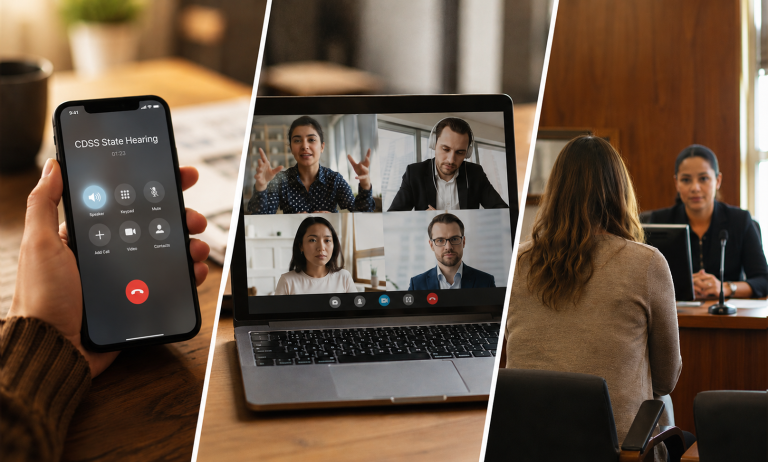
If you disagree with a county decision about your IHSS hours — a denial, a reduction, a termination — you have the right to ask for a State Hearing. What surprises a lot of people is that the hearing itself doesn’t have to happen in a courtroom. You can attend by phone, by video, or in person, and all three carry exactly the same legal weight.
Here’s how each option actually works, what it’s good for, and how to ask for the one you want.
How the three formats compare
-
Phone
Scheduled by default. You, the judge, and the county all dial into one call from wherever you are.
Good for: staying home, avoiding travel, lower sensory pressure.
-
Video
You request this instead of the default. Notices and the video link can be sent by email.
Good for: face-to-face contact, showing documents on screen.
-
In Person
Held at your local county welfare office — a table, not a courtroom.
Good for: readers who find in-person conversation clearest.
The Default Is a Phone Hearing
Unless you say otherwise, the California Department of Social Services (CDSS) State Hearings Division schedules your hearing by telephone. You call in at your scheduled time, the Administrative Law Judge (ALJ) calls in, and the county representative calls in — everyone dials into the same line from wherever they are.
A phone hearing tends to work well when you:
- Want to be in your own home, in your own chair, without arranging transportation
- Have a condition where travel, waiting rooms, or unfamiliar buildings are genuinely difficult
- Feel more able to concentrate and speak clearly without being physically observed
- Need your caregiver or a family member nearby to help, without coordinating a trip
You Can Ask for a Video Hearing Instead
If you’d rather see the judge and be seen, you can request a video hearing. You’ll want to tell the State Hearings Division your preference when you file your request, since phone is what gets scheduled by default. The Division can also send hearing notices and links by email if you ask.
Video can be a good middle ground: you get the face-to-face read of a hearing without leaving home, and it can make it easier to hold up a document or gesture toward something you’re describing. The trade-off is that you need a working device, a camera, and a stable internet connection.
In-Person Hearings Still Happen
You can also ask for your hearing to be held in person at your local county welfare office. This isn’t a courtroom appearance — advocates describe it as sitting at a table with the judge and the county worker, not standing before a bench. Some people find that setting easier to read; others find it more intimidating. Either is a reasonable reaction, and it’s worth being honest with yourself about which is true for you.
Worth knowing: No matter which format you pick, the person deciding your case is a state Administrative Law Judge employed by CDSS's State Hearings Division — not a county employee. The county is just the other party in the case, defending the action it took. An in-person hearing happens in a county building, but the county isn't who rules on your case.
If You Don't Have a Phone or Internet at Home
You’re not stuck with whatever equipment you own. CDSS’s hearing request form lets you say you have no phone or internet access and that you want to use the phone or video equipment at a hearing site instead of appearing from home. Ask about this when you file your request.
Flag: Whether a specific county office has video equipment ready to go, and how far in advance you need to ask, isn't spelled out in the statewide guidance behind this article. If you plan to use a hearing site's equipment, call the State Hearings Division ahead of your date to confirm what that county location has available.
How to Request Your Hearing — and Your Format
You have 90 days from the date on your Notice of Action to ask for a hearing. You can do it:
- Online through the ACMS portal at acms.dss.ca.gov
- By phone: 1-800-743-8525 (TDD 1-800-952-8349)
- By mail or fax, using the request form included with your notice
Whichever way you file, say directly which format you want — phone, video, or in person — and whether you’ll need an interpreter. If you don’t specify, phone is what you’ll get.
Ready to request your hearing?
Say directly which format you want — phone, video, or in person — and whether you need an interpreter. If you don't specify, phone is what you'll get. You have 90 days from your Notice of Action date.
- Online: ACMS portal at acms.dss.ca.gov
- By phone: 1-800-743-8525 (TDD 1-800-952-8349)
- By mail or fax: the request form included with your notice
Sources
- CDSS — State Hearing Requests — 90-day filing window, ACMS portal, phone and TDD numbers.
- Disability Rights California — IHSS Fair Hearings Guide (2026) — phone as the automatic default; right to request video or in-person; table-not-courtroom description.
- CDSS — State Hearing Request Form (NA 1238) — requesting a non-default format, email notices, using equipment at a hearing site.
- Orange County SSA — State Hearings Policy (B-0122) — citing CDSS MPP Division 22-000.1 on state ALJs conducting hearings.
CDSS is the primary authority throughout. Where county-level policy and CDSS guidance differ, CDSS's statewide guidance governs.