In-Home Supportive Services (IHSS) pays for a caregiver to help you at home so you don’t have to move into a nursing home or care facility. It is a Medi-Cal benefit available in all 58 California counties — but there is no statewide application. You apply through the county you live in, and every county runs its own intake process.
That is the single biggest reason people get stuck. This guide walks through what IHSS requires, exactly which forms you’ll encounter, how to reach your county office wherever you are in California, and what to do if you’re denied.
Call your county before you gather a single document.
The day you request IHSS becomes your protected date of eligibility. If you are approved, the county can pay for services back to that date — even if the paperwork takes another two months.
Counties are required to take your application by phone, by fax, or in person, and online or by email if they have the capability. Someone else can apply on your behalf. There is nothing you need to have ready before you call.
What IHSS Actually Pays For
IHSS authorizes hours for a provider — often a family member, friend, or neighbor — to help you with daily tasks. The California Department of Social Services lists these covered services:
Domestic and related services
- Housekeeping
- Meal preparation and meal clean-up
- Routine laundry
- Shopping for food and other necessities
- Heavy cleaning
- Yard hazard abatement
Personal care services
- Assistance with respiration
- Bowel and bladder care
- Feeding
- Bed baths, bathing, and grooming
- Dressing
- Menstrual care
- Assistance with ambulation and transfers
- Rubbing skin and repositioning
- Care and assistance with a prosthesis
Other authorized services
- Accompaniment to medical appointments and alternative resources
- Protective supervision — observing a non-self-directing, confused, or mentally impaired person and intervening to prevent injury
- Paramedical services — tasks requiring judgment based on training from a licensed health care professional, such as administering medication or puncturing the skin
IHSS covers both hands-on help and verbal assistance, including reminding or prompting.
The program has statutory monthly caps: 283 hours per month for recipients classified as severely impaired, and 195 hours per month for everyone else (Welfare and Institutions Code section 12303.4). Most people are authorized far fewer hours than the cap. Your hours come from your assessment, not from the ceiling.
Who Qualifies
CDSS lists four requirements that apply to every IHSS applicant:
Do You Qualify? The Four Requirements
These four criteria apply to every IHSS applicant in California, in every county.
-
California residency
You must be a resident of California.
-
A Medi-Cal eligibility determination
You don't have to already be enrolled — but the county has to run the determination. If you're not on Medi-Cal, apply for it at the same time.
-
You live in your own home
Or a home of your own choosing. Acute care hospitals, long-term care facilities, and licensed community care facilities do not count.
-
A completed Health Care Certification (SOC 873)
Signed by a licensed health care professional. The county cannot authorize services without it.
Plus: IHSS serves people who are aged 65 or older, blind, or living with a disability, and who cannot safely perform certain daily tasks without help. Children qualify too — IHSS is not an adults-only program. There is no separate income test beyond Medi-Cal.
The Application Process, Step by Step
Step 1: Call your county IHSS office and ask to apply
This is the most important thing to know: the date you request services is your “protected date of eligibility.” If you are approved, the county can authorize services retroactive to that date — even if the rest of the paperwork takes weeks.
So call early. Don’t wait until you have every document assembled.
Counties are required to accept IHSS applications by telephone, by fax, or in person. If the county has the capability, it must also accept applications online and by email (CDSS All-County Information Notice I-58-21). Someone else can apply on your behalf.
Use the county finder below to reach the right office.
Step 2: Complete the SOC 295
The SOC 295 — Application for In-Home Supportive Services is the state application form. Some counties will take the whole application over the phone and fill it out for you; others will mail it or ask you to download it.
The SOC 295 is available directly from CDSS in Armenian, Cambodian, Chinese, Farsi/Dari, Korean, Russian, Spanish, Tagalog, and Vietnamese, plus large-print versions of each. You have a legal right to free interpretation and translation services — ask for them.
Step 3: Get the SOC 873 completed by a licensed health care professional
The SOC 873 — Health Care Certification Form is the form that stops the most applications. The county cannot authorize services without it.
Here is how it works:
- You complete Section B, authorizing release of your health information.
- A licensed health care professional completes Section C. That does not have to be a physician. CDSS accepts physicians, physician assistants, regional center clinicians and clinician supervisors, occupational therapists, physical therapists, psychiatrists, psychologists, optometrists, ophthalmologists, and public health nurses — among others licensed in California and acting within the scope of their license.
- The professional must confirm two things: that you cannot independently perform one or more activities of daily living or instrumental activities of daily living, and that at least one IHSS service is recommended to prevent out-of-home care.
- If both answers are yes, they must also describe your condition and confirm whether it is expected to last at least 12 consecutive months or result in death within 12 months.
- The form goes back to your IHSS worker, not to you.
Your doctor cannot charge you for this. Under California Health and Safety Code section 123114, health care providers and clinics may not charge a fee for completing forms related to an IHSS eligibility determination. If you’re billed for it, report it to the CDSS Adult Programs Division at (916) 651-5350.
One important exception: if you are at imminent risk of out-of-home placement, the county can grant IHSS immediately and give you 45 days to submit the health care certification — extendable up to 90 days for good cause. If you are being discharged from a hospital or facility and have nowhere safe to go, say that explicitly when you apply.
Step 4: The in-home assessment
A county social worker comes to your home and conducts a needs assessment. This is not a formality — it determines how many hours you get.
The assessment is comprehensive. Per CDSS, it covers your medical history and diagnoses, medications and their purpose, emergency contacts, physician information, household composition, functional index rankings, a mini-mental health assessment, language preferences and interpreter needs, referrals to other services if appropriate, and a full biopsychosocial assessment.
Social workers score your need using three tools: the Functional Index Rankings, the Annotated Assessment Criteria, and the Hourly Task Guidelines.
How to prepare:
- Describe your worst days, not your best days. People routinely understate their needs out of pride, and the assessment is a snapshot.
- Have a family member or advocate present if that helps you communicate accurately.
- Have your medication list, diagnoses, and recent medical records available.
- Be specific about time. “I need help bathing” is weaker than “I can’t lift my leg over the tub edge, and it takes about 25 minutes with help.”
- Mention every task you struggle with, including ones you’ve stopped doing entirely because you can’t.
Step 5: Receive your Notice of Action
You will be notified in writing whether IHSS was approved or denied. If approved, the notice lists the specific services authorized and the number of hours per month for each. If denied, it states the reason.
Read this notice carefully and keep it. It is the document you appeal from, and it starts your appeal clock.
Step 6: Hire your provider
If you’re approved, you must hire someone to perform the authorized services. You are the employer. You hire, train, supervise, and fire your provider. The county does not assign one to you.
Your options:
- A family member, friend, or neighbor
- A provider from your county’s Public Authority registry, if your county has one
- A contracted IHSS provider, if your county contracts
- A county homemaker employee, if your county has them
The state — not you — issues the paychecks.
Step 7: Complete provider paperwork and start timesheets
Your provider has their own enrollment process (below). Once they’re enrolled and you’ve designated them, both of you submit and sign timesheets electronically through the Electronic Services Portal at etimesheets.ihss.ca.gov. IHSS has two pay periods per month: the 1st through the 15th, and the 16th through the end of the month.
Find Your County IHSS Office
IHSS is run county by county. Type your county name or pick it from the list, and the contact details for your local office will appear below.
or
Select your county to get started.
All 58 California counties are covered.
Before you call: numbers marked Verified were confirmed against the county’s own website in July 2026. Numbers marked State list come from a California Department of Health Care Services contact list carrying an internal revision date of 2015 — treat those as a starting point. The county’s official page, linked on every result, is always the authoritative source.
Statewide IHSS Service Desk: (866) 376-7066
How Long Does It Take?
There is no single guaranteed turnaround, and anyone who tells you “30 days” is oversimplifying.
What CDSS actually does is monitor counties against a 90-day timeframe, measured from your protected date of eligibility. That 90 days is built to accommodate the up-to-45 days that may be needed to complete the Medi-Cal eligibility determination and get the Health Care Certification back (ACIN I-58-21).
In practice, the two things that most often stretch the timeline are the SOC 873 sitting on a doctor’s desk and a pending Medi-Cal determination. Both are worth chasing actively.
Remember: even if it takes the full 90 days, an approval can be retroactive to the day you first asked for services.
Every Form You’ll Encounter
IHSS forms all start with “SOC.” Tap any form below to see what it does, who fills it out, and to open the official copy on the state’s website. Your county also provides blank copies of all of them.
Forms for the applicant
SOC 295Application for In-Home Supportive Services
The state application form. Many counties will take the whole thing over the phone and fill it out for you — you do not have to complete it yourself before calling.
Completed byYou, or the county on your behalf by phone.
Open SOC 295 on cdss.ca.gov → Large print (18pt) Nine other languages PDF · CDSS revision 9/18 · standard version is 14ptSOC 873Health Care Certification Form
Required before the county can authorize any services. This is the form that stalls the most applications — follow up with your doctor's office rather than waiting.
Your doctor cannot charge you to complete it (California Health & Safety Code §123114).
Completed byYou sign Section B. A licensed health care professional completes Section C and returns it directly to your IHSS worker — not to you.
Open SOC 873 on cdss.ca.gov → Large print PDF · CDSS revision 10/16SOC 426ARecipient Designation of Provider
Tells the county who you have chosen to hire. If you have more than one provider, file a separate form for each of them.
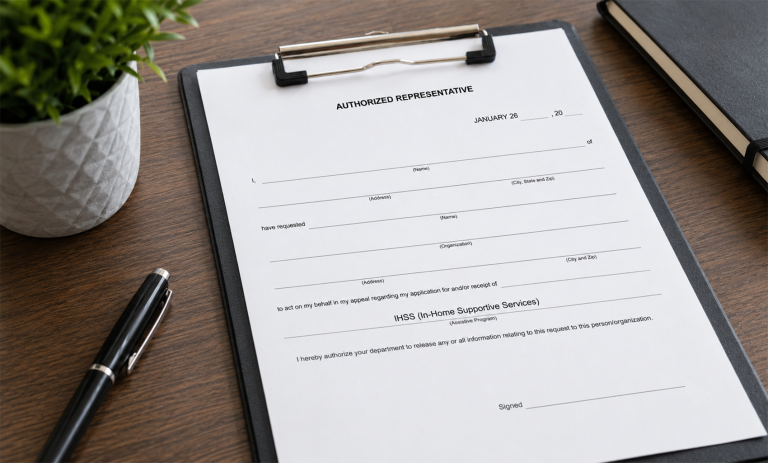
Completed byYou, or your authorized representative.
Open SOC 426A on cdss.ca.gov → PDF · CDSS revision 1/16SOC 862Recipient Request for Provider Waiver
Lets you hire someone who would otherwise be excluded because of a Tier 2 criminal conviction. The waiver covers one provider working for one recipient in one county — if either of you moves counties, it has to be redone.
Completed byYou. If your provider is also your authorized representative, they cannot sign this on your behalf to waive their own conviction.
Open SOC 862 on cdss.ca.gov → Large print PDF · CDSS revision 5/16Forms for the provider
SOC 847Important Information for Prospective Providers
The official four-step enrollment instructions, including the Tier 1 and Tier 2 crime rules. Read this before starting anything else — the 90-day enrollment clock starts when you begin.
WhenBefore starting enrollment.
Open SOC 847 on cdss.ca.gov → PDF · CDSS revision 5/16 · the fingerprinting cost it quotes is likely outdatedSOC 426Provider Enrollment Form
Step 1 of enrollment. Must be returned in person to the county IHSS office or Public Authority — you cannot mail it. Bring a valid photo ID issued by a U.S. federal, state, or federally recognized tribal government, and an original or replacement Social Security card.
WhenStep 1. Answers are verified against a Department of Justice background check.
Open SOC 426 on cdss.ca.gov → PDF · CDSS revision 6/16SOC 846Provider Enrollment Agreement
Signed at the end of county provider orientation. By signing, you confirm you understand and agree to the program rules and requirements.
WhenStep 4 — the final step of enrollment.
Open SOC 846 on cdss.ca.gov → PDF · CDSS revision 10/19SOC 863Applicant Provider Request for General Exception
For someone found ineligible because of a Tier 2 conviction who wants to be listed on a provider registry. Requires supporting documentation such as employment history and personal references.
WhenOnly if excluded for a Tier 2 crime and seeking a general exception rather than a single-recipient waiver.
Open SOC 863 on cdss.ca.gov → PDF · CDSS revision 5/19SOC 829Direct Deposit Enrollment, Change, or Cancellation
Sends your paycheck straight to a checking account, savings account, or pay card instead of through the mail. Most providers can now do this online through the Electronic Services Portal instead of on paper.
WhenAfter enrollment is approved.
Open SOC 829 on cdss.ca.gov → Enroll online instead PDF · CDSS revision 10/18SOC 2298Live-In Self-Certification for Federal and State Tax Wage Exclusion
Excludes IHSS wages from federal and state income tax for providers who live in the same home as their recipient. It does not exclude Social Security or Medicare (FICA) — those still appear on your W-2.
You do not need to re-certify every year. It stays in effect as long as you keep working for and living with the same recipient.
WhenOnly if the provider lives in the same home as the recipient.
Open SOC 2298 on cdss.ca.gov → More on live-in certification PDF · CDSS revision 1/19All links go to cdss.ca.gov — the state's own copy of each form. You should never have to pay for an IHSS form, and no health care provider may charge you to complete one. If a link is broken, ask your county IHSS office for a blank copy; they are required to provide one, along with free interpretation and translation if you need it.
The Provider Enrollment Process in Detail
Becoming a Paid IHSS Provider: The Four Steps
If a family member, friend, or neighbor is going to be your caregiver, this is what they have to complete.
-
Complete and sign the SOC 426
Get a blank form from the county IHSS office or Public Authority and return it in person. Bring a valid photo ID issued by a U.S. federal, state, or federally recognized tribal government, and an original or replacement Social Security card.
Answer every question truthfully — the answers are verified against a Department of Justice background check.
-
Fingerprinting and DOJ background check
Wait for the county's instructions before getting fingerprinted. The county can give you a list of Live Scan locations. The provider pays this cost.
If you have any arrest or conviction in the last 10 years, start here instead of Step 1. DOJ review takes longer, and the 90-day clock keeps running. CDSS's SOC 847 quotes a $40–$90 fingerprinting cost, but that form was last revised in 2016 — ask your county what it costs now. -
Attend county provider orientation
The county IHSS office or Public Authority will tell you when and where. Orientation covers program rules, timesheets, and the violations system.
-
Sign the SOC 846
Signed at the end of orientation. Once approved, you can provide services for any IHSS recipient, as long as you stay active and your background check stays clear.
Tier 1 — Disqualifying for 10 years
- Specified child abuse (Penal Code 273a(a))
- Abuse of an elder or dependent adult (PC 368)
- Fraud against a government health care or supportive services program
No exceptions. A Tier 1 conviction disqualifies you even if it was expunged.
Tier 2 — Three paths back in
- Violent or serious felonies (PC 667.5(c), PC 1192.7(c))
- Felonies requiring sex offender registration (PC 290(c))
- Felony fraud against a public social services program
You may still qualify through expungement or a Certificate of Rehabilitation, an individual waiver from a specific recipient (SOC 862), or an approved general exception (SOC 863). An individual waiver only covers one recipient in one county.
Note that an individual waiver is tied to one recipient in one county. If either of you moves counties, the background check and waiver have to be redone.
You’ll also need a Medi-Cal application if you’re not already enrolled. Apply through your county’s Medi-Cal office or through Covered California. IHSS cannot be authorized without a Medi-Cal eligibility determination, so treat this as a parallel track, not a later step.
If You’re Denied
A denial is not the end of the process.
You can request a hearing in writing or orally, and there is a request form printed on the back of the Notice of Action itself. Assessments are subjective, and hours are frequently restored on appeal.
Include in your request:
- That the program is IHSS
- Why you disagree with the county's action
- Whether you need an interpreter, and in what language
- A copy of the Notice of Action
Missed the 90 days? You can still request a hearing by showing good cause — a substantial and compelling reason beyond your control.
Before your hearing, request a copy of your assessment documentation from the county. You are entitled to see how your functional index rankings were scored, and that is usually where a successful appeal starts.
Free legal help is available. Disability Rights California, your local legal aid office, and your county’s Public Authority can all point you toward advocates who handle IHSS hearings. There are numerous for-profit advocates around California that are also very helpful when free help isn’t enough or available.
Common Mistakes That Delay Approval
- Waiting to call. Your protected date of eligibility is the day you request services. Every day you delay is a day of retroactive benefits you can’t get back.
- Leaving the SOC 873 with the doctor. Follow up. The county cannot authorize services until it arrives.
- Downplaying your needs during the assessment. Describe your hardest days honestly.
- Not applying for Medi-Cal in parallel. A pending Medi-Cal determination is one of the two most common holdups.
- Waiting until approval to look for a caregiver. Approval does not come with a caregiver attached. Finding one is entirely on you, which is why we created www.ihssconnect.com.
- Letting the provider’s 90-day enrollment window lapse. If your caregiver doesn’t finish all four steps in time, they start over.
Key Statewide Contacts
- IHSS Service Desk (timesheets, ESP, provider and recipient questions): (866) 376-7066
- Electronic Services Portal: ihss.ca.gov
- Adult Protective Services hotline (24/7, enter your ZIP to reach your county): (833) 401-0832
- IHSS Fraud Hotline: (888) 717-8302
- CDSS Adult Programs Division (to report a provider charging for IHSS forms): (916) 651-5350
Line Up Your Caregiver While You Wait
Start looking for your caregiver while your application is still pending.
Getting approved for IHSS does not come with a caregiver attached. The county authorizes your hours — then finding, interviewing, and hiring the person is entirely on you. California has no statewide caregiver registry, and the search is fragmented county by county.
That gap is where people lose weeks. Your hours are approved and sitting there unused because nobody is available to work them.
- Search for caregivers across every California county
- Free to create a recipient profile
- Start before you're approved, so you're ready on day one
- Built for IHSS recipients, families, and providers
To be clear about what this does and doesn't do: registering on IHSS Connect will not speed up your county's eligibility determination or your assessment — nothing outside the county can. What it removes is the delay after approval, when authorized hours sit unused while you look for someone to fill them.
Sources
Every figure, deadline, and form number on this page traces to one of the records below. Links open in a new tab.
-
State agency
California Department of Social Services, In-Home Supportive Services Program -
State agency
California Department of Social Services, County IHSS Offices -
Form
CDSS Form SOC 295, Application for In-Home Supportive Services PDF. Translations available in nine languages. -
Form
CDSS Form SOC 873, Health Care Certification Form PDF. Revised 10/16. -
Form
CDSS Form SOC 847, Important Information for Prospective Providers PDF. Revised 5/16 — the fingerprinting cost range it quotes is likely outdated. -
State notice
CDSS All-County Information Notice I-58-21 (June 14, 2021) PDF. As summarized by Legal Services of Northern California. -
Statute
California Welfare and Institutions Code section 12303.4 Maximum monthly IHSS hours. -
Statute
California Health and Safety Code section 123114 Prohibits charging a fee to complete IHSS eligibility forms. -
State agency
California Department of Health Care Services, IHSS Public Authority Contact Information PDF. Carries an internal revision date of 2015; county phone numbers drawn from it are flagged as unconfirmed in the county finder above.
Last reviewed: July 2026. Program rules, county contact information, and wage rates change. Always confirm details with your county IHSS office before relying on them.