CPR (Cardiopulmonary Resuscitation) is not a required skill for IHSS providers, but when someone stops breathing in front of you, the two minutes before an ambulance arrives belong entirely to you.
IHSS Does Not Require CPR — and That Is Worth Talking About
California’s In-Home Supportive Services program does not require caregivers to be trained in CPR or first aid. There is no licensing requirement, no mandatory health credential, and no minimum clinical skill set beyond what the county social worker determines a recipient needs. That flexibility is by design — IHSS exists to let people stay home with care that fits their lives, and many authorized tasks are non-medical.
But IHSS caregivers are also often the only person in the room with an elderly, disabled, or medically fragile individual for hours at a time. That is a different kind of situation than the program’s paperwork reflects.
This article does not argue that CPR certification should become a program requirement. It argues something simpler: if you have the option, the time, and any access to training, getting certified is one of the highest-value things you can do — for the person you care for, and for yourself.
What the Data Actually Shows
Cardiac arrest is not rare among the populations IHSS serves. The median age of out-of-hospital cardiac arrest patients in the U.S. is 66, and roughly 71 percent of cardiac arrests happen at home, according to the 2024 CARES Annual Report — the national registry used by emergency medical services researchers. IHSS recipients are disproportionately elderly or disabled adults living at home. The overlap is significant.
Here is what the evidence consistently shows about timing and outcome:
- • Survival chances decrease by roughly 7 to 10 percent for every minute that passes without CPR, according to the American Red Cross and AHA research.
- • Bystander CPR increases the likelihood of surviving to hospital discharge — 13.0 percent survival with bystander CPR versus 7.6 percent without it, per 2024 CARES data.
- • When CPR is started within 3 to 5 minutes, survival rates in witnessed cardiac arrests can reach 40 to 50 percent, according to analysis citing AHA data.
The average EMS response time in California varies widely by county — urban areas may see 6 to 8 minutes, rural areas significantly longer. In the gap between collapse and ambulance arrival, the person best positioned to act is whoever is already there.
In most IHSS relationships, that person is you.
What CPR Certification Actually Gives You
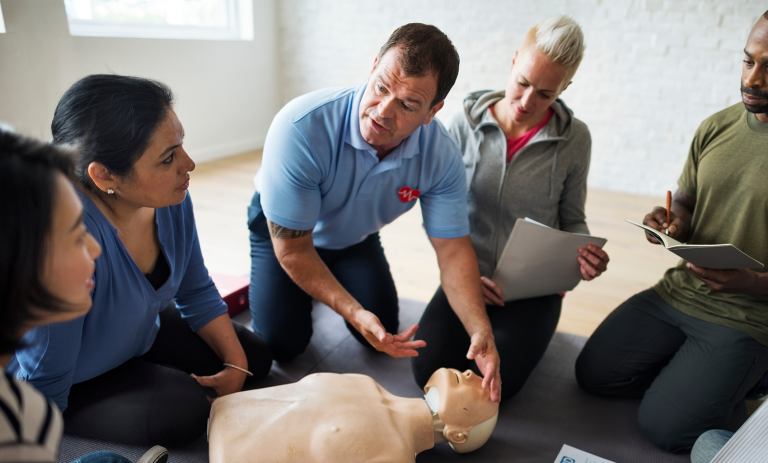
A standard CPR and AED certification course — from the American Heart Association or American Red Cross — typically takes two to four hours and covers:
- How to recognize cardiac arrest and when to call 911
- Hands-only chest compressions for adults (and technique differences for children and infants)
- Rescue breathing, where applicable
- How to use an Automated External Defibrillator (AED)
- How to respond to choking in adults, children, and infants
Certifications from AHA and Red Cross are valid for two years. Fully online-only courses generally do not meet California employer standards because they do not include in-person skills verification — but blended courses (online content plus a brief hands-on skills check) do qualify and often cost less than traditional classroom-only options.
What It Means for You as a Provider
Beyond the recipient, certification has real value for caregivers themselves.
Marketability and pay
If you work or plan to work with home care agencies, adult day programs, or in any capacity beyond IHSS, CPR certification is frequently required or preferred. It signals professionalism and can differentiate you when families are choosing between caregivers.
Confidence in a crisis
Research on bystander CPR consistently shows that untrained bystanders hesitate — not because they do not care, but because they are uncertain what to do. Training reduces that hesitation. In a genuine emergency, that hesitation costs time that cannot be recovered.
A note on liability for paid caregivers
California’s Good Samaritan law (Health and Safety Code §1799.102) protects people who provide emergency care in good faith from civil liability — but the law’s protections are written for volunteers acting without expectation of compensation. Whether and how those protections extend to a paid caregiver acting within their employment relationship is a legal question that has not been clearly resolved in California courts.
We flag this not to discourage action — doing nothing during a cardiac arrest carries its own risks, practical and ethical — but to be honest about what the law does and does not guarantee. If you are concerned about your specific situation, speaking with an attorney familiar with California home care law is the right step.
Free and Low-Cost CPR Certification in California
Cost and access are real barriers. The following are verified or well-established options. Availability, schedules, and pricing change — always confirm directly with the provider before registering.
Free Options
LA Care Community Resource Centers (Los Angeles County) LA Care, the public health plan for low-income Los Angeles County residents, partners with certified training providers to offer free CPR and AED certification classes at multiple Community Resource Centers. Locations have included East LA, Inglewood, Lynwood, El Monte, Norwalk, Palmdale, and Pomona, among others. Classes are in English and Spanish. Certification cards are AHA-recognized. Seats are limited and fill quickly.
Find current dates: freecprla.com | communityresourcecenterla.org
Cosumnes Fire Department — Hands-Only CPR Training (Sacramento area) Cosumnes Community Services District (CSD) Fire Department offers free Hands-Only CPR training for the public. This is skill-building training, not a certification course — but it is a legitimate starting point, particularly for caregivers in the greater Sacramento area.
More information: cosumnescsd.gov
American Heart Association — Community CPR Events The AHA’s Northern California chapter reported training more than 330,000 community members in CPR in a recent year. The AHA periodically offers free community CPR events, particularly in underserved areas. Events are not always listed far in advance.
Check your region: heart.org/en/affiliates/california
Low-Cost Options (Under $100)
American Red Cross The Red Cross offers CPR/AED courses statewide through in-person, blended, and online formats. Blended learning (online course plus a brief in-person skills session) tends to be more affordable than full classroom courses and meets California employer and OSHA requirements. Prices vary by location and course type; check current pricing when registering.
Find a class: redcross.org/local/california/take-a-class/cpr
Safety Training Seminars (Statewide — Northern and Central California focus) An American Heart Association-licensed training center (AHA license #20784) operating since 1989, with more than 70 locations across California including Sacramento, San Francisco, San Jose, and Oakland. Offers blended learning, same-day certification cards, and a low-price guarantee. Occasionally donates free courses to nonprofit organizations. Also offers reduced-cost courses for community groups.
safetytrainingseminars.com | Free CPR resources: safetytrainingseminars.com/free-cpr-classes
Local Fire Departments and Community Colleges Many California fire departments offer community CPR classes at low or no cost. Community colleges throughout the state frequently offer first aid and CPR as continuing education courses at significantly reduced rates compared to private providers — sometimes under $30. Check with your county fire department’s community outreach program or your nearest community college’s continuing education catalog.
Search: [Your county] fire department CPR class | [Your city] community college CPR continuing education
A note on online-only courses
Fully online CPR courses without an in-person skills component are generally not accepted by California employers, healthcare facilities, or regulatory bodies. For IHSS caregivers seeking professionally recognized certification, choose an in-person or blended course from an AHA- or Red Cross-authorized training center.
The Bottom Line
CPR certification will not change what IHSS pays you. It is not on any checklist your social worker reviews. Nobody will know you have it unless you tell them — or unless you need it.
What it gives you is preparation. The people IHSS serves are among those most likely to experience a medical emergency at home. A two- to four-hour course does not make you a paramedic. But it may be the difference between watching someone die and doing something real while help is on the way.
That is worth more than a checkbox.