Self-Determination Program Spending Plan Builder & Budget Tracker

A free, friendly worksheet to help you organize your own Self-Determination Program numbers — then bring them to your regional center team.

IHSS Connect

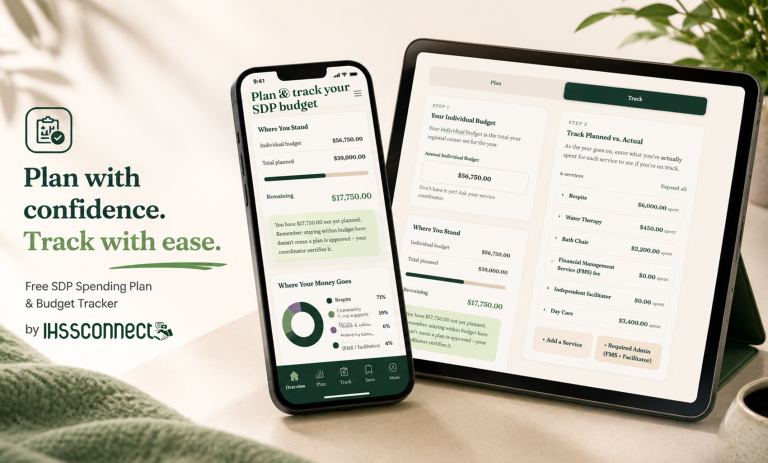
Plan & track your
SDP budget

Self-Determination Program numbers at your fingertips.

The Self-Determination Program gives you real choice and control over your services. This tool is here to make that freedom a little easier to manage — working alongside your regional center and service coordinator, never in place of them.
Please read first — what this tool does & does not do (tap to read)
  • It does not decide what you get. Only your regional center and IPP team set your budget and certify your spending plan.
  • It does not know your budget. You enter the number your regional center gave you. The tool never creates or estimates a budget.
  • It does not tell you if a plan will be approved. Whether a service qualifies depends on official SDP rules your coordinator and facilitator confirm.
  • It only adds up the numbers you enter. No hidden math, no advice on amounts.

Step 1

Your Individual Budget

Your individual budget is the total your regional center set for the year. Enter the exact number they gave you.

Don't have it yet? Ask your service coordinator. You can leave this blank for now and just total your services.

Step 2

Your Services & Supports

Add each service, its category, and the planned annual cost. Include the full cost of a worker's pay — wages plus benefits, payroll taxes, and insurance.

The FMS is required for every SDP participant. Recent DDS guidance indicates its fee is paid by your regional center outside your individual budget — confirm with your coordinator. An independent facilitator is optional and usually billed hourly. Use the buttons above to add these with the right setup.

Where You Stand

Individual budget
Total planned$0.00
Remaining
Enter your budget and services to see where you stand.

Where Your Money Goes

A breakdown of your planned spending by category. Tap a slice or bar to see its exact amount.

Add services with costs and categories to see your breakdown here.

Save & Share

Everything stays on your device — nothing is sent anywhere. Save a file you control, then load it later on this or another device to continue.

⚠ Your saved file holds personal information. On a shared phone or computer, keep it somewhere private and delete it when you're done.

Plain-Language Glossary

Everyday explanations of common SDP terms — to help you understand, not to replace the official guidance your coordinator and facilitator provide.

+The Basics: Budget, Plan & How They Connect
Self-Determination Program (SDP)
A voluntary way to receive regional center services where you direct your own budget and choose your own services and providers, rather than the regional center arranging them for you.
Individual budget
The total amount set for you to buy services for the year. Your regional center sets it, and by law it can't exceed what your services would have cost in the traditional system.
Spending plan
Your written plan for using the budget — which services, how often, and the cost of each. The total can't exceed your budget, and your regional center certifies it before money is spent.
IPP (Individual Program Plan)
Your overall plan with the regional center listing your goals. Every service in your spending plan should connect to a goal in your IPP.
Certification
The step where your regional center reviews and confirms your spending plan before funds are used. A plan that adds up correctly still must be certified.
+The People & Required Services
Service coordinator
Your main contact at the regional center. They help with your IPP and certify your spending plan. Your partner through the whole process.
Financial Management Service (FMS)
The vendor that pays your workers and providers, handles taxes and paperwork, and tracks spending. Required for every SDP participant; its cost is paid from your budget.
Independent facilitator
Optional. Someone you can hire to help build and manage your plan. If you use one, their cost is paid from your budget.
Person-centered planning
A process that puts you and your own goals at the center of deciding what services and supports you need.
Participant Choice Specialist
A regional center staff member whose job is to help people understand SDP and participant-directed options. A great person to bring your questions to.
+Common Services People Plan For
Respite
Short-term care that gives a family caregiver a break — in-home or out-of-home. A common reason families explore SDP.
Community living supports
Help with daily living, building skills, and taking part in community life so a person can live as independently as possible.
Employment & community participation
Supports for getting and keeping a job, or for taking part in community activities during the day.
Transportation
Getting to work, programs, appointments, and community activities.
Technology
Devices or tools that help a person communicate, stay safe, or be more independent.
A note on choosing services
A service must match an official SDP service definition to be paid for — the name alone isn't enough. Confirm each one with your coordinator before counting on it.
+Money Words You'll Hear
Cost neutrality
A rule that, statewide overall, SDP should cost about the same as the traditional system. It's why your budget ties to what your services would otherwise have cost.
True cost of a worker
Paying someone is more than their hourly wage — it includes benefits, payroll taxes, and insurance. Plan for the full amount or your numbers fall short.
Generic resources / Medi-Cal
Services already covered by Medi-Cal or other public programs generally can't be paid again with SDP funds. Check before including them.
Budget transfer / adjustment
During the year you may be able to move money between services or adjust your plan with your IPP team. Your coordinator explains how and when.
FMS fee — how it's charged
The FMS charges a flat monthly fee set by an official state rate schedule — not a percentage. The fee depends on the FMS model (Bill Payer, Co-Employer, or Sole Employer) and how many workers/providers are in your plan. Recent DDS guidance says this fee is paid by your regional center, outside your individual budget — so it may not reduce your spending money. Rules are changing, so confirm with your coordinator. (Reference: DDS FMS rate schedule effective May 1, 2023, ranging roughly $230–$925/month by model and tier — verify the current figure with your FMS.)
Independent facilitator — how they charge
IFs usually bill by the hour, not as a percentage of your budget. Your regional center may pay for an IF during your transition into SDP; ongoing IF help after that is typically written into your spending plan and paid from your budget. Confirm what applies to you.
+Mistakes People Commonly Make
Forgetting the FMS cost
It's required and comes from your budget. Leaving it out makes a plan look affordable when it isn't.
Listing only wages
Forgetting benefits, taxes, and insurance for a worker is the most common budgeting error.
Treating the plan like an estimate
It's a working budget your regional center certifies, not a rough guess. Specifics matter.
Assuming "reasonable" means "covered"
A sensible-sounding service can still be turned down if it doesn't match a defined SDP service. Confirm first.

You're Not Doing This Alone

Self-determination puts you in the driver's seat — and your regional center, your service coordinator, and your facilitator are there to help you succeed. This worksheet is just a friendly co-pilot from IHSS Connect to help you walk in prepared.

A free tool from IHSS Connect, made with for California families.
Not an official document · not legal or financial advice · your regional center is the authority.

Share

Next Story

What Services Can I Get from a California Regional Center?

A plain-language guide to one of California’s least-understood entitlements — what Regional Centers actually do, why two families in different...

California Families Are Reaching a Caregiving Breaking Point

California has quietly built one of the largest in-home care systems in the country. Every day, hundreds of thousands of...

Respite Hours Through the Regional Center — And How to Actually Use Them

FAMILY GUIDE • REGIONAL CENTER SERVICES Respite Through Regional Center How many hours you’re entitled to — and how to...