
California has quietly built one of the largest in-home care systems in the country. Every day, hundreds of thousands of parents, spouses, adult children, and relatives wake up and immediately step into the role of nurse, scheduler, advocate, behavioral specialist, transportation coordinator, therapist, and protector — often before they’ve even had coffee. For many caregivers, especially those navigating programs like IHSS, Regional Center services, Medi-Cal, or complex medical care at home, caregiving stops feeling like a temporary responsibility and starts becoming an entire identity.
And that’s where the danger begins.
Caregiver burnout in California is no longer just an emotional issue. It is becoming a public health issue, a workforce issue, and in many households, a financial survival issue. Families are trying to hold together impossible schedules while simultaneously managing therapies, doctor appointments, medication routines, school systems, insurance paperwork, behavioral crises, and their own exhaustion. The emotional toll builds slowly. Most caregivers do not suddenly “break down.” Instead, they gradually normalize running on empty until chronic stress becomes their baseline.
What makes this especially complicated in California is that many caregivers are also tied into state systems that unintentionally reward overextension. Parents caring for medically fragile children may be performing advanced medical tasks at home while also coordinating IHSS Protective Supervision, paramedical services, IEP meetings, Regional Center services, CCS appointments, or waiver programs. Adult children caring for aging parents are navigating long waitlists, housing costs, transportation demands, and impossible work-life balances in one of the most expensive states in America.
Yet despite how common this has become, caregiver wellness is rarely discussed as part of the actual care plan.
The California Caregiver Trap Nobody Talks About
Many caregivers slowly lose the ability to separate “being helpful” from “being constantly available.” The line disappears over time. California families often feel pressure to prove they can “handle everything,” especially during interactions with agencies, doctors, or county programs. Some even fear admitting exhaustion because they worry it could reflect poorly on their ability to care for a loved one.
But burnout rarely looks dramatic at first.
It often starts as forgotten meals, interrupted sleep, increasing irritability, social withdrawal, or feeling emotionally numb. Caregivers stop exercising. Friendships fade. Hobbies disappear. Medical appointments for themselves get postponed repeatedly. Entire years pass where their own identity exists only in relation to caregiving.
California’s caregiving culture can unintentionally glorify this sacrifice. Parents are praised for “doing it all.” Spouses become full-time caretakers without ever truly clocking out. Adult children move parents into their homes while juggling employment and raising kids of their own. The caregiving itself may come from love — but the expectation of endless self-erasure is unsustainable.
Technology Is Quietly Changing What Caregiving Looks Like
A major shift is happening across California: caregivers are increasingly relying on technology not just for convenience, but for survival.
Apps that once seemed optional are becoming essential tools for organizing care routines, coordinating family help, tracking medications, documenting symptoms, managing appointments, and reducing cognitive overload. Even small systems can make an enormous difference. Something as simple as shared calendars, automated reminders, or searchable medical notes can reduce the constant mental burden caregivers carry every day.
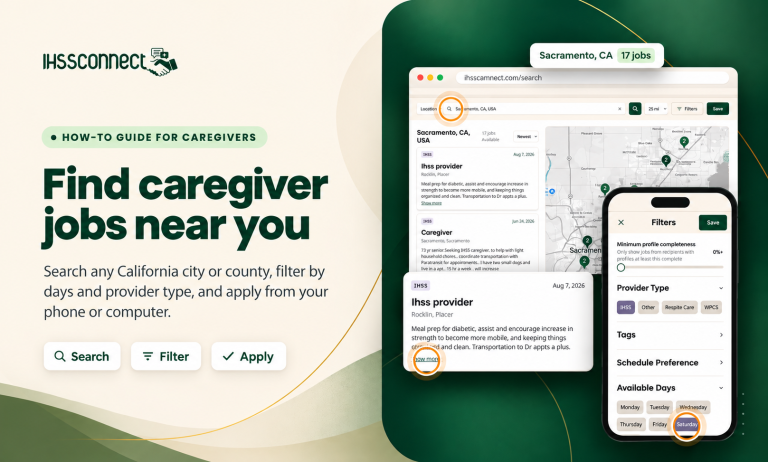
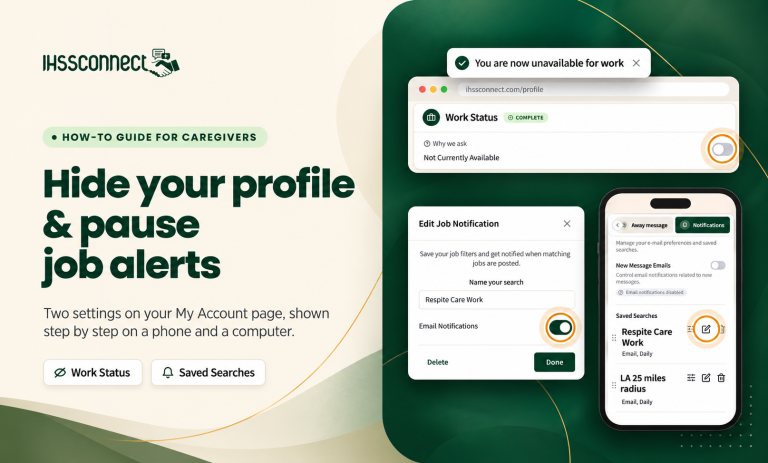
For IHSS families specifically, technology is also reshaping how caregivers and recipients connect with one another. Platforms like IHSS Connect are part of a broader movement toward modernizing how California families find in-home care support. Instead of relying entirely on word-of-mouth Facebook posts or outdated registries, families now have access to California-specific tools designed around real caregiving needs, language accessibility, direct communication, and safer connections between recipients and providers.
The future of caregiving in California will almost certainly involve even more technology integration. Remote patient monitoring, AI-assisted medication tracking, telehealth expansion, adaptive communication tools, wearable medical alerts, and smart-home safety systems are already changing how care happens inside the home. For some families, these tools provide something they haven’t felt in years: breathing room.
Why Small Wellness Habits Matter More Than Big Lifestyle Changes

One of the biggest misconceptions about caregiver wellness is that self-care must be elaborate to matter. In reality, the most effective wellness habits are often the smallest and most repeatable.
A five-minute stretch in the morning. Drinking water consistently. Sitting outside briefly before the next appointment. Sending a quick text to a friend instead of isolating. Taking ten minutes to decompress after a behavioral incident instead of immediately moving to the next task. These small acts may seem insignificant, but they help regulate stress before it compounds into chronic emotional exhaustion.
California caregivers are particularly vulnerable to “functional burnout,” where they continue operating at a high level while emotionally deteriorating underneath the surface. Because caregiving responsibilities often cannot simply stop, many caregivers become incredibly skilled at suppressing their own distress. The problem is that suppressed burnout eventually shows up somewhere else — physically, emotionally, relationally, or financially.
That is why sustainability matters more than perfection.
Caregivers Need Support Systems Too
One of the most damaging myths in caregiving is the belief that asking for help somehow reflects weakness or failure. In reality, isolation is one of the strongest predictors of burnout.
Support does not always have to look dramatic. Sometimes it is another family member learning part of the routine. Sometimes it is a friend handling errands. Sometimes it is finding an online support group filled with people who genuinely understand the complexity of caregiving life in California.
For many IHSS families, simply connecting with other caregivers who understand Protective Supervision, Regional Center services, Medi-Cal rules, or paramedical care can dramatically reduce feelings of isolation. Shared experience matters.
California’s caregiving system depends heavily on unpaid or under-supported labor performed inside homes every single day. Yet the emotional well-being of caregivers themselves is still treated like an afterthought. That needs to change.
Caregiving Should Not Mean Disappearing
Perhaps the most important thing caregivers need to hear is this: your life still matters too.
Caregiving can coexist with personal growth, friendships, career development, creativity, and joy. Many caregivers wrongly assume they must place their own futures entirely on hold indefinitely. But protecting your own identity is not selfish — it is protective.
The healthiest caregiving relationships are rarely built on total self-destruction. They are built on sustainability, adaptability, support, and balance — even if that balance is imperfect.
California families are carrying extraordinary responsibilities inside their homes every single day. The work is real. The exhaustion is real. But so is the need to care for the caregiver too.
Because eventually, the system depends on whether the caregiver can keep going.