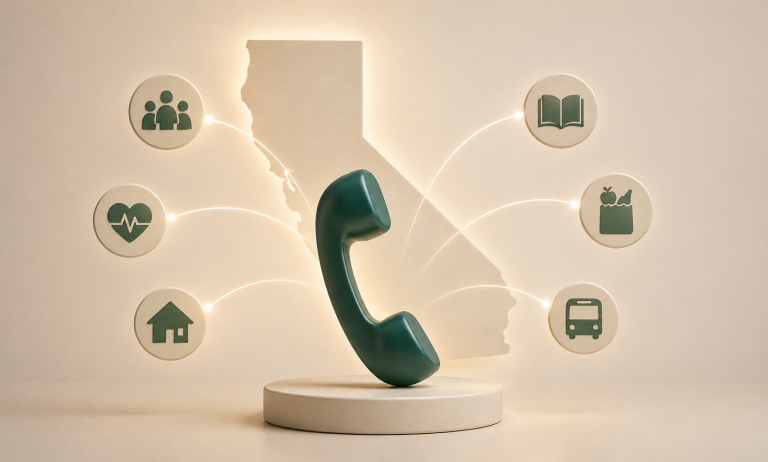
If you have ever struggled to find help — and did not know who to call — there is a number you should know: 2-1-1.
It is free. It is available around the clock. It connects callers to real, local services across California. And it covers far more ground than most people realize.
For IHSS recipients, caregivers, people with disabilities, and older adults navigating a complicated web of services, 211 can be a practical starting point — or a lifeline in a crisis.
What Is 211?
211 is a free, confidential telephone helpline that connects people to community resources. When you call, you reach a trained specialist who listens to your situation and refers you to local services — whether you need food assistance, help paying your utility bill, mental health support, emergency housing, transportation, or dozens of other needs.
The 211 dialing code was designated by the Federal Communications Commission in July 2000 for community information and referral services nationwide.
In California, 211 is overseen at the state level by 211 California, a 501(c)(3) nonprofit designated by the California Public Utilities Commission (CPUC) as the lead entity for the system. Local service is handled county by county, with each county operating its own 211 center staffed by specialists who know their local resource landscape.
A Brief History in California
California's first 211 service launched in Ventura County on February 11, 2001 — making it the first in the state. The California Public Utilities Commission issued its first statewide 211 authorization in 2003, and counties have been adding the service ever since.
As of 2024, 211 service has been authorized in 53 counties, covering approximately 99.3% of California's population. The most recent county to receive authorization was Yuba County in October 2024.
Thirteen rural counties — representing about 1.2% of the state's population — still lack full 24/7 service, though nine of those counties have disaster-only 211 coverage.
Who Can Use It?
Anyone can call 211. There are no income requirements to place a call or get a referral. You do not have to prove eligibility or share personal information unless it is needed to connect you to a specific program.
The service is available in more than 150 languages, depending on your local 211 provider. TTY access is available for people who are deaf or hard of hearing. You can also text your zip code to 898-211 (where the service is available in your county) or search for resources online at 211ca.org.
Callers who have historically used 211 most include:
- Older adults on fixed incomes
- People with disabilities
- Family caregivers
- People experiencing housing instability or homelessness
- Individuals in mental health or substance use crises
- People who have lost income or are struggling to pay bills
- Undocumented community members seeking services with no income requirements
211 is not means-tested as a service itself. Specialists will refer you to what is available; eligibility for individual programs varies.
What Can You Call About?
Housing & Shelter
Emergency shelter, eviction prevention, rental assistance, affordable housing options.
Food
Food banks, meal programs, CalFresh enrollment assistance.
Utilities
Help paying gas, electric, water, and phone bills — including LIHEAP.
Health Care
Free and low-cost clinics, Medi-Cal navigation, mental health referrals.
Crisis Support
Crisis counseling referrals, domestic violence services, emotional support warm lines.
Transportation
Paratransit options, ride assistance, transportation to medical appointments.
Disability Services
Independent living centers, IHSS information, respite care, disability advocacy.
Disaster & Emergency
Evacuations, shelter locations, recovery resources during declared emergencies.
How 211 Can Help IHSS Recipients and Caregivers
If you are an IHSS recipient or a caregiver, 211 is not a replacement for your county IHSS office — but it is a useful complement to it, particularly in these situations:
- You need help with something outside of IHSS — like food, utilities, or transportation — and do not know where to start
- You are waiting on an IHSS assessment and need temporary support in the meantime
- You are a caregiver feeling burned out and looking for respite services or emotional support resources
- You need help finding legal aid for a benefits appeal
- You are navigating a sudden crisis — housing loss, a medical emergency, or a family situation — and need rapid local referrals
- English is not your first language and you need help in your own language
211 specialists are trained to look at the whole picture, not just the immediate question. That matters for people navigating complex systems.
How to Reach 211
There are four ways to connect:
- Call 2-1-1 from any phone, 24 hours a day, 7 days a week
- Text your zip code to 898-211 (available in select counties)
- Chat online or search resources at 211ca.org
- If you are in a county not yet served by 211, call 866-FIND-211 (866-346-3211) and enter your zip code to be routed to the nearest available 211
Calls are confidential. You can ask for help without sharing your name. Specialists will ask questions to understand your situation, but you are in control of what you share.
A Note on Coverage Gaps
While 211 serves the vast majority of California, coverage is not equal across the state. Thirteen rural counties — including parts of the Sierra Nevada, Central Valley, and far Northern California — still lack full-service 211 access. Residents in those areas may reach a disaster-only line or experience limited hours. If you are unsure whether 211 is fully available in your county, call the number and ask, or check with your county’s Department of Social Services.