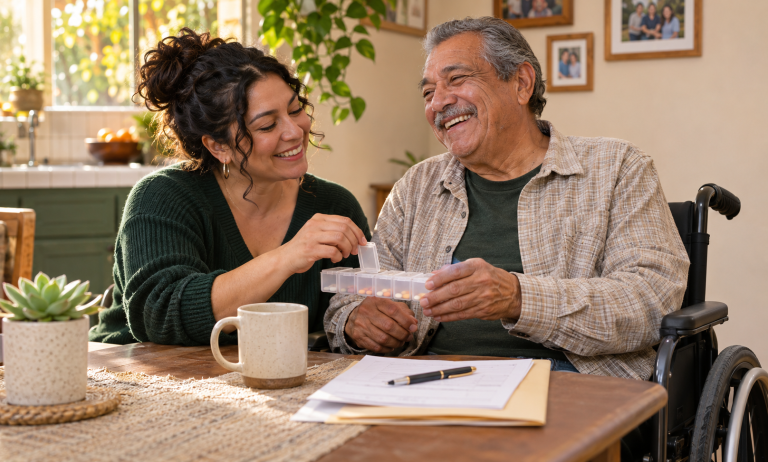
Being an IHSS caregiver is real work with real rules. Many of the most important ones are never clearly explained, and small mistakes can cost you pay or even your eligibility to work.
This guide covers what every provider should know, from who you work for to how overtime works, and links to our in-depth guides on each topic.
Start here
Your IHSS caregiver roadmap
Pick where you are. Each tab links to our full guides on that topic.
Learn how IHSS works and get enrolled.
Timesheets, deposits, wages, and taxes.
Do the work well and stay safe.
Build steady hours and new clients.
Avoid pay delays and missed letters.
Who you work for
This surprises a lot of new providers. Your employer is the recipient, not the county.
- The recipient hires you, sets your schedule within their authorized hours, directs your work, and can end the arrangement.
- The county decides how many hours the recipient gets, enrolls you, and processes your pay through the state.
- The Public Authority in your county may run a provider registry, training, and benefits. What it offers varies by county.
Every county runs IHSS a little differently, so when in doubt, ask your county IHSS office or Public Authority. Find yours on the CDSS county offices list.
Getting started
Before you can be paid, you must finish orientation, sign forms SOC 426 and SOC 846, and pass a background check. Our IHSS provider orientation guide walks through each step and includes a tracker for your 90-day deadline.
Timesheets and EVV
You submit timesheets through the Electronic Services Portal (ESP) or the Telephone Timesheet System, and your recipient approves them. Under Electronic Visit Verification (EVV), most providers also check in and out of every shift using the ESP, the IHSS EVV mobile app, or the phone system. You’re paid for the hours you report, not for the time between check-in and check-out.

Worth knowingIf you live in the same home as your recipient, you can self-certify as a live-in provider on form SOC 2298. The state’s check-in and check-out rule is written for providers who haven’t self-certified. Self-certifying can also change how your pay is taxed. Read our SOC 2298 guide
New to the portal? Read What Is the ESP for IHSS? and set up IHSS direct deposit so you’re not waiting on a paper check.
Hours, overtime, and travel time
These rules cause more pay problems and violations than anything else. Know them well.
- The IHSS workweek runs from 12:00 a.m. Sunday to 11:59 p.m. Saturday.
- Each recipient has a weekly maximum based on their authorized monthly hours. Stay within it, and never go over their monthly total.
- Hours over 40 in a workweek are paid at time and a half.
- If you work for more than one recipient, you can’t work more than 66 hours a week in total, unless the county approves an exemption. Use form SOC 2255 to plan your week.
- Travel time directly between two recipients on the same day is paid, up to 7 hours per workweek.
- Going over 40 hours when you usually don’t, or adding more overtime than usual, may need county approval first.
Workweek hours check
Enter the hours you plan to work this week (Sunday to Saturday) for each recipient, plus travel time between them. Nothing you type is saved.
This checks the statewide limits only. Each recipient also has a weekly maximum based on their authorized hours. Check your hours against those in the ESP or with your county.
FlagGoing over your weekly maximum or the travel time limit counts as a violation. The first two bring written notices; you can take a one-time training to clear the second. A third means a three-month suspension, and a fourth means you can’t work as an IHSS provider for one year. You can appeal each notice.
Pay and sick leave
Your hourly wage depends on your county, and it changes over time. See IHSS raises by county for the latest we can confirm. Some counties also offer benefits like dental or vision coverage; ask your Public Authority what’s available and who qualifies.
Worth knowingIHSS providers earn paid sick leave each year starting July 1. For fiscal year 2026–27, that’s 40 hours. New providers first work 100 hours to earn it, then 200 more hours or 60 days before using it. Unused hours expire every June 30. Request sick leave in the ESP, or on form SOC 2302. See the state’s sick leave page
Live with your recipient? Your IHSS pay may be exempt from federal and state income tax. Read SOC 2298 Explained, and talk with a tax professional about your situation.
Your responsibilities
- Follow the rules you agreed to in your provider agreement (SOC 846), including accurate timesheets.
- Only do the tasks your recipient is authorized for, during the hours you report.
- Keep your recipient’s health and personal information private.
- Keep your address and phone number current with the county. Here’s how.
FlagAs an IHSS provider, you’re a mandated reporter. If you suspect abuse or neglect of an elder, dependent adult, or child, report it to your county’s Adult Protective Services or Child Protective Services as soon as possible, even when you’re off the clock. If you see abuse happening, call 911. You don’t have to prove it; the county investigates.
Doing the job well
Recipients hire and keep caregivers they trust. Show up when you say you will, communicate early, and protect your own body. Our guides on caregiver communication, preventing caregiving injuries, and essential guidance for home care professionals cover the details.
Finding work
IHSS doesn’t assign caregivers to recipients. Once you’re approved, finding a recipient is up to you, and word of mouth can be slow.
That’s why we built IHSS Connect. It’s free: browse IHSS jobs, create a caregiver profile families can find, and message recipients directly. See how it works. If you care for someone through a regional center, read our WPCS guide too.
Sources
- CDSS — IHSS Provider Enrollment Agreement (SOC 846) (PDF)Overtime at time and a half; 7-hour travel limit; violation steps and penalties
- CDSS — Provider orientation: Workweek scheduling (PDF)Sunday–Saturday workweek; 66-hour limit for multiple recipients; travel time; SOC 2255
- Los Angeles County DPSS — IHSS Overtime (FLSA)Exemptions up to 90 hours; county approval for one-time exceptions
- CDSS — Electronic Visit Verification for Recipients and ProvidersWho checks in and out; ESP, phone, and mobile app; live-in self-certification
- CDSS — IHSS Paid Sick Leave40 hours for FY 2026–27; earning and using rules; June 30 expiration; SOC 2302
- CDSS — Mandated Reporter information for IHSS providers (PDF)IHSS providers are mandated reporters; report to APS or CPS; call 911 for abuse in progress
- CDSS — Live-In Provider Self-CertificationSOC 2298; income tax exemption for live-in providers
- San Luis Obispo County — IHSS Provider BenefitsExample of county-level benefits (dental, vision, life insurance); its sick leave figures are out of date
- CDSS — County IHSS OfficesContact list for every county
CDSS is the primary authority. County pages are examples; rules about wages, benefits, and local processes vary by county.
About this article
This is IHSS Connect’s main guide for IHSS caregivers in California. It covers the rules every provider should know and links to our in-depth guides on each topic. We update it when state rules change.
Program rules come from the California Department of Social Services. IHSS Connect is an independent, free registry for families and caregivers. We are not part of any state agency or county, and this article is general information, not legal or tax advice.
Spot something out of date? Let us know and we’ll check it.