When families are desperate for help, they often turn to the fastest place they know: Facebook.
A parent needs overnight care for a child with epilepsy. A daughter is trying to find someone trustworthy to help her father after a stroke. A spouse is overwhelmed caring for a partner with dementia and posts in a local community group asking if anyone knows an IHSS provider.
Within minutes, the comments start.
“Message me.”
“My cousin does this.”
“I know someone great.”
“She can start tomorrow.”
It feels immediate. It feels personal. It feels like help.
And sometimes, it is.
But for families navigating disability, chronic illness, aging, or extraordinary care needs, social media can also be one of the riskiest places to search for support.

The problem is not that Facebook is bad. The problem is that Facebook was never designed to safely connect vulnerable families with caregivers.
It was built for conversation, not care coordination. For visibility, not privacy. For engagement, not accountability.
And when the stakes involve your child’s safety, your parent’s dignity, or your own ability to remain safely at home, that distinction matters.
Consumer safety advocates have repeatedly warned against oversharing personal information in public forums, especially when it involves health, disability, routines, addresses, or household vulnerabilities. The Federal Trade Commission advises consumers to be cautious about sharing sensitive personal details online because scammers and bad actors often use seemingly harmless posts to build trust or exploit vulnerable households.
Close to Home
For families seeking care, the risk is even more personal.
A single Facebook post can unintentionally reveal far more than intended: where someone lives, when they are home alone, what medical equipment is in the house, whether a child is nonverbal, whether a parent works nights, or whether a loved one requires total assistance with bathing, feeding, or supervision.
These are not just details. They are vulnerabilities.
Dr. Eva Velasquez, president and CEO of the Identity Theft Resource Center, has often emphasized that oversharing personal details online creates opportunities for exploitation, particularly when people are under stress and looking for urgent help. Families in caregiving crises are often making decisions from exhaustion, not strategy.
That urgency creates openings for people who know exactly how to exploit it.
Some families find incredible caregivers through Facebook groups. That truth matters too. Community recommendations can be powerful, and word-of-mouth still matters. Many providers are honest, compassionate people trying to find meaningful work.
But there is no real structure
Care Without Boundaries
No consistent verification. No standardized communication. No accountability if something goes wrong. No professional boundaries built into the platform. No protection against ghosting, misrepresentation, or unsafe interactions.
A profile picture is not a background check.
A mutual friend is not a credential.
A kind message is not a hiring process.
This becomes even more complicated in California’s In-Home Supportive Services system, where recipients are often trying to hire providers who understand IHSS rules, timesheets, county requirements, Protective Supervision realities, or the difference between IHSS and programs like WPCS.
Most general platforms do not understand those distinctions.
Families are left trying to explain complex care needs inside Facebook Messenger.

They are discussing toileting assistance, seizure protocols, behavioral supervision, autism elopement risks, feeding tubes, transfers, or aggressive self-injurious behaviors in direct messages on an app built to share vacation photos and birthday reminders.
It is not dignified. It is not efficient. And often, it is not safe.
Even the larger caregiving platforms that advertise nationally are usually built for broad household care: babysitting, senior companionship, pet sitting, housekeeping. They are rarely designed around extraordinary impairments, Medicaid waiver systems, regional center families, or the realities of long-term disability care.
Families with medically fragile children or adults with significant support needs often discover quickly that they do not fit neatly into those systems either.
The issue is not just finding someone.
It is finding the right someone.
Caregiving, Not Babysitting
Someone who understands that “watching” a child with autism who elopes is not babysitting. Someone who understands that non-self-directing behavior under IHSS Protective Supervision is not occasional forgetfulness. Someone who understands that trust is built differently when your loved one cannot always advocate for themselves.
That gap is exactly why platforms like IHSS Connect were created.
Not because technology solves caregiving, but because the right structure can protect people. Service access and equity.
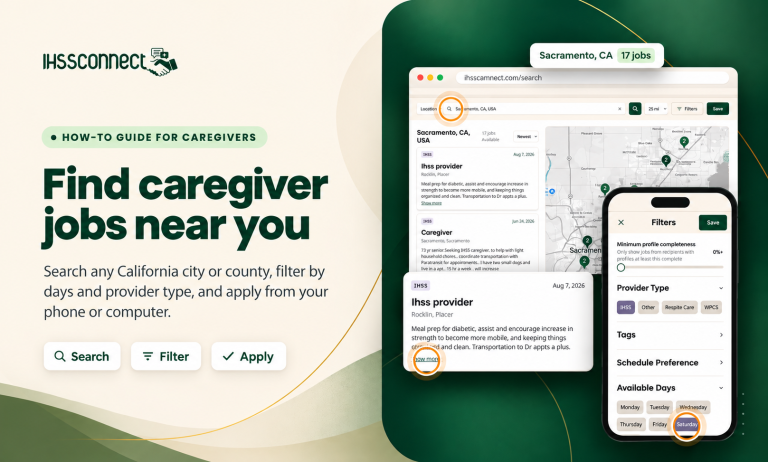
IHSS Connect was built specifically for Californians navigating in-home care through programs like IHSS, WPCS, respite, and related support systems. It was designed as a free peer-to-peer marketplace where recipients and providers can connect without having to expose their lives publicly in social media groups.
Families can search with purpose instead of posting their vulnerabilities into the open.
Providers can create meaningful profiles instead of relying on comment sections and private messages.
Communication happens in a more intentional environment built around care—not social performance.
And importantly, the people using it understand the language of this world. IHSS Connect is available in 12 languages, to be exact.
They know what IHSS means.
They know what Protective Supervision means.
They know why reliability matters more than a polished profile picture.
No platform is perfect. Families should still ask hard questions, check references, verify fit, and trust their instincts. Safety is never something that can be outsourced entirely.
But there is a meaningful difference between using a tool built for caregiving and using one built for engagement metrics.
Care is too intimate to be treated like casual networking.
The truth is, most families who post on Facebook looking for help are not careless. They are tired. They are trying to solve a problem before tomorrow morning arrives.
They deserve better than scrambling through comment sections hoping the right person appears.
They deserve privacy. They deserve dignity. They deserve a system that understands the difference between finding help and finding care.
And in California, they deserve a place built specifically for that purpose.