
Understanding IHSS, Medi-Cal, Regional Centers, CCS—and How It All Actually Works Together
If you’re raising a child with significant medical, developmental, or cognitive needs in California, you’ve probably heard a flood of acronyms—IHSS, Medi-Cal, Regional Center, CCS. Maybe you’ve applied for one or two. But understanding what each program actually does—and more importantly, how they work together—is where most families get stuck.
The truth is, California offers one of the most comprehensive support systems in the country for children with disabilities. But it doesn’t come in a single, easy-to-follow package. Instead, it’s a network of programs operating independently, each with its own rules, applications, and purpose. Once you understand the role each one plays, the system becomes far less overwhelming—and far more powerful.
The Foundation: Medi-Cal
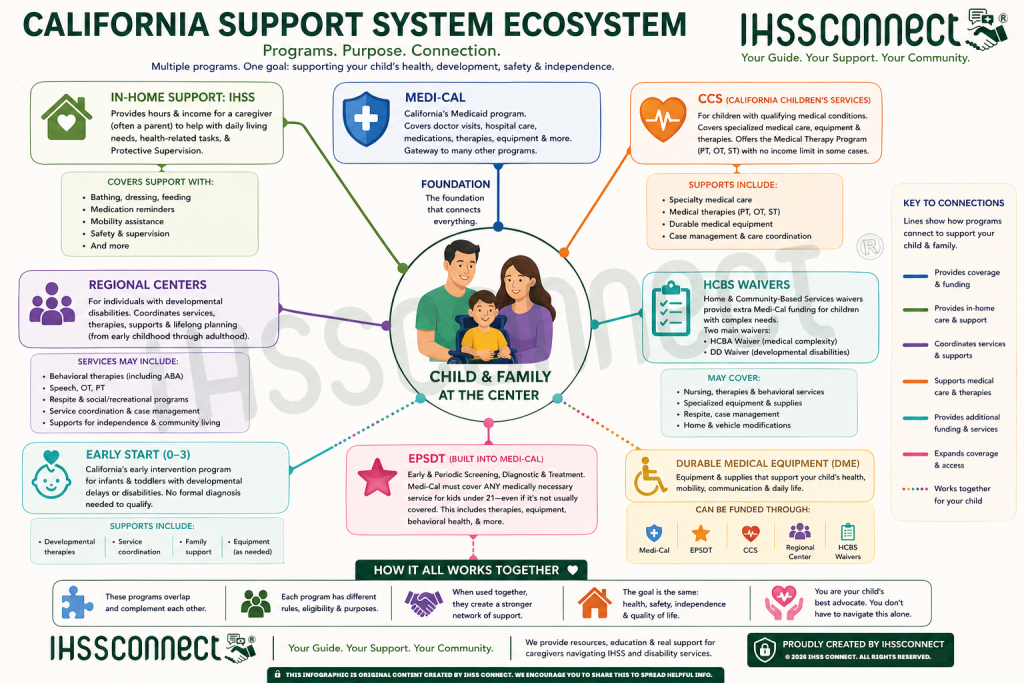
Everything begins with Medi-Cal. If your child qualifies—whether through income, disability, or institutional deeming—it becomes the gateway to much of what California offers.
Medi-Cal covers doctor visits, hospital care, medications, therapies, and medical equipment. For children with complex needs, it often acts as the primary insurance—even if a family also has private coverage.
But what many parents don’t realize is that Medi-Cal is more than just insurance—it’s the access point to other essential programs like IHSS and certain waiver services. Without Medi-Cal, many of the supports discussed below simply aren’t available.
What Most Parents Don’t Realize: EPSDT
There’s a powerful layer built into Medi-Cal that most families are never clearly told about: EPSDT (Early and Periodic Screening, Diagnostic and Treatment).
EPSDT applies to anyone under 21 and requires Medi-Cal to cover any medically necessary service, even if that service isn’t typically included in standard coverage.
This can include:
- Physical, occupational, and speech therapy
- Behavioral services
- Durable medical equipment (like wheelchairs or communication devices)
- In-home supports in certain situations
This is often where families succeed when something has been denied. If a service is medically necessary for your child, EPSDT can be the argument that changes the outcome.
It reframes Medi-Cal from basic insurance into something much more powerful: a legal entitlement to care.
In-Home Support: IHSS
IHSS (In-Home Supportive Services) is one of the most impactful—and misunderstood—programs available to families.
IHSS provides hours, and often income, for a caregiver who assists a child with daily living needs. This includes feeding, bathing, mobility support, medication management, and for some children, Protective Supervision when they cannot safely assess danger.
It’s important to understand that IHSS is not a medical program—it’s based on functional need. The question isn’t your child’s diagnosis, but what they cannot safely do on their own compared to a typically developing child of the same age.
For many families, IHSS allows a parent to become the paid caregiver, creating both financial relief and continuity of care at home.
Lifelong Developmental Support: Regional Centers
California’s Regional Center system is unique and plays a central role for children with developmental disabilities.
There are 21 Regional Centers statewide. Once a child qualifies, the Regional Center becomes a long-term partner—often supporting individuals from early childhood through adulthood.
They coordinate and fund services such as therapies, behavioral supports, respite care, and life skills programs, all managed through a Service Coordinator.
Unlike IHSS, Regional Centers don’t provide direct payments to families. Instead, they fund services and supports designed to improve development, independence, and quality of life.
Early Start: Support Before Age Three
For younger children, Early Start provides critical early intervention.
This program supports infants and toddlers (birth to age three) with developmental delays or risk factors. It offers therapies, developmental services, and family support—even before a formal diagnosis is finalized.
Getting support early can significantly impact a child’s developmental trajectory, and many families don’t realize they can access services this early.
Medical Complexity Support: CCS
California Children’s Services (CCS) focuses on children with specific medical conditions requiring specialized care.
If your child qualifies, CCS can cover treatments, therapies, equipment, and access to specialized providers. It also includes the Medical Therapy Program, which provides physical and occupational therapy—sometimes without strict income limits.
CCS often works alongside Medi-Cal, creating an additional layer of medical support for children with complex conditions.
Expanding Access: Waiver Programs Most Families Never Hear About

Beyond the core programs, California offers waiver programs that can significantly expand access to care—especially for families who don’t qualify for Medi-Cal based on income alone.
The HCBA (Home and Community-Based Alternatives) Waiver is designed for children with high medical needs who would otherwise require institutional care. It can provide full-scope Medi-Cal regardless of parental income and may include nursing, therapies, and equipment.
There’s also a developmental disabilities waiver that supports Regional Center services. This is often the underlying funding source that allows Regional Centers to provide therapies, respite, and even home or vehicle modifications.
These waivers are often the missing link for families who feel stuck between financial ineligibility and real need.
Durable Medical Equipment: Where It Actually Comes From
One of the most confusing areas for families is how to get equipment—things like wheelchairs, feeding supplies, communication devices, or safety equipment.
The reality is that there isn’t just one pathway. Equipment can be funded through multiple systems, including:
- Medi-Cal (with prior authorization)
- EPSDT (to expand what’s covered)
- CCS (if the condition qualifies)
- Regional Center (especially if other systems deny coverage)
- Waiver programs for more complex or specialized needs
This is one of the most important insights for parents: If one program says no, another may say yes. So, don’t stop asking because you’ll typically find funding for it as long as it’s “medically necessary”.
Understanding how to navigate these overlapping pathways often determines whether a child gets what they need.
How These Programs Work Together
One of the biggest misconceptions families have is that they must choose between programs. In reality, the strength of California’s system comes from how these programs layer together.
A single child might have Medi-Cal as their insurance, IHSS providing in-home care, a Regional Center coordinating developmental services, CCS managing medical needs, and a waiver filling in the gaps.
Each program serves a different role. They are not redundant—they are complementary.
But they don’t automatically communicate—or sometimes ever at all. Parents often become the bridge between systems, which makes understanding each program even more important.
The Missing Piece: Documentation and Alignment
Applying for services is one step. Getting meaningful, consistent support is another. Strong documentation across multiple systems is what drives better outcomes.
If your child requires a high level of supervision or care, those needs should appear consistently across:
- Medical records
- IEPs (school reports)
- Regional Center assessments (IPPs)
- Therapy notes
When multiple systems describe the same challenges in similar language, it becomes much harder for any one program to minimize or deny those needs.
Self-documentation is important—but it’s rarely enough on its own. Alignment across systems is where real leverage happens.
Where Families Get Stuck
Most families don’t struggle because services don’t exist—they struggle because the system isn’t explained clearly.
They’re left asking:
- Where do I start?
- Which program applies to my child?
- Why was my child approved in one place but denied in another?
- How do I get these programs to work together?
The answers aren’t always simple. But when you understand the purpose of each program, the system starts to feel less like a maze and more like a set of tools.
California’s system can feel overwhelming. It can be slow, bureaucratic, and frustrating at times. But it is also incredibly powerful.
You don’t need to master everything at once. Start with Medi-Cal. Explore IHSS if your child needs hands-on care. Connect with your Regional Center for developmental support. Look into CCS for medical needs. And understand that waivers and EPSDT can expand what’s possible far beyond what you’re initially told.
The real strength of this system isn’t in any one program—it’s in how they work together.
When used strategically, they can create a level of support that doesn’t just help your child get by—but helps your child truly thrive.
If you found this article helpful, we bet someone else you know will, too. Please consider sharing so we can educate parents throughout California together.