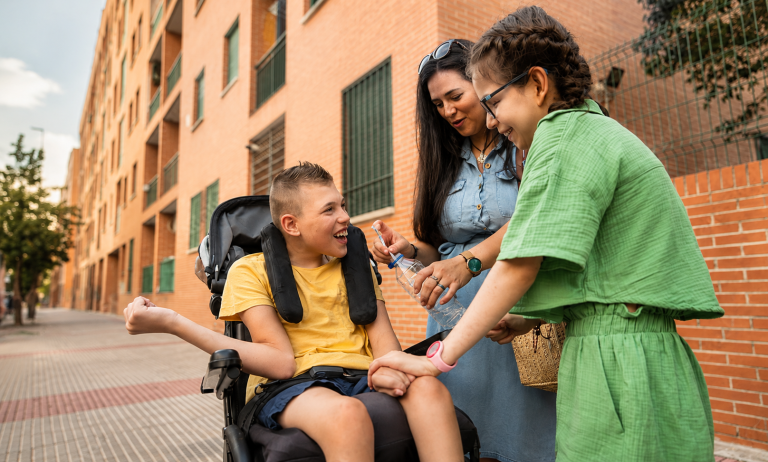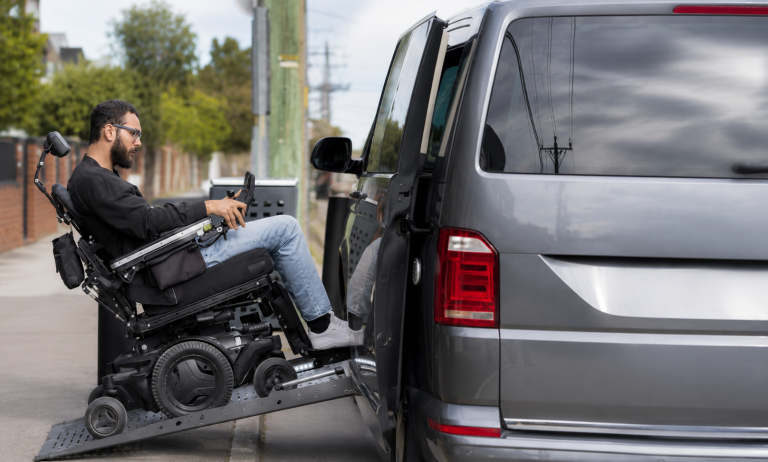

The person you care for isn't the only one who can get hurt.
Caregivers are taught how to keep others safe — rarely how to protect themselves. Here's how to transfer safely, when to ask for equipment, and how to protect your own back and shoulders.
Most caregiving injuries don’t happen in a dramatic fall. They build up quietly — one awkward lift, one twist to catch someone sliding out of a chair, one more transfer at the end of a long day. Then one morning your back locks up, and the person who depends on you suddenly has no one. Caregivers are taught how to keep the people they care for safe. They are rarely taught how to keep themselves safe. This article is about you.
The risk is real
Move a person several times a day, every day, and the strain adds up faster than most people realize. Researchers studying hospital nursing staff estimated that a caregiver can lift a cumulative 1.8 tons — the combined weight of every lift, boost, and reposition — in a single eight-hour shift. In that same body of research, more than half of nurses reported chronic low back pain, and a large share missed work because of it.
One honest caveat: those figures come from studies of nurses and hospital aides, not from IHSS caregivers specifically. No one has measured our workforce the same way. But the demands are at least as high. IHSS caregivers often work alone, in homes that were never designed for care, without a mechanical lift or a second set of hands to help. If anything, the risk is higher — not lower.
The uncomfortable truth about “lifting with your legs”
“If I just lift with my legs and keep my back straight, I won't get hurt.”
Good body mechanics matter — but on their own they don't prevent injury when moving a dependent adult. Safety research is clear: proper technique plus the right equipment is the only approach shown to actually prevent handling injuries.
Here is the single most important idea in this article, and it contradicts what most caregivers were told: good body mechanics alone will not protect you from injury when you are moving a person who cannot fully support themselves.
The National Institute for Occupational Safety and Health (NIOSH) has concluded there is no safe way to manually lift a fully dependent adult. When researchers applied the NIOSH lifting equation to patient handling, they arrived at a recommended limit of roughly 35 pounds for the weight a caregiver should move by hand — and pointed out that most real transfers involve far more than that. It is worth knowing that this 35-pound figure is a researcher’s application of the equation, not an official legal limit; NIOSH itself has not set a fixed weight cap for patient handling. Either way, the direction of the evidence is clear.
The only approach shown to actually prevent handling injuries is proper technique combined with the right equipment — not technique on its own. Workplaces that added mechanical lifts and trained staff to use them saw manual-lifting injury exposure and workers’ compensation claims fall sharply. So technique still matters. It just isn’t a substitute for equipment or for knowing your limits.
Transfer technique that protects you
When a transfer is genuinely within your ability — the person can bear some weight, can follow simple directions, and isn’t likely to suddenly lurch — good mechanics lower your risk:
- Plan the move before you start. Clear the path, lock the wheelchair or bed wheels, and tell the person exactly what you’re going to do.
- Set a stable base. Feet about shoulder-width apart, one slightly ahead of the other.
- Bend at your hips and knees, not your waist. Keep your back in its natural line and let your legs do the work.
- Keep the person close to your body. The farther the weight is from you, the more it strains your spine.
- Turn by moving your feet — never twist your spine. Pivot the whole body instead of rotating at the waist.
- Go slow and count together. “On three” gives you both control and prevents the sudden yank that pulls muscles.
- Don’t let them grab your neck. A hand around your neck can wrench it in a fall. Have them reach for the armrest or your waist instead.
The gait belt: a tool, not a magic fix
A gait belt (also called a transfer belt) is a sturdy strap fastened snugly around the person’s waist, giving you a firm handhold instead of grabbing an arm or clothing. Used well, it steadies someone as they stand, walk, or move between surfaces, and it lowers the chance of a fall.
What it is not is a hoist. A gait belt is for guiding and stabilizing — not for lifting a person’s full body weight. Grip it from the side with an underhand hold, palms facing up, which lets your stronger arm muscles do the work. If you find yourself using the belt to lift rather than to steady, that is the signal the transfer has become too much to do by hand.
When to stop lifting by hand and ask for equipment
Needs change, and a transfer that was fine six months ago can quietly become dangerous. Treat these as signals to switch from muscle to equipment:
!Signs a transfer has outgrown your hands
- The person can no longer reliably bear weight on their legs.
- They slide, buckle, or nearly fall during transfers.
- Getting them up takes everything you have.
- They need frequent repositioning in bed.
- You are sore, stiff, or in pain afterward.
Seeing these? The answer is equipment — not more effort.
When you notice these, the answer isn’t to try harder or push through. It’s to get equipment — a mechanical (Hoyer) lift, a transfer board, a slide sheet for repositioning, or a hospital bed with rails and adjustable height.
How to actually get equipment in California
This is where IHSS caregivers get stuck, so be clear on how it works: IHSS pays for hours of care, not for equipment. A patient lift, hospital bed, or transfer board is “durable medical equipment” (DME), and for someone enrolled in Medi-Cal it is usually covered through Medi-Cal — a separate process from IHSS. Here is the path:
- Talk to the recipient’s doctor. DME has to be tied to medical necessity, so the doctor’s documentation is the foundation of the request.
- Ask for an evaluation and a prescription. The doctor refers the person to a DME provider (and often to a physical or occupational therapist) who evaluates what equipment fits the home and the need.
- The DME provider submits the authorization request to the person’s Medi-Cal managed care plan for approval.
- If the person has both Medicare and Medi-Cal, the Medi-Cal plan must review the request on its own and should not make you wait for Medicare to approve or deny it first.
A tip that speeds things up: ask the doctor for a home safety evaluation by an occupational or physical therapist. A therapist can recommend the right equipment and document exactly why it’s needed — which makes the authorization far more likely to go through.
✓Do
- Fasten it snug around the waist.
- Grip underhand, palms facing up.
- Hold from the side, using your legs.
- Use it to steady and guide.
×Don't
- Use it to lift a person's full weight.
- Grab an arm or clothing instead.
- Hoist someone who can't bear weight.
- Push through pain afterward.
Protecting your back and shoulders every day
Transfers get the attention, but most caregiver wear-and-tear comes from the small repeated movements in between. A few habits protect you across a whole day:
- Raise the work to you. Adjust the bed to about waist height before care so you’re not bent over; if the bed doesn’t adjust, that’s another reason to request one.
- Get close instead of reaching. Step in toward the person rather than stretching across the bed.
- Use slide sheets to reposition. Sliding a person up in bed by hand is one of the worst movements for your back; a slide sheet cuts the effort dramatically.
- Protect your shoulders. Keep loads close, use both arms, and avoid lifting while reaching overhead or out to the side — that combination is what tears rotator cuffs. Move deliberately; sudden jerks do the damage.
- Take micro-breaks. Even a few seconds to reset your posture between tasks reduces cumulative strain.
If pain lingers more than a few days, or a joint feels weak or catches, see a medical professional rather than working through it. A physical therapist can address the problem before it becomes the kind of injury that forces you to stop caregiving entirely.
If you do get hurt, you may be covered
Hurt on the job? You may be covered.
IHSS providers in California are covered by workers' compensation for injuries suffered while performing authorized IHSS services — and this includes many family caregivers.
Report it fast. Counties advise reporting as soon as possible (some within 24–48 hours), with a general 30-day outer limit to protect your benefits. Your county IHSS social worker or Public Authority provides the DWC-1 claim form. Confirm the exact steps with your county IHSS Public Authority.
Many caregivers don’t realize this: IHSS providers in California are covered by workers’ compensation for injuries suffered while performing authorized IHSS services. Coverage is provided through the state and, since December 2021, administered by a company called Intercare. This applies to many family caregivers too — don’t assume you’re excluded just because you care for a relative.
If you are injured on the job, report it quickly. Counties advise reporting as soon as possible — some within 24 to 48 hours — and there is generally a 30-day outer limit to protect your right to benefits, so don’t wait. Your county IHSS social worker or Public Authority provides the DWC-1 workers’ compensation claim form once you report an injury. Because the exact steps and deadlines vary by county, confirm the details with your county IHSS Public Authority.
Last One Standing
The best caregiver is one who is still standing next month. Protecting your own body isn’t selfish — it’s the difference between care that lasts and care that ends in an emergency room. Use good technique, know the point where a transfer has outgrown your hands, ask for the equipment you’re entitled to, and get help early if something hurts.
Sources & Further Reading
Every claim in this article is drawn from the primary and secondary records below.
- Preventing Back Injuries in Health Care Settings NIOSH / CDC
- Back Safety (StatPearls) NIH / NCBI Bookshelf
- Revisiting the Limits of the 35 Pound Limit NIOSH / PMC
- Durable Medical Equipment: Medi-Cal, Medicare & Dual Eligible Individuals Disability Rights California
- IHSS Workers' Compensation Guide for Providers (Pub 203) CA Dept. of Social Services
- Provider Workers' Compensation Orange County IHSS Public Authority
A note on this article
This article is for general educational purposes and does not provide medical, clinical, or professional advice. Every caregiver and care recipient is different, and only you can judge your own physical limits — never push past them. Before starting, changing, or stopping any care technique, exercise, or use of equipment, consult a doctor, physical therapist, or other qualified professional. If you or the person you care for is injured or in pain, seek medical care. IHSS Connect is not responsible for actions taken based on this content.