You did everything the county asked. You filled out the SOC 426, sat through the provider orientation, signed the SOC 846, and stood for a Live Scan fingerprint scan. Then the phone stopped ringing — because it never started.
If that is your experience, you have not done anything wrong, and you are not imagining the silence. You ran into a structural gap in how California’s In-Home Supportive Services program connects providers to the people who need them. This article explains where that gap is, what the law actually obligates your county to do, and the specific calls to make this week.
The short version
- Enrollment makes you payable, not findable. The SOC 426, orientation and Live Scan authorize the county to pay you. They do not put your name in front of anyone.
- The registry is a separate application. In most counties it has its own forms, its own orientation, references and a phone interview.
- Registries are county by county. There is no single statewide list. Move counties and you start over.
- Referral is not placement. Your county has a legal duty to run a referral system. It has no duty to find you work.
Enrollment makes you payable. It does not make you findable.
This is the single most important thing to understand, and almost nobody explains it at orientation.
The IHSS provider enrollment process — the forms, the orientation, the background check — exists to authorize the county to pay you. It answers the question “is this person allowed to be paid with public funds to provide care?” It does not answer the question “who should hire this person?”
Orange County’s IHSS Public Authority states this plainly on its own website: a provider who has completed enrollment but wants more work is a “Non-Registry Provider,” and getting listed on the registry requires attending a separate Registry Recruitment Orientation, which the agency notes is “different from the Provider Enrollment Orientation.”
| Question | Provider enrollment | County registry |
|---|---|---|
| What it does | Authorizes the county to pay you | Puts your name in front of recipients looking for care |
| Do you need a recipient first? | Normally yes — the process assumes someone has already chosen you | No — this is the route for providers without a recipient lined up |
| Orientation | Provider Enrollment Orientation | A separate Registry Recruitment Orientation in counties that hold one |
| References and interview | Not part of the process | Commonly required — professional references plus a phone interview |
| Does completing it get you work? | No | It makes you eligible to be referred. It is not a placement service. |
Completing enrollment and then waiting is the most common mistake enrolled providers make. There is no queue you were added to.
The program was built around caregivers who already had someone
IHSS is unusual among publicly funded care programs: the recipient hires and directs their own provider. That design is deliberate and it is a genuine win for consumer control and disability self-determination. But it has a side effect.
Justice in Aging reports that roughly 73% of IHSS recipients have a provider who is related to them. The dominant path through the program is therefore: a person needs care, a family member steps in, and the family member then enrolls in order to be paid for work they were already doing.
Justice in Aging published this 73% figure in a March 2026 overview but does not attach a collection date to it. Treat it as directionally reliable rather than current-to-the-month.
If you enrolled without a specific person already lined up, you entered through a door that was built for people who arrive holding someone’s hand. The matching machinery — the part that would introduce you to a stranger who needs care — is a separate system, and you have to opt into it.
That separate system is your county's registry
California Welfare and Institutions Code section 12301.6 lists the functions a public authority or nonprofit consortium must perform. Among them: assisting recipients in finding personnel “through the establishment of a registry,” investigating “the qualifications and background of potential personnel,” and establishing “a referral system under which in-home supportive services personnel shall be referred to recipients.”
So the registry is not an optional nicety your county invented. Where a public authority exists, maintaining one is a statutory duty. County ordinances repeat the language almost verbatim — Sacramento County Code section 2.97.060(a) uses the same three phrases.
Getting on it is a real application
Registry requirements vary by county, but Orange County’s published process is representative of what to expect:
Registry application checklist
Orange County's published seven-step process, shown as an example of what counties typically ask for.
- A complete registry application, separate from your provider enrollment paperwork
- Valid government-issued photo ID and Social Security card
- Professional references addressing work performance and ethics
- A phone interview with the registry team
- A Department of Justice Live Scan background check
- Registry Recruitment Orientation
- Provider Enrollment Orientation
Orange County notes that prior homecare experience is not required, but that “dependability, honesty, and trustworthiness are a must.” The references and the interview are where those get assessed — which means the references are not a formality.
The seven steps above are Orange County’s published process. Other counties run their own applications with their own requirements, and some registries periodically close to new applicants. Call your own Public Authority and confirm before you assume any of this applies where you live.
There is no single statewide list to be on
Registries are built and run county by county. Assembly Bill 1682 (1999) required each county to designate an employer of record for IHSS providers, and most counties met that requirement by establishing a Public Authority. Each of those authorities maintains its own registry, with its own application, its own orientation schedule, and its own staff.
Section 12301.6(a) says a county board of supervisors “may, at its option, elect” to establish a public authority or contract with a nonprofit consortium. The registry duty attaches once such an entity exists — it is not phrased as a direct statewide mandate on every county.
In practice California operates through this structure across all 58 counties. But if your county administers IHSS differently, ask what its employer of record is and who holds the registry.
The practical consequence for you: if you moved counties, or you live near a county line and would work in either, being on one registry does nothing for you in the other. Each is a separate application.
What the registry promises — and what it does not
Alameda County’s Public Authority describes its process for recipients: registry staff gather information about what the person needs, then generate a list of up to eight eligible pre-screened providers. The recipient contacts those providers directly.
Read that from your side of the table. Getting listed puts you into a pool from which you may appear as one of eight names on a printout, handed to someone who will then decide which of the eight to call. Being on the registry is necessary. It is not sufficient, and it is not a placement service.
Nothing in section 12301.6 obligates a county to find you work, market you, or guarantee you hours. The duty is to operate a referral system. Referral and placement are different things, and confusing the two is why a lot of registered providers conclude the system is broken when it is in fact working exactly as written.
What to do this week
Call your Public Authority and use the word “registry”
Do not ask whether you are enrolled — you are. Ask whether you are listed on the registry, which is a different database.
Ask three questions and write down the answers
Am I currently on the registry? Is it open to new applicants right now? What exactly do I need to submit to be added?
Line up references before you apply
Two or three people who can speak to reliability and judgment. Confirm their current phone numbers first.
Ask about the Back-Up Provider System
BUPS covers urgent short-term gaps when a recipient's regular provider is unavailable. It is a legitimate way to get hours and meet recipients.
Make your availability specific
“Anything, anytime” reads as no information. Exact days and hours, languages you speak, whether you can do transfers and lifting, whether you drive, and which parts of the county you can reach.
Do not rely on one channel
Recipients also search on their own, ask their social workers, post in community groups, and use independent job boards.
The May 2026 Senate Budget and Fiscal Review Subcommittee No. 3 agenda records stakeholder concerns that the Back-Up Provider System shows low spending and utilization, and that many requests for back-up care go unfulfilled.
That is a statement of stakeholder testimony in a legislative document, not a state finding about your county specifically. Ask your Public Authority how it actually runs BUPS locally.
The demand is not hypothetical
California’s IHSS caseload is growing. The Legislature’s May 2026 budget analysis put the program at 810,336 recipients for 2025-26, with 875,344 projected for 2026-27 — an increase of roughly 8% in a single year.
The figure of 65 posts in the past 30 days is IHSS Connect’s own platform data, covering jobs posted on this site only. It is not a statewide count of unfilled IHSS positions, and no such statewide count is published.
The California Department of Social Services publishes monthly recipient and provider data but does not report how many enrolled providers are unmatched.
On a smaller and more immediate scale: in the last 30 days, 65 new caregiving jobs were posted on IHSS Connect by people in California looking for a provider. That is roughly two households a day deciding that the channels available to them were not enough, and posting publicly instead.
Sixty-five is not a huge number, and we are not going to dress it up as one. But every one of those posts is a real household that has not yet found the right person. If you are enrolled, screened, and sitting at home waiting for a call, the gap between you and them is not a shortage of need. It is a matching problem — and matching problems are solvable by showing up in more than one place.
One more place to be findable
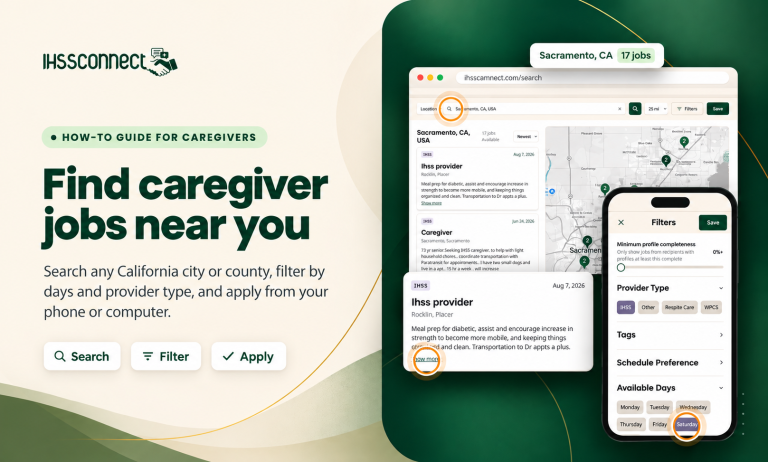
The county registry is a route worth taking, and this article is meant to help you take it. It is also one route. IHSS Connect runs a free California caregiver job board as a second one.
- Browse jobs posted by recipients and families across California
- No county boundary — search anywhere you are willing to work
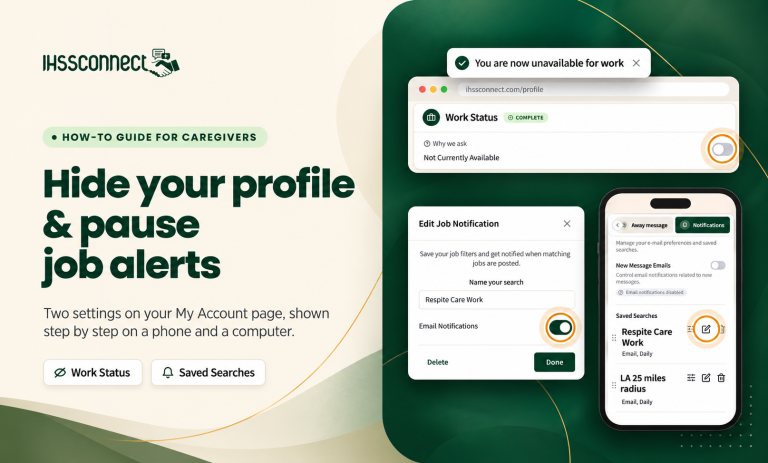
- Free for providers, and you keep control of what you share
IHSS Connect is an independent publication and job board. We are not the California Department of Social Services, and we are not your county Public Authority. Using this site does not replace county registry enrollment.
Sources
- California Welfare and Institutions Code § 12301.6 — statutory duties to establish a registry, investigate provider qualifications, and operate a referral system; the “may, at its option, elect” language on forming a public authority.
- CDSS All County Letter 98-20 — the minimum functions a public authority or nonprofit consortium must furnish, including registry, background investigation, referral, and training.
- Orange County IHSS Public Authority — Registry Provider — the seven-step registry application, the reference and phone-interview requirements, and the statement that Registry Recruitment Orientation differs from Provider Enrollment Orientation.
- Alameda County Public Authority for IHSS — Consumer Registry — how registry matching works for recipients, including lists of up to eight pre-screened providers.
- Sacramento County Code, Chapter 2.97 — IHSS Public Authority — county ordinance language mirroring the statutory registry and referral duties.
- Senate Budget and Fiscal Review Subcommittee No. 3, agenda of May 7, 2026 — IHSS caseload of 810,336 for 2025-26 and 875,344 projected for 2026-27; stakeholder concerns regarding Back-Up Provider System utilization.
- Justice in Aging — In-Home Supportive Services: California’s Personal Caregiving Program — the figure that approximately 73% of IHSS recipients have a provider related to them.
- CDSS — IHSS Program Data — confirmation of what the state publishes monthly, and that unmatched-provider counts are not among it.
- California Association of Public Authorities — History — AB 1682 (1999) and the county employer-of-record requirement.
CDSS and the Welfare and Institutions Code are the primary authorities throughout. Where county guidance and the statute differ, the statute governs — county pages describe local administrative practice, not the limits of the law.